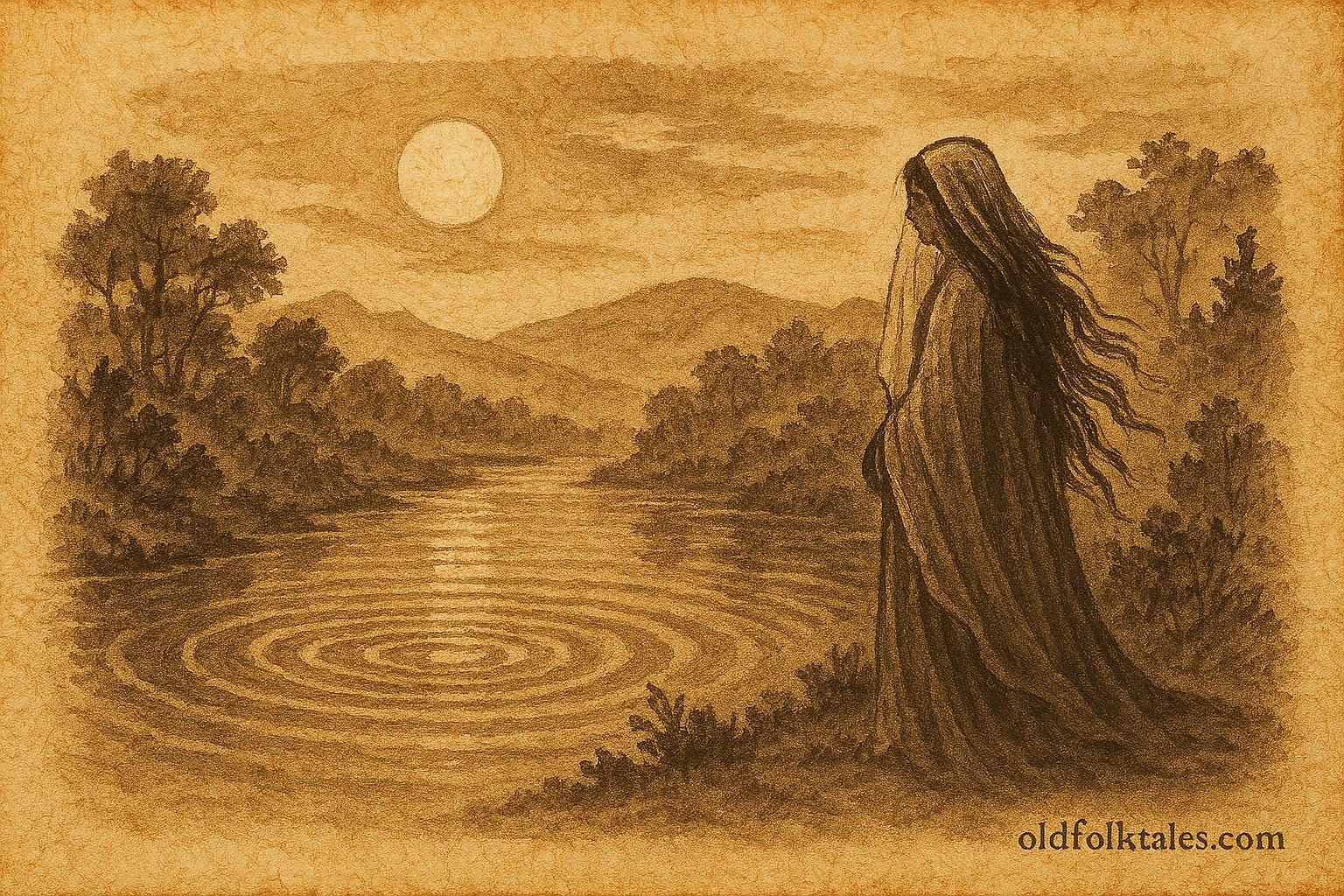
Along the winding rivers of Honduras, where water moves steadily through valleys and fields, there is a story carried by sound rather than sight. It is heard at night, when the air cools and the land grows quiet, and it travels on the mist rising from the riverbanks. This is the lament of La Llorona, the Weeping Woman, whose sorrow has no end and whose presence has shaped fear and caution for generations.
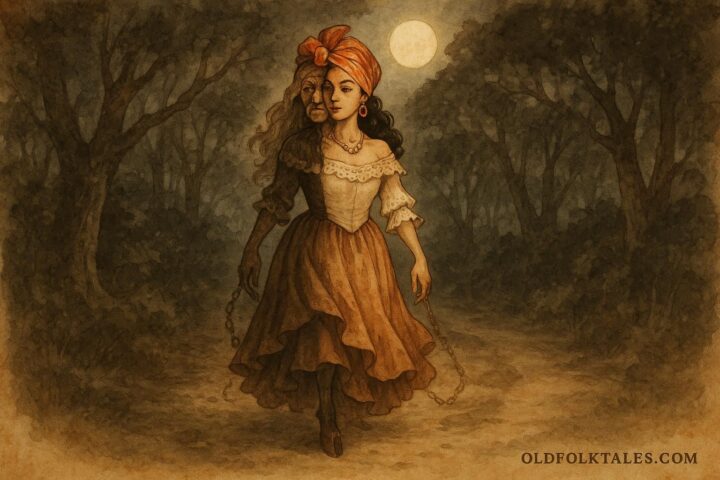
La Llorona is said to appear only after nightfall. She wanders beside rivers and streams, her figure often hidden by darkness and distance. Before she is ever seen, she is heard. Her cries drift across the water, long and mournful, filled with grief so deep it unsettles even the bravest listener. Some nights her voice seems far away, echoing faintly across the valley. On other nights it sounds suddenly close, as if she stands just beyond the bend of the river. No one can predict where her wail will rise next.
Click to read all South American Folktales — timeless stories from the Andes to the Amazon.
In Honduran tradition, La Llorona is the spirit of a woman condemned to eternal wandering. She searches endlessly for her lost children, calling out to them with a voice worn thin by sorrow. Her cries are not sharp or angry, but heavy with regret and despair. Those who hear her say that the sound carries a deep sadness that lingers long after it fades, settling into the silence like a shadow.
Villagers believe that following her voice is dangerous. The sound itself can disorient the listener, drawing them closer to the river’s edge without their full awareness. Paths that were familiar by day seem to twist in the darkness, and the steady flow of water becomes hypnotic. Those who pursue the sound of La Llorona risk becoming lost among the riverbanks, unable to find their way back. Others are said to fall ill afterward, weakened by fear and the emotional weight of the encounter.
Though she is feared, La Llorona is not described as a violent spirit. Her power lies in her grief and the warning it carries. She does not chase or strike. Instead, she mourns, and it is this mourning that unsettles the living. Her presence is a reminder of irreversible loss, of sorrow that cannot be undone, and of mistakes that echo beyond a single lifetime.
Among river communities in Honduras, the story of La Llorona serves a practical purpose as well as a spiritual one. Parents tell the tale to children to keep them away from rivers after dark, when the currents are harder to see and accidents are more likely. The story gives shape to unseen dangers, turning caution into a narrative that is easily remembered and respected. A child who fears La Llorona will think twice before wandering near the water at night.
The legend also reflects deeper emotional themes that resonate across generations. Regret and guilt stand at the heart of La Llorona’s story, though the details of her past are often left unspoken. What matters is not how she lost her children, but that the loss defines her existence. She is bound to the rivers because they witness her sorrow, carrying her cries downstream and across the land.
Elders say that the rivers themselves remember her. When the wind moves across the water and carries a sound that is almost, but not quite, a human voice, people lower their heads and listen carefully. Even those who doubt the literal truth of the legend treat it with respect. To mock La Llorona is to invite misfortune, or at the very least, to show disrespect for the shared memory of grief that her story represents.
Over time, La Llorona has become one of the most enduring figures in Honduran folklore. Her legend is not tied to a single village or valley, but flows wherever rivers run. Each community tells her story in its own way, yet the core remains unchanged. She is the weeping woman, the mother in mourning, the spirit bound to water and night.
Her cries remind listeners that some losses cannot be repaired and that actions carry consequences beyond intention. In this way, La Llorona is both a warning and a reflection. She mirrors human sorrow in its most enduring form, grief that does not fade with time but becomes part of the landscape itself.
Even today, when the night is still and the river runs dark, some swear they hear her voice rise and fall with the current. Whether believed as truth or understood as legend, La Llorona continues to shape how people see the river, the night, and the quiet power of remorse.
Moral Lesson
The legend of La Llorona teaches the weight of regret and the permanence of loss. It warns against careless actions and reminds listeners to respect natural dangers and the emotional bonds that define human responsibility.
Knowledge Check
1. Who is La Llorona in Honduran folklore
La Llorona is the spirit of a grieving woman who wanders riverbanks crying for her lost children.
2. Where is La Llorona most often encountered
She is said to appear along rivers and watercourses throughout Honduras at night.
3. What happens to those who follow La Llorona’s cries
They may become lost, disoriented, or fall ill after the encounter.
4. Why do parents tell the story of La Llorona to children
The tale warns children to stay away from rivers after dark for safety.
5. What themes are central to the legend of La Llorona
The story reflects grief, guilt, regret, and irreversible loss.
6. What cultural role does La Llorona play in Honduran communities
She serves as both a moral warning and a symbol of enduring sorrow.
Source: Honduran oral tradition; folklore anthologies
Cultural Origin: Honduras
Adapted from river community oral traditions throughout Honduras