In the quiet villages and rolling hills of central Nicaragua, particularly around Masaya, there is a story whispered from one generation to the next, a tale that stirs unease on nights when the moon is full. It is the legend of La Carreta Nagua, the Nagua Cart, a spectral wagon that rolls through the countryside, carrying with it a portent of death.
The story begins with a still night. The wind is calm, the fields silent, and the moon hangs low, casting pale light across dirt roads and worn stone paths. From a distance comes a faint, almost tentative sound, the creak of wooden wheels. At first, villagers dismiss it as a late traveler returning home or a farmer making his way from the fields. But as the sound grows nearer, it takes on a hollow, unnatural resonance, echoing through the town in a way no living wagon should.
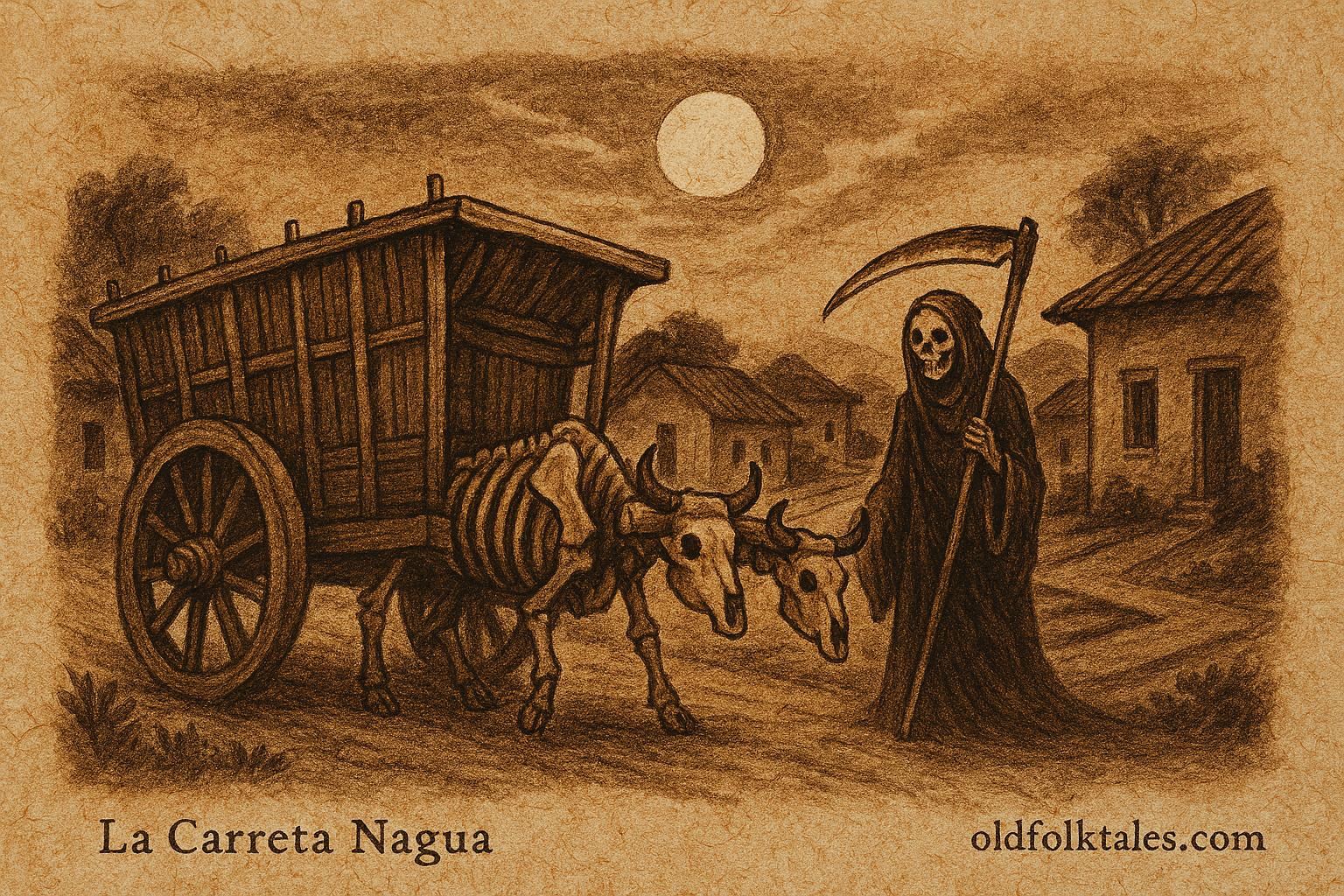
Suddenly, the cart appears. It is massive and ancient, its wood cracked and dry from centuries of use. Its wheels groan under weight that no one can see, yet it moves without pause. The oxen that pull it are nothing more than skeletal remnants, bones etched sharply against the night sky. Their empty sockets seem to stare blindly forward, yet they walk with unnerving precision. The sight alone chills the spine of anyone fortunate enough, or unfortunate enough, to see it.
Standing beside the cart is the most terrifying figure of all: Death itself. Cloaked in darkness, tall and imposing, a scythe glints in the pale moonlight, catching reflections from the worn path. The figure does not speak, does not turn, but its presence communicates inevitability. Villagers say that La Carreta Nagua does not slow or pause for anyone; it cannot be diverted. It moves in straight lines, passing through intersections and village streets in ways that defy reason. It vanishes at corners only to reappear farther along the road, relentless and unstoppable.
Those who hear the creaking wheels or glimpse the spectral wagon know the meaning of its passage. La Carreta Nagua is a harbinger of death. Legend holds that someone in the village will die before sunrise, and the closer the cart seems, the nearer the impending doom. Some families retreat to their homes, bolting doors and whispering prayers into the night, hoping that faith can offer protection. Others leave candles burning in windows or at crossroads, an appeal to unseen forces for mercy. Yet the cart continues on its path, indifferent to human intervention.
In some accounts, the Nagua Cart carries more than just Death’s presence. It symbolizes the fragility of life and the inescapable nature of fate. The skeletal oxen and the ancient wood remind listeners that death is both inevitable and impartial, touching every household without preference or warning. Even the most devout and cautious cannot avoid the cart entirely; they can only seek solace in preparation and faith.
The legend also reflects a deep connection to the indigenous and rural history of Nicaragua. The central regions, with their strong traditions and reverence for ancestors, see La Carreta Nagua as both a warning and a lesson. It is a reminder that life is fleeting, that community is bound by care for one another, and that vigilance, both spiritual and practical, is necessary. Stories of those who glimpsed the cart, hearing the hollow wheels before witnessing the apparition, are told to caution the young and impress upon all the certainty of mortality.
Over the years, the tale of La Carreta Nagua has persisted, carried in oral traditions, folkloric accounts, and modern retellings. Each telling preserves the essential elements: the wooden wagon, the skeletal oxen, the figure of Death, and the dread that precedes its arrival. In Masaya and surrounding villages, the story continues to shape night-time rituals and communal caution, reinforcing the shared belief in unseen forces that watch over the living.
Even today, when a full moon rises over the hills and roads lie quiet, some claim they hear a distant creak. The sound spreads through the village, hollow and deliberate, and for a brief moment, the boundary between the living and the dead feels thinner. La Carreta Nagua has arrived again, if only in memory and fear, reminding all who hear it that life is fragile, and death waits for none.
Moral Lesson
The story of La Carreta Nagua teaches the inevitability of death and the importance of preparation, faith, and respect for life. It reminds listeners that while fate cannot be avoided, acknowledgment of mortality can guide moral conduct and communal vigilance.
Knowledge Check
1. What is La Carreta Nagua in Nicaraguan folklore
It is a ghostly wagon drawn by skeletal oxen, accompanied by the figure of Death.
2. Where is La Carreta Nagua said to appear
In rural villages and roads of central Nicaragua, especially around Masaya.
3. What sounds announce the arrival of La Carreta Nagua
The hollow, creaking wheels of the ancient wagon.
4. What does the cart symbolize
It symbolizes death, fate, and the fragility of life.
5. How do villagers respond to the cart’s arrival
They retreat indoors, pray, or leave candles at crossroads for protection.
6. What cultural lessons are reflected in the legend
The story emphasizes mortality, communal caution, spiritual vigilance, and respect for life.
Source: 5 Nicaraguan Myths and Legends; folkloric accounts
Cultural Origin: Nicaragua
Adapted from oral tradition in central Nicaraguan villages and Masaya