In the misty heartlands of Nicaragua, where the nights stretch dark and deep across the countryside, villagers whisper the same warning generation after generation, beware the Carreta Nagua, the Cart of Death. This ancient folktale tells of a spectral cart that glides through lonely roads under the pale moonlight, an omen no mortal dares to ignore.
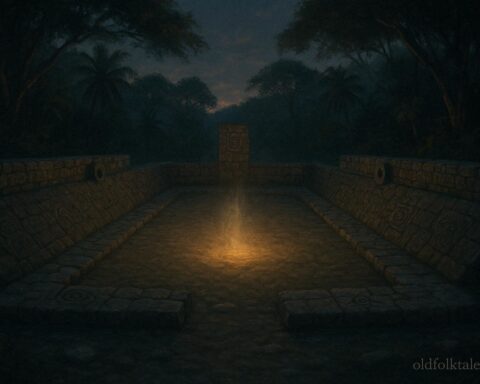
On quiet nights, when the wind dies and even the crickets fall silent, a low, dreadful creaking rises from the distance. It is not the sound of ordinary wheels, nor the rattle of an ox-drawn wagon. The noise comes slow and heavy, the echo of ancient wood grinding upon unseen stones, a sound that chills the soul before it ever reaches the ear.
Those who live along the rural paths say they can feel its presence before they hear it. The air thickens, the dogs begin to howl, and lamps flicker weakly in their glass. Mothers clutch their children and whisper prayers under their breath, for they know the sign well, the Carreta Nagua is passing near.
The villagers say the cart bears no oxen at its yoke. Instead, two skeletons drag its massive weight forward, their bones rattling and their rusted chains scraping across the stones. Their hollow eyes burn with a pale, cold light, neither of life nor death. The cart itself is built of blackened wood, aged as though from another world, and its wheels groan with the burden of countless souls.
Seated upon the cart is Death itself, cloaked in shadows, its face hidden beneath a deep hood. In one hand it holds a whip of bone, and in the other, a lantern whose dim flame flickers with every passing soul. Wherever it goes, darkness seems to thicken, swallowing the moonlight until the world falls silent, waiting, trembling.
When the Carreta Nagua halts before a home, the meaning is clear. The next dawn will not come for someone inside. The villagers say that when this omen appears, no medicine, no priest, and no prayer can turn away the hand of Death. The sound of the cart is the sound of a final summons.
But it does not always come to claim. Sometimes, they say, it merely warns. The wise know to stay indoors and pray. The foolish, the curious — those who dare to peek through the window or open their door are never the same again. If they look upon the Carreta Nagua, their soul becomes marked, and though they may live for a time, their spirit carries the scent of death.
The elders teach that to survive the passing of the Cart of Death, one must pray without ceasing until the sound fades away. “Do not look,” they say. “Do not answer. Do not even breathe too loudly.” For to witness Death’s cart is to invite it inside.
The origin of this haunting legend is said to reach back to the colonial era, when funeral carts once rolled through the cobbled streets of León and Granada, carrying the dead to their graves. Over time, their image merged with fear and superstition. As the old wooden carts decayed, their memory became ghostly, the carts themselves reborn in tales as the wandering Carreta Nagua, forever cursed to travel between the living and the dead.
Even now, in the small villages of Nicaragua’s Pacific and central regions, people swear they have heard it. A farmer walking home at night hears the distant creak and hides behind a wall, trembling. A grandmother, lighting her candle before bed, notices her lamp flicker and falls to her knees to pray. For though centuries have passed, the Cart of Death still roams, reminding all who hear it that no one can escape their hour.
And so, when the wind falls still and the night grows heavy, the people whisper:
“Do not seek what calls to you from the road. When you hear the Carreta Nagua, close your eyes, and let it pass.”
Moral Lesson
The tale of La Carreta Nagua reminds us that death often gives warning, yet the unwise allow curiosity to lead them toward their own ruin. It teaches reverence for the mysteries of life and the boundary between the living and the dead, a boundary that must never be crossed.
Knowledge Check
1. What is La Carreta Nagua?
It is the ghostly Cart of Death from Nicaraguan folklore that appears at night to foretell death.
2. Who or what drives the Cart of Death?
Death itself, cloaked in black, drives the cart with two skeletons pulling it.
3. What happens when the Carreta Nagua passes a house?
Dogs howl, lamps flicker, and it means someone inside will die soon.
4. What should a person do if they hear the cart’s creak at night?
They should pray and never look out the window or open the door.
5. What is believed to happen to those who see the Carreta Nagua?
Their soul becomes marked by death, leading to madness or eventual death.
6. What is the origin of the Carreta Nagua legend?
It likely evolved from colonial-era funeral carts in Nicaragua’s Pacific and central regions.
Source: Adapted from Folklore Nicaragüense Archives; Los Mitos y Leyendas de Nicaragua.
Cultural Origin: Nicaragua (Pacific and Central regions; Colonial-era folklore).