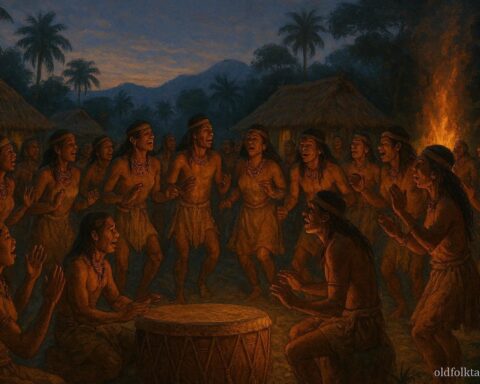
In the hills and rural pathways of Nicaragua, where funeral processions once followed winding dirt roads and silence carried meaning, people spoke quietly of a sorrowful spirit named Kairasa. Her story, passed down through oral tradition and recorded in Cuentos, leyendas y mitos de Nicaragua, is not one of spectacle but of grief, betrayal, and unresolved justice.
Kairasa was remembered as a young woman promised in marriage. Her wedding was meant to unite families and secure honor, a moment of hope in a society where reputation and trust were deeply bound to family standing. Yet before that day could arrive, her future was undone by the very person who was meant to protect her. Her fiancé betrayed her trust in a way that shattered her honor and brought shame upon her household.
Click to read all South American Folktales — timeless stories from the Andes to the Amazon.
The tale does not linger on the act itself. What matters, and what the elders emphasized, was its consequence. In the moral universe of traditional Nicaraguan folklore, betrayal carried weight beyond the individual. The disgrace spread outward, touching parents, siblings, and ancestors. Kairasa’s suffering became a wound that could not be closed by silence.
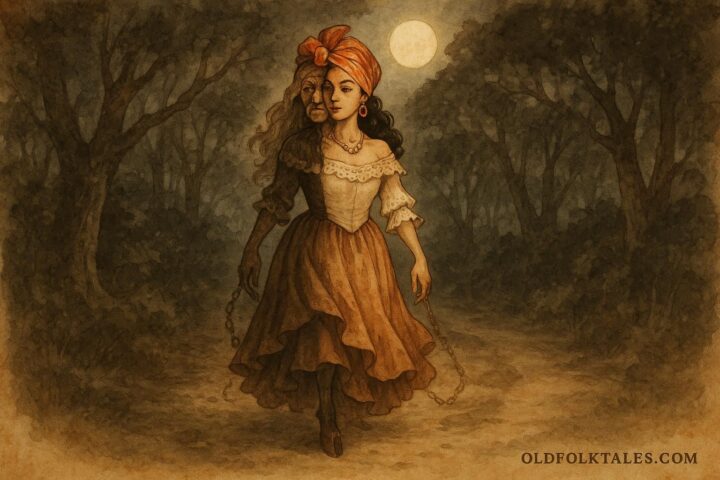
Overcome by sorrow and injustice, Kairasa did not find peace in death. According to legend, her spirit began to wander the routes once taken by mourners and the lonely hills beyond village boundaries. Travelers described hearing a woman’s voice at dusk, crying softly, calling out not in rage but in longing. Her presence was marked by lamentation rather than terror.
Unlike many spirits in regional folklore, Kairasa was not driven solely by fear or vengeance. She was said to test those who encountered her. When passersby greeted her respectfully or acknowledged her pain, she allowed them to pass unharmed. Those who showed kindness felt only a chill breeze or heard her weeping fade into the distance.
However, those who mocked her cries, ignored her presence, or dismissed her suffering were believed to invite misfortune. Crops failed, journeys went astray, or illness followed. These outcomes were not described as punishments inflicted by Kairasa herself, but as consequences of a lack of compassion in the face of injustice.
Kairasa’s story served as a warning and a lesson. It reminded communities that honor was not preserved through silence alone, and that cruelty carried consequences beyond the moment it was committed. Her wandering spirit embodied unresolved wrongs and the belief that the land itself remembers betrayal.
The legend also reflected the strict social codes of its time. Women were often judged harshly for offenses committed against them, while the guilty party escaped public consequence. In this way, Kairasa became a symbol of collective guilt and unspoken sorrow.
Even today, her name is spoken with care. Travelers on old paths greet the air politely, and elders remind the young that kindness costs nothing. Kairasa’s voice, they say, still listens for respect.
Moral Lesson
The story of Kairasa teaches that compassion matters, silence does not erase injustice, and betrayal leaves lasting echoes. Respect for suffering is a moral duty.
Knowledge Check
-
Who is Kairasa in Nicaraguan folklore
A wandering spirit of a betrayed bride -
What caused Kairasa to become a spirit
A deep betrayal that brought shame and injustice -
Where is Kairasa said to appear
Funeral routes and remote hills -
How does Kairasa treat kind travelers
She allows them to pass unharmed -
What happens to those who mock or ignore her
They may experience bad fortune -
What cultural lesson does the story emphasize
Compassion and respect for suffering
Source: Cuentos, leyendas y mitos de Nicaragua
Cultural Origin: Nicaraguan folktale, patriarchal honor tradition