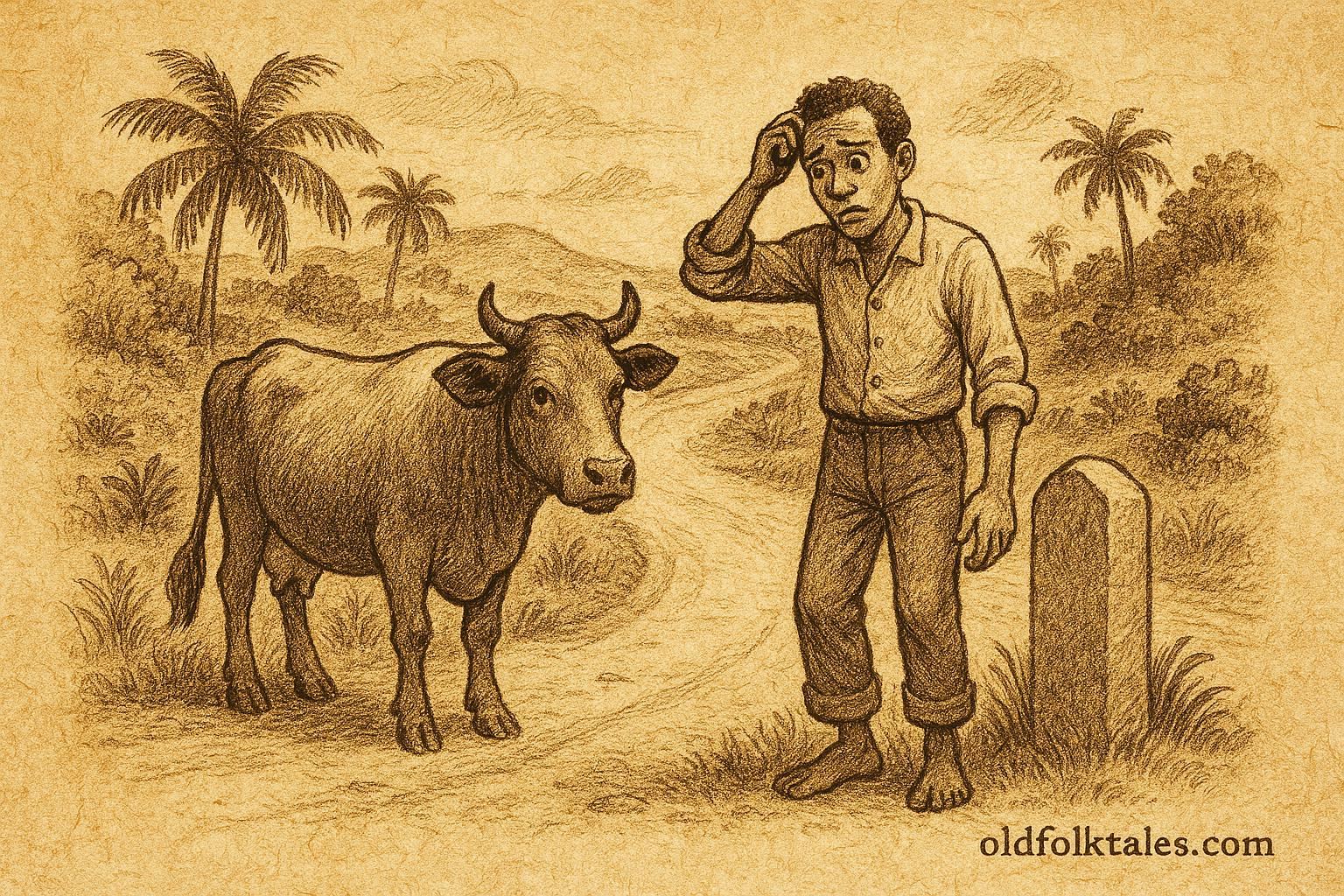
In a small rural settlement where dusty footpaths met open fields, there lived a man named Jean Saute-Point, known in Creole as Jan Sòt Pwent. Jean was not cruel or unkind, but he was famous for one thing above all else: he took every word exactly as it was spoken and never paused to think beyond it. People laughed at him often, though Jean himself rarely understood why.
One morning, Jean’s family gave him a simple task. He was to take their only cow to the market and sell it for a fair price. Before he left, they warned him carefully, “Go to the market, sell the cow, and do not go past the point.” The point was a well-known place along the road, marked by a large stone where travelers often rested before turning back home. Jean nodded solemnly. He repeated the instructions aloud to be sure he remembered them, then set off down the road, leading the cow by a rope.
The sun rose high as Jean reached the market. The place was alive with voices, animals, and bargaining. After some time, Jean found a buyer who offered him a reasonable price. Jean accepted, handed over the rope, and took the money. Proud of himself, he turned to leave, but as he walked away, doubt crept into his thoughts. He stopped and stared at the coins in his hand.
“What if that man tricked me?” Jean wondered. “What if the cow was worth more?” He remembered his instructions again and again, repeating them under his breath. The more he thought, the more uneasy he became. At last, he decided he must get the cow back and be sure everything had been done properly.
Jean returned to the buyer and demanded the cow. The buyer, confused and irritated, refused. Jean argued that something felt wrong and insisted that he could not be sure until he had followed his instructions perfectly. The argument grew loud, and market-goers gathered to watch. In the end, Jean gave back the money and reclaimed the cow, convinced he had corrected a terrible mistake.
With relief, he led the cow away from the market. But soon another thought troubled him. The warning echoed in his mind: do not go past the point. Jean froze. He had gone past the point earlier when he walked into the market. Fear seized him. Perhaps he had already failed, and perhaps the cow should never have gone beyond that place at all.
Determined to fix this, Jean turned back toward the point, pulling the confused cow along the road. When he reached the stone, he stopped and examined it carefully. “This is the point,” he said aloud. “I must not go past it.” But now he was unsure which side counted as “past.” Afraid of making another mistake, Jean decided the safest thing was to stay exactly there.
Hours passed. The cow grew restless. Jean grew tired and hungry. At last, Jean decided the only way to obey the instructions was to move without crossing the point himself. He tied the rope to a bush on one side and tried to push the cow around the stone from the other. The cow resisted, pulling free and wandering off into the brush.
Panicked, Jean chased after it, forgetting entirely about the point. By the time he caught up with the cow, the stone was far behind him. Realizing this, Jean sat down in despair. He had crossed the point again and broken the rule a second time.
Believing there was no fixing such a mistake, Jean decided the cow must no longer belong to him. He left it where it stood and returned home empty-handed. When his family asked where the cow and money were, Jean explained everything in careful detail. Though his story made perfect sense to him, his family could only shake their heads.
Jean Saute-Point learned too late that instructions are meant to guide, not trap, and that understanding matters more than blind obedience.
Moral Lesson
Jean Saute-Point teaches that common sense and understanding the spirit of instructions are as important as following them. Overthinking simple guidance can turn success into failure.
Knowledge Check
1. Who is Jean Saute-Point?
He is a foolish but harmless trickster figure known for taking instructions too literally.
2. What task is Jean given?
He is told to sell a cow at the market and not go past the point.
3. What causes Jean’s failure?
His overthinking and literal interpretation of the instructions.
4. What does the “point” symbolize?
The boundary between sensible judgment and blind obedience.
5. What type of folktale is this?
A noodlehead or foolish trickster tale.
6. What lesson does the story teach?
That wisdom requires understanding intent, not just words.
Source: Haitian folktale, Caribbean Americas
Adapted from Haitian Folktales, Tale #3, transcript by Laura Tanna.
Cultural Origin: Haiti