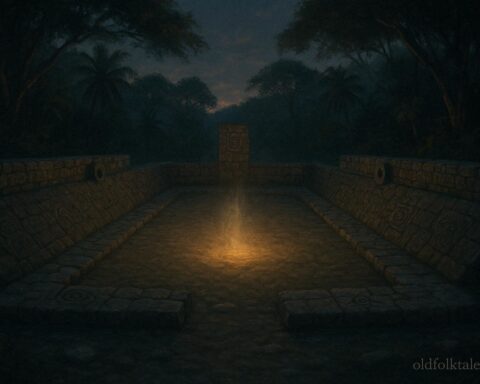
Glyphs are carved marks of memory in the Maya world, and none are more sorrowful than those left behind by the silent princess of Tikal. Long after the great city’s golden age had faded and its plazas stood half reclaimed by jungle, the Snake Dynasty still clung to ritual, power, and fragile alliances. It was during this decline that a princess of royal blood became a living instrument of political survival.
She was promised to a powerful general from a rival city-state, a union meant to still unrest and secure peace. The princess accepted her fate outwardly, as tradition demanded, yet her heart belonged elsewhere. She loved a humble stela-carver, a man whose hands shaped stone into history. He etched kings into time, though his own name would never be carved beside theirs. In quiet moments among fallen monuments, he taught her the meaning of sacred symbols, showing how love, water, and memory could live forever in stone.
Click to read all South American Folktales — timeless stories from the Andes to the Amazon.
On the eve of her arranged wedding, the lovers chose flight over obedience. Beneath a moonlit sky, they attempted to escape the city’s towering temples and watchful guards. Their plan failed. They were captured before reaching the forest paths, dragged back into the ceremonial heart of Tikal where power ruled without mercy.
The general ordered the execution of the carver. Without ritual or honor, the man was killed and his body cast into the aguada, the great reservoir that sustained the city through drought and time. The princess was forced to watch as the waters swallowed the one she loved, erasing him from the world of breath but not from memory.
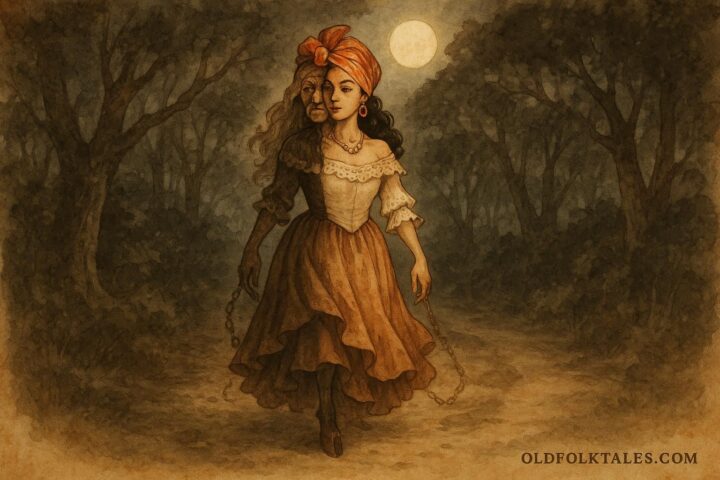
Clad in a ceremonial gown adorned with quetzal feathers, symbols of royalty and sky, the princess was returned to Temple IV, the tallest pyramid in Tikal. There, before the assembled witnesses of stone and silence, she cursed the general and the hollow peace he sought to claim. Then she stepped from the temple’s summit and fell into legend.
Since that night, the city has never fully slept.
When the moon aligns perfectly with the long stairway of Temple IV, guards speak of a pale figure descending the steps. She does not cry like other wandering spirits. She does not wail or call out. Instead, she traces the walls with delicate fingers, moving with purpose and restraint. Those who dare to follow hear a faint tap tap echoing through the plazas, the unmistakable sound of a sculptor’s tool striking stone.
By dawn, new carvings appear.
Fresh glyphs emerge on ancient walls, precise and flawless, untouched by age or weather. Elders recognize them instantly. They are the symbols for love and water, the bond between the carver and the reservoir that claimed him. The princess does not haunt in anger. She mourns through creation, inscribing her devotion into the bones of the city so that it can never be erased.
She is known as the Weeping Woman of Tikal, though no tears fall. Her grief lives instead in stone, in sacred marks that bind human love to ancestral memory. Through her, the city remembers what power tried to silence.
Moral Lesson
True love and truth cannot be erased by force or betrayal. Even when silenced in life, they endure through memory, art, and the sacred language of culture.
Knowledge Check
Q1: Who is the Weeping Woman of Tikal?
A1: She is a princess of the Snake Dynasty who died after her lover was executed.
Q2: What do the glyphs she carves represent?
A2: They symbolize love and water, reflecting devotion and loss.
Q3: Why is Temple IV important in the story?
A3: It is the tallest pyramid and the site of the princess’s death.
Q4: Who was the stela-carver?
A4: A humble artist and the princess’s forbidden lover.
Q5: Is the spirit considered dangerous?
A5: No, she represents artistic mourning rather than vengeance.
Q6: What cultural belief does the tale reflect?
A6: The Maya belief that memory and meaning live on through symbols.
Cultural Origin and Source
Source: Mestizo Maya legend, Guatemala
Adapted from Petén oral traditions recorded by CIRMA researchers in the 1970s, blending Post Classic Maya history with the La Llorona archetype.