In the ancient times, before the great terraces were carved into mountainsides and before irrigation channels brought water singing down from the high places, the people of the Andes lived under a reign of terror. The world was different then harsher, crueler, governed by forces that demanded blood and offered only survival at a terrible price. This was the age of Huallallo Carhuincho, the fire-eating deity whose very name carried the heat of volcanic fury and whose laws were written in ash and fear.
Huallallo Carhuincho ruled from his domain in the mountains, a god of consuming flame and destructive heat. His body radiated the fierce energy of subterranean fires, and when he opened his mouth, flames poured forth that could melt stone and turn forests to cinder. The people who lived under his dominion knew only his harsh decrees, and the most terrible of these was the law of sacrifice: each family was permitted to raise only two children. When a third child was born, it had to be given to Huallallo Carhuincho, who devoured it in his eternal hunger.
Click to read all South American Folktales — timeless stories from the Andes to the Amazon.
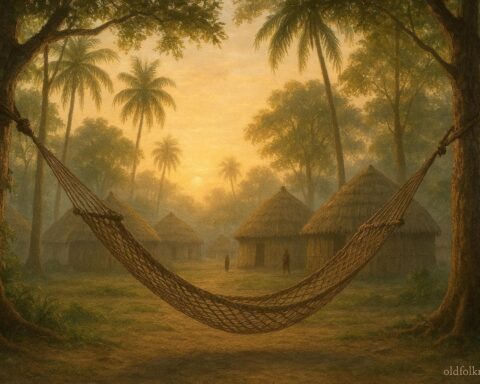
The villages huddled in the valleys, their lives marked by grief and resignation. Mothers wept as they handed over infants, knowing their children would feed the fire god’s insatiable appetite. Fathers turned their faces away, unable to bear witness to what their obedience demanded. The crops struggled in soil baked hard by relentless heat. Droughts alternated with periods of destructive fire that swept across the land, consuming what little grew. Water was scarce, jealously guarded, fought over. Life under Huallallo was not abundance but mere existence, purchased at the highest price a people could pay.
The priests of Huallallo maintained his worship through fear, reminding the people constantly that disobedience would bring even greater destruction. They tended the sacred fires that burned without ceasing, made offerings of flesh and fat to keep their god satisfied, and enforced his brutal laws with the certainty of those who knew no other way. For generations, this was the only religion the people knew fire, sacrifice, and the endless heat that exhausted the land and dried the tears of grieving parents.
But high in the mountains, where the snow never melted completely and the winds carried the breath of coming change, something new was stirring. In a hidden place among the highest peaks, five falcon eggs lay waiting. These were no ordinary eggs, and the falcons that had laid them were no earthly birds. They were vessels of transformation, containing within their fragile shells a power that would challenge the fire god’s reign and bring a new order to the world.
When the time came, the eggs began to crack. First one, then another, then all five-splitting open under the pale mountain sun. But what emerged was not the form of falcons. From the first egg came rain not the harsh, sporadic drops that occasionally fell during Huallallo’s reign, but steady, life-giving rain that fell like a blessing upon the parched earth. From the second came mist that softened the harsh landscape and brought moisture to dying plants. From the third emerged thunder that rolled across the sky like a great voice announcing change. From the fourth came lightning that split the darkness with brilliant light. And from the fifth egg came the god himself Pariacaca.
Pariacaca rose from the mountain peaks in his full power, a deity of water, storm, and agricultural abundance. Where Huallallo was fire and consumption, Pariacaca was rain and growth. Where Huallallo demanded death, Pariacaca offered life. His body was formed of clouds and flowing water, his voice was thunder, his gaze was lightning. He looked down upon the land suffering under Huallallo’s dominion and saw a people ready for liberation, even if they did not yet know to hope for it.
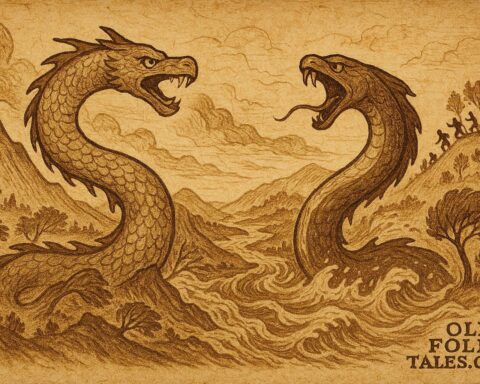
The confrontation between the two gods was inevitable. Pariacaca descended from his mountain heights, gathering his power as he came clouds darkening the sky, wind rising to a roar, the first drops of rain beginning to fall like warnings. Huallallo sensed the challenge and emerged to meet it, flames roaring from his mouth, heat radiating in waves that should have turned back any attacker.
But water does not fear fire when it comes in sufficient force. Pariacaca unleashed the full power of the storm. Rain fell in torrents such as the land had never seen, not destructive but cleansing, washing away the ash and char of Huallallo’s reign. Floods rose, not to destroy villages but to extinguish the sacred fires, to drown out the old order. Thunder crashed like the breaking of ancient chains, and lightning illuminated a new path forward.
Huallallo fought with all his fierce power, sending flames roaring upward to meet the descending rain, heating the very air until steam rose in great clouds. But fire cannot ultimately prevail against the ocean falling from the sky. The flames sputtered and died. The heat that had scorched the land for generations was cooled by the endless water. Huallallo’s power, which had seemed absolute and eternal, proved vulnerable after all.
Weakened and defeated, Huallallo Carhuincho fled. He could not maintain his position in the high mountains against this new god of rain and storm. He retreated eastward, down from the highlands toward the coast, leaving behind the people he had terrorized for so long. Some of his followers, those most devoted to the old ways of fire and sacrifice, fled with him, but most remained, ready to embrace the new order that Pariacaca brought.
With Huallallo’s departure, transformation swept across the Andes. The people emerged from their villages, faces lifted to the gentle rain, hands outstretched to catch the water that fell freely, no longer scarce and fought over but abundant and life-giving. They abandoned the altars where they had made their terrible sacrifices. They let the sacred fires of Huallallo go cold and unattended. They no longer lived under the law that forced them to choose which children would live and which would die.
Pariacaca taught them new ways. He showed them how to work with water rather than fear its absence how to build irrigation channels that carried his blessing to their fields, how to terrace the mountainsides so that rain would nurture crops rather than wash away soil, how to honor the forces of nature through offerings of respect rather than blood. Under his dominion, agriculture flourished. Maize grew tall in fields kept moist by careful irrigation. Potatoes swelled in the cool earth of higher elevations. Quinoa rippled in terraced plots like waves of gold.
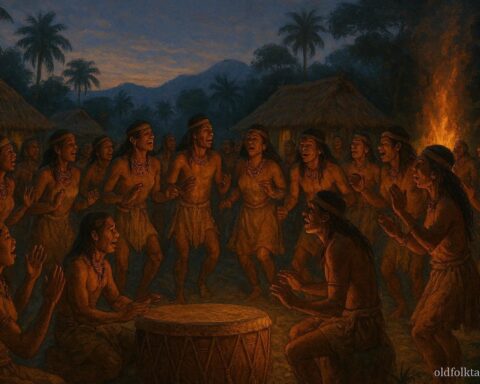
The people established new forms of worship, new rituals that celebrated water, rain, and the cycles of planting and harvest. They organized their communities around communal work the shared effort of building terraces, maintaining channels, and managing the agricultural calendar together. Where Huallallo had ruled through individual fear and isolated suffering, Pariacaca’s reign encouraged cooperation, collective effort, and the understanding that abundance came through working together in harmony with the life-giving forces of water and weather.
Pariacaca took his place as the great mountain god, watching over the people from his heights, sending rain when the crops needed it, holding back floods when the earth was saturated, maintaining the balance that allowed life to flourish. The people-built shrines to him on mountaintops, made offerings of chicha and coca, sang prayers that rose with the mist to reach his ears. They remembered the dark times under Huallallo not with nostalgia but with relief that those days had ended, that fire had given way to water, that destruction had been replaced by growth.
And so, the age of Pariacaca began in the Andes, an age of agriculture, communal organization, and reverence for the rain and storms that brought life to the mountains. The people prospered under these new conditions, their children grew safely, their crops flourished, and they learned to live in accordance with the rhythms of water rather than the demands of consuming fire. The myth of Huallallo’s defeat and Pariacaca’s triumph became the sacred story that explained not just a change in gods but a transformation in how people understood their relationship with the divine forces that shaped their world.
Click to read all Andean Highland Folktales — echoing from the mountain peaks of Peru, Bolivia, and Ecuador.
The Moral Lesson
This ancient Andean myth represents the profound transformation from destructive, fear-based worship to life-sustaining, communal religion. Huallallo Carhuincho symbolizes the forces of destruction, scarcity, and individual suffering demanding the ultimate sacrifice while offering only harsh survival. Pariacaca represents the triumph of life-giving forces: water, agriculture, cooperation, and abundance. The story teaches that civilization advances when people abandon practices based on fear and sacrifice in favor of systems that nurture life and encourage communal flourishing. It reflects the actual historical shift in Andean religion from earlier worship of volcanic and fire deities to the later dominance of rain and mountain gods who supported agricultural society.
Knowledge Check
Q1: Who was Huallallo Carhuincho and what did he demand from the Andean people?
A: Huallallo Carhuincho was an ancient fire-eating deity who ruled the Andes before Pariacaca. He was a god of consuming flames and destructive heat who demanded that each family sacrifice their third child to him. Under his reign, people lived in fear, droughts alternated with destructive fires, and life was characterized by scarcity and suffering rather than abundance.
Q2: How was Pariacaca born and what forms did he take?
A: Pariacaca was born from five falcon eggs hidden in the high mountains. From these eggs emerged first rain, then mist, then thunder, then lightning, and finally Pariacaca himself in his full divine form. He manifested as a god of water, storms, and agricultural abundance his body formed of clouds and flowing water, his voice thunder, his gaze lightning.
Q3: What happened during the confrontation between Huallallo and Pariacaca?
A: Pariacaca unleashed the full power of storms against Huallallo, sending torrents of rain and floods that extinguished Huallallo’s sacred fires and cooled his destructive heat. Despite Huallallo’s fierce resistance with flames and heat, water proved more powerful. Weakened and defeated, Huallallo fled eastward from the highlands toward the coast, leaving his dominion behind.
Q4: What changes came to Andean society after Pariacaca’s victory?
A: After Pariacaca’s triumph, the people abandoned fire worship and child sacrifice. They learned to work with water through irrigation and terracing, developed agriculture that flourished with adequate rain, and organized their communities around communal cooperation rather than individual fear. Life shifted from scarcity and suffering to abundance and collective flourishing.
Q5: What is the cultural and historical significance of this myth?
A: This myth from the Huarochirí Manuscript explains the actual historical shift in Andean religion from earlier worship of destructive fire and volcanic deities to later dominance of rain and mountain gods who supported agricultural civilization. It represents the transformation from societies based on fear and sacrifice to those organized around life-sustaining practices, irrigation agriculture, and communal cooperation.
Q6: What does Pariacaca symbolize in Andean cosmology?
A: Pariacaca symbolizes the life-giving forces of water, rain, and agricultural abundance that allowed Andean civilization to flourish. As a mountain god who controls storms and rainfall, he represents the balance between natural forces and human needs, the importance of water management for highland agriculture, and the shift toward communal organization and practices that nurture life rather than consume it.
Source: Adapted from the Huarochirí Manuscript (Quechua: Manuscrito de Huarochirí), a colonial-era document recording ancient Andean myths and religious practices. English translations by Frank Salomon and George L. Urioste, “The Huarochirí Manuscript: A Testament of Ancient and Colonial Andean Religion”
Cultural Origin: Ancient Andean peoples, Central Peruvian Highlands (Huarochirí region)