In a time of sparse rain and thin soil, hunger was a familiar ghost in the Jamaican hills. It visited the hut of Anansi the spider, known to some as “Dry-Head” for his smooth, bald crown, and his son, a clever youth named Tacooma. Their bellies were tight as drums, and their eyes had grown large and wistful.
One evening, scouting the edges of the forest for a lizard or a few wild yams, they stumbled upon a sight that made their mouths flood with hope. In a cleared field, bathed in the golden light of the setting sun, stood rows of magnificent plantain trees. Their branches hung heavy with bunches of fat, green-yellow fruit, ripe and ready for the pot. It was a treasure.
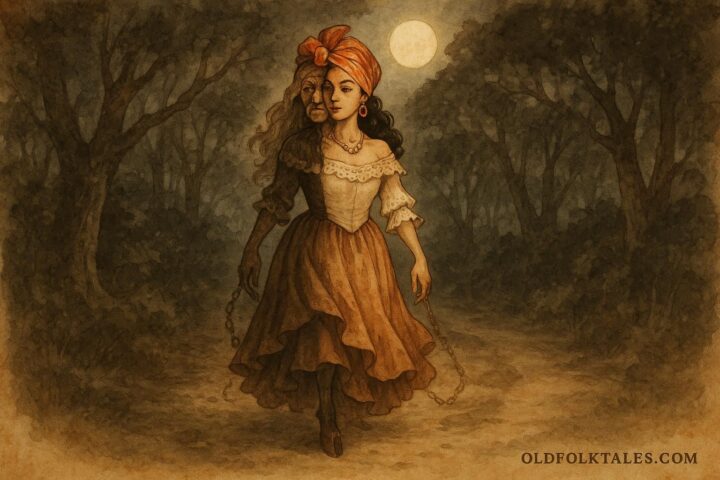
But the owner of this bounty was no simple farmer. She was a formidable woman, known in whispers as a Old Higue or a witch, who could fly on night winds and whose temper was as sharp as her machete. To steal from her was to risk more than a beating; it was to risk your very soul.
“We will not survive another week without food, son,” Dry-Head whispered, his eyes gleaming not just with hunger, but with cunning. “We must be like shadows. We will go tonight, take only what we need, and be gone before the moon is high.”
Tacooma agreed, but a knot of worry tightened in his stomach. His father’s plans often twisted toward excess.
Under the cover of a moonless sky, they crept to the edge of the field. The witch’s hut was dark and silent. They had earlier loosened two boards in the wooden fence, creating a hole just big enough for a lean, hungry man to slip through. Dry-Head, being smaller, went first.
The moment Anansi was inside, the rich, earthy smell of the ripe plantains overwhelmed him. The ghost of hunger possessed him entirely. “Just one,” he muttered, tearing a fat plantain from its stem and devouring it in three bites. The sweet, starchy flesh was a ecstasy. “Maybe two more for the bag.” He stuffed his sack.
But then he saw an even larger, more perfect bunch. He ate another, and another, not just to quiet his gut, but for the pure, gluttonous pleasure of it. He ate until his sides ached, until his bag was swollen, and his own belly was round and taut as one of the fruits he stole. He ate for tomorrow, and the next day, and for the memory of yesterday’s hunger.
Meanwhile, Tacooma waited nervously by the fence hole. “Father, come now!” he hissed into the darkness. “The sky is lightening in the east!”
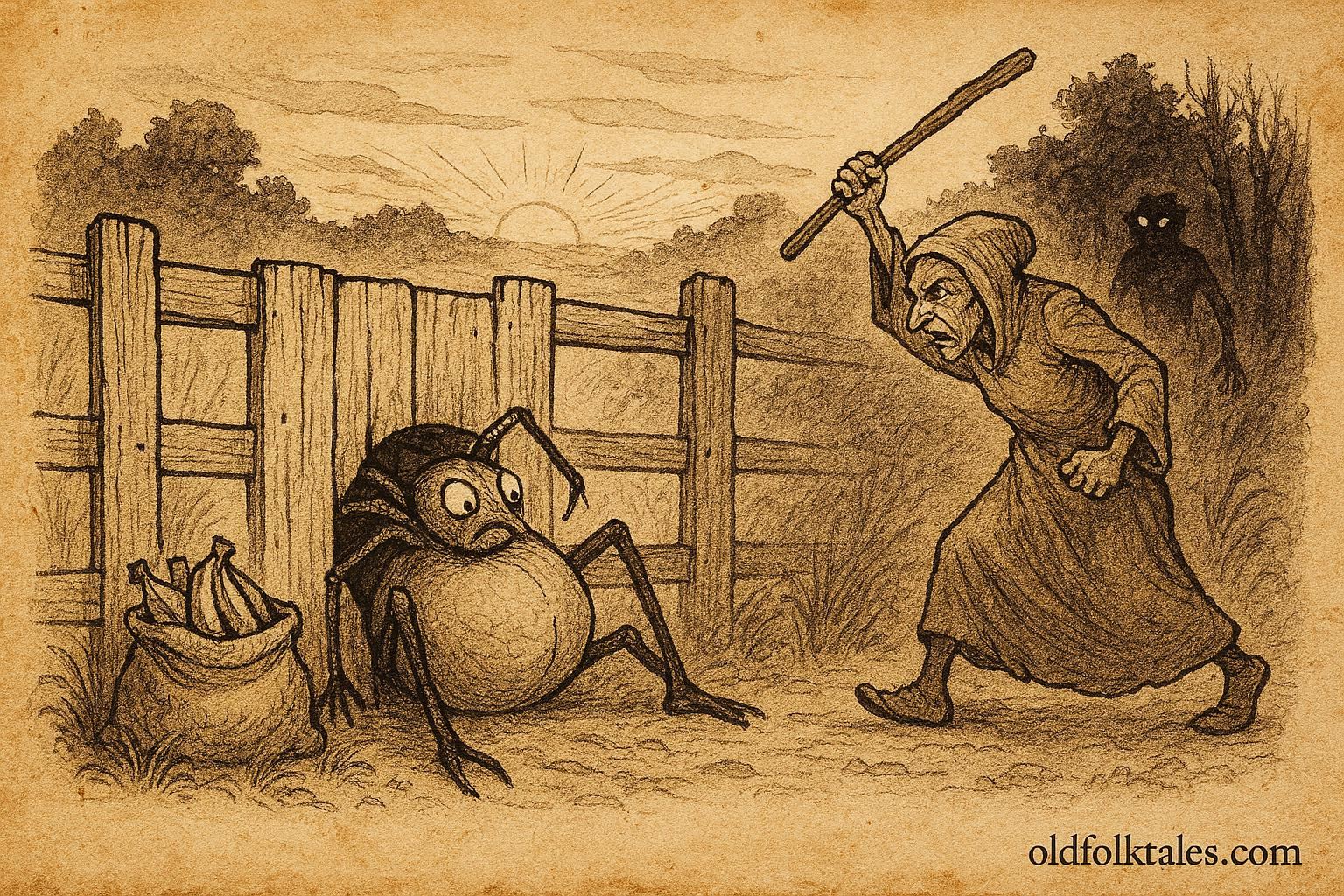
Dry-Head finally waddled back to the hole, his sack bulging. But when he tried to squeeze through, his swollen belly caught on the wood. He pushed and grunted, but he was stuck fast. The greedy feast had made him too large for the very escape route he had made. Panic, cold and sharp, replaced his fullness.
“Leave the bag!” Tacooma urged, pulling at his father’s arms.
“Never!” Dry-Head gasped, clinging to his hoard. “I earned this!”
It was too late. A door slammed. The witch, tall and furious with sleep-tousled hair, stormed from her hut with a heavy walking stick. She had heard the commotion.
Tacooma, with a last, despairing look at his trapped father, did what he must for survival. He took the single bunch he had picked for himself and fled, swift and silent, back into the protective cloak of the forest.
Dry-Head was left alone, a prisoner of his own gluttony. The witch looked down at the thief stuck in her fence, his bag of stolen fruit beside him, and she showed no mercy. “So, Dry-Head,” she seethed, “you thought to feast on my sweat?” She raised her stick.
What followed was a sound and thorough beating. The stick fell on Anansi’s back, his legs, and with a particularly sharp crack, across the crown of his smooth, bald head. The blow split his dry scalp, a wound that would ache for a long, long time. Only when her arm was tired did she pry him loose and throw him, bruised and groaning, out of her field.
Tacooma found him later, crumpled and moaning at the forest’s edge, the stolen plantains scattered and lost. The son shared his own small bunch with his father, not with scorn, but with a sad understanding.
As Anansi nursed his cracked head and his wounded pride, he learned a bitter lesson. In a world where survival was a shared struggle, the greed of one could doom them both. His son, who took only what was needed, had saved himself. Dry-Head, who took all he could, was left too fat to flee and bore the scars to prove it.
The Moral Lesson:
This tale is a stark lesson in moderation and community ethics. It teaches that greed and selfishness are self-defeating, making one vulnerable and risking the well-being of the whole group. In times of scarcity, taking only what one needs ensures that everyone, including oneself, has a path to safety and survival.
Knowledge Check
Q1: What does the nickname “Dry-Head” refer to, and who is it?
A1: “Dry-Head” is a common nickname for Anansi the spider, referring to his smooth, bald head. He is the protagonist and the one punished for his greed.
Q2: Why is stealing from the plantain field especially dangerous?
A2: The field is owned by a dangerous witch or Old Higue-like figure, a being with supernatural associations and a fierce temper, making the theft risk far greater than from an ordinary farmer.
Q3: What is the crucial mistake Anansi makes after entering the field?
A3: He becomes consumed by gluttony, eating and stuffing his sack until he is physically too large and fat to fit back through the hole in the fence he used to enter.
Q4: How does Tacooma’s behavior contrast with his father’s, and what is the result?
A4: Tacooma takes only what he needs. He remains lean, agile, and able to escape when danger comes, highlighting that moderation and self-control lead to survival.
Q5: What is Anansi’s specific physical punishment for his greed?
A5: He is caught and beaten by the witch, who delivers a blow that cracks open his “dry-head” (scalp), a lasting injury that symbolizes the consequence of his foolish gluttony.
Q6: What core community value does this Jamaican folktale reinforce?
A6: It reinforces the value of moderation and anti-greed ethics crucial for collective survival. It warns that selfish excess endangers not just the individual, but the entire family or community unit.
Cultural Origin: Jamaican Folktale (of African diaspora origin).
Source: Adapted from the story “Dry-Head and Anancy” in Walter Jekyll’s Jamaican Song and Story.