Deep within the dense forest and winding by‑ways of Trinidad, there lurk spirits unlike any other. These are the Douen, sometimes called Duenns, the lost children who never received baptism and now wander between the worlds of the living and the dead. Their presence is whispered in every rustle of leaves, every shadow that stretches across a moonlit path, and every sound of laughter or crying that seems too eerie to be ordinary.
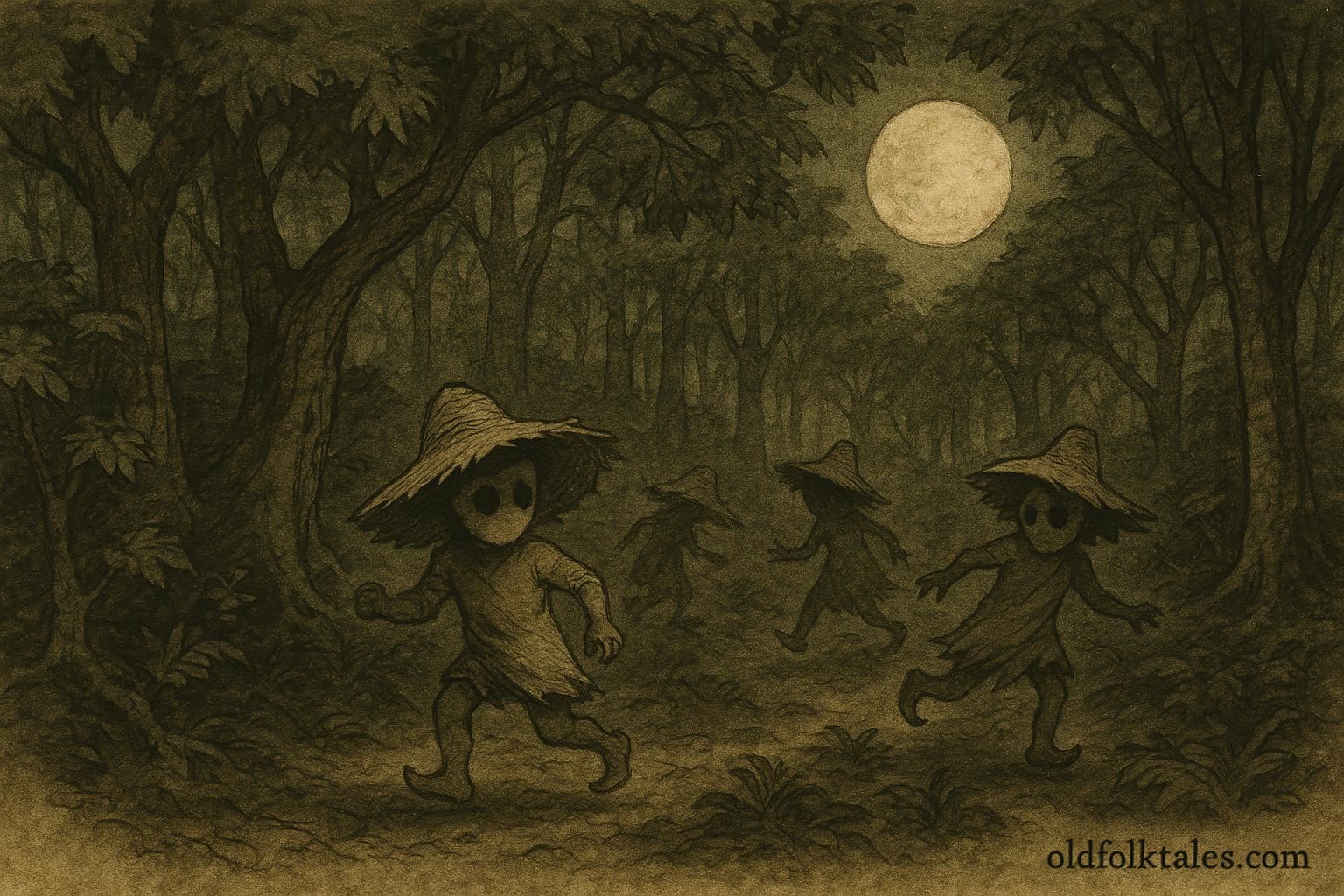
The Douen are immediately recognizable, yet profoundly unsettling. They have no faces, only a small, round mouth through which they whisper, call, or sometimes wail. Their feet are backward, heels in front, a feature that marks them as unnatural and otherworldly. Many wear large, floppy straw hats shaped like mushrooms, which sway as they move, adding to their peculiar silhouette in the forest twilight.
These spirits are playful, but their tricks can be dangerous. Children are warned never to respond if a Douen calls their name aloud. The Douen often mimic the voices of familiar friends or siblings, hoping to lure a living child into the forest. Should the child shout or answer, the Douen gains influence, weaving mischief or even leading the child astray for hours, or perhaps longer.
One tale tells of a man named Lastique who wandered beneath the spreading branches of a giant silk‑cotton tree. From the dense roots came the sound of a baby crying, plaintive and sorrowful. Moved by compassion, Lastique bent down and scooped the infant into his arms. Yet the child grew impossibly heavy, weighing down on him until he could barely stand. Panic and fear pressed upon him, and he realized he had been tricked. With trembling hands, he returned the Douen to the forest floor. Instantly, the creature shrank, its form folding in on itself, and vanished into the shadows, leaving Lastique shaken but unharmed.
The forests of Trinidad echo with countless such stories. Parents warn their children: do not wander alone, do not answer your name aloud in open spaces, and always watch for the peculiar gait of the Douen, their backward‑pointing feet betraying their unnatural origin. Hunters, woodcutters, and even travelers speak of the sudden appearance of small figures darting between trees, only to vanish when approached, leaving behind the faint rustle of straw hats and the uneasy sense that they were never truly alone.
In these stories, the Douen serve as a cautionary figure, blending fear and fascination. They remind all who walk the forests that some places are sacred, some paths are dangerous, and some children, lost before baptism, continue to walk the earth with a peculiar purpose. They are the guardians of forgotten innocence, tricksters of the unseen world, and a reflection of the community’s deep respect for life, death, and spiritual ritual.
Moral Lesson
The Douen remind us to respect spiritual boundaries, cherish life, and heed the wisdom of elders. Disregard for sacred rites or nature’s hidden guardians can lead to danger, while caution and mindfulness ensure safety and harmony.
Knowledge Check
1. Who are the Douen in Trinidadian folklore?
Douen are spirits of children who died before baptism, roaming forests and tricking the living.
2. What distinct features identify a Douen?
They have no faces, backward-pointing feet, and often wear large straw mushroom-shaped hats.
3. Why must children never shout their names aloud near Douen?
Shouting gives Douen power, allowing them to lure the child into mischief or danger.
4. What lesson does the story of Lastique convey?
Compassion without caution can be dangerous; the Douen are powerful tricksters.
5. How do Douen reflect Trinidadian cultural beliefs?
They represent spiritual guardianship, respect for life and death, and African, Indigenous, and French-Creole folklore blends.
6. What role do Douen play in forest folklore?
They serve as cautionary figures, reminding humans to respect nature, sacred spaces, and spiritual traditions.
Source: Adapted from Besson, The Folklore of Trinidad & Tobago, Publication 00648.
Cultural Origin: Trinidad & Tobago (African, Indigenous, French-Creole folklore)