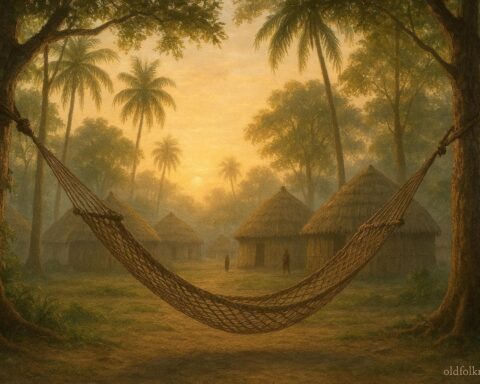
Long ago, when the trees could still whisper and the rivers carried the voices of the ancestors, there lived a young hunter named Chéggue. He was the pride of his village, strong, fearless, and quick with his bow. His laughter could be heard across the hills, and even the elders said the forest spirits must have blessed his birth.
But Chéggue was also restless. He was born during a time when the hunters of the land honored taboos of the monte, sacred periods when no man was to set foot in the forest. During those days, the earth was said to breathe, the animals to speak among themselves, and the spirits of the wild to walk freely. Hunting during that time was forbidden, for to do so would anger Olufi, the supreme being who governed all life, and awaken the watchful eyes of the ancestors beneath the rivers.
Chéggue’s father was an old hunter, weathered by sun and wind, who knew every rustle and call of the forest. He had spent his life respecting the rhythms of the land, and he tried to teach his son the same patience. “My son,” he would say, “there is a time to hunt, and a time to be still. When the forest sleeps, we must listen. When the river sings, we must wait. Do not chase the echo of your own pride.”
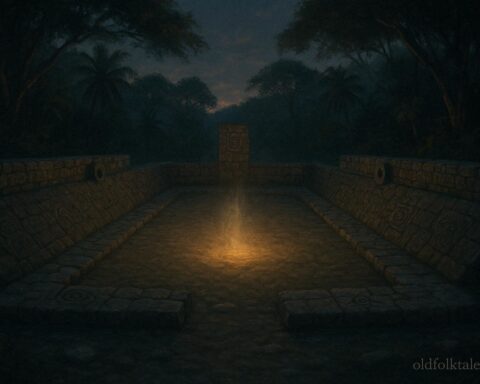
But Chéggue, young and proud, felt that no spirit or rule could bind him. One dawn, when the mists clung low to the ground and the world seemed half-dream, he took up his spear and his hunting horn. The air was thick with silence. Even the birds refused to sing. He hesitated only for a heartbeat before stepping past the village edge and into the forbidden monte.
The trees closed around him like sentinels. Shadows rippled between the trunks, and the sound of his own footsteps seemed to mock him. He tracked the prints of a deer deeper into the undergrowth, his heart thrumming with excitement. “I will bring home the grandest prize,” he told himself. “The forest will remember Chéggue’s name.”
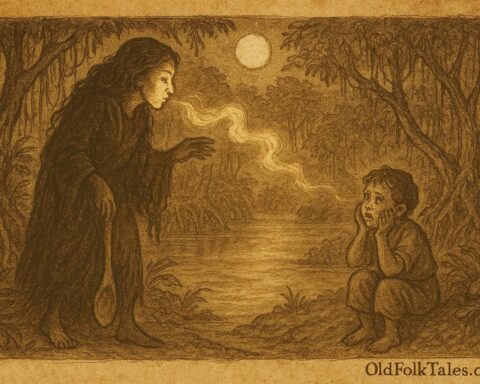
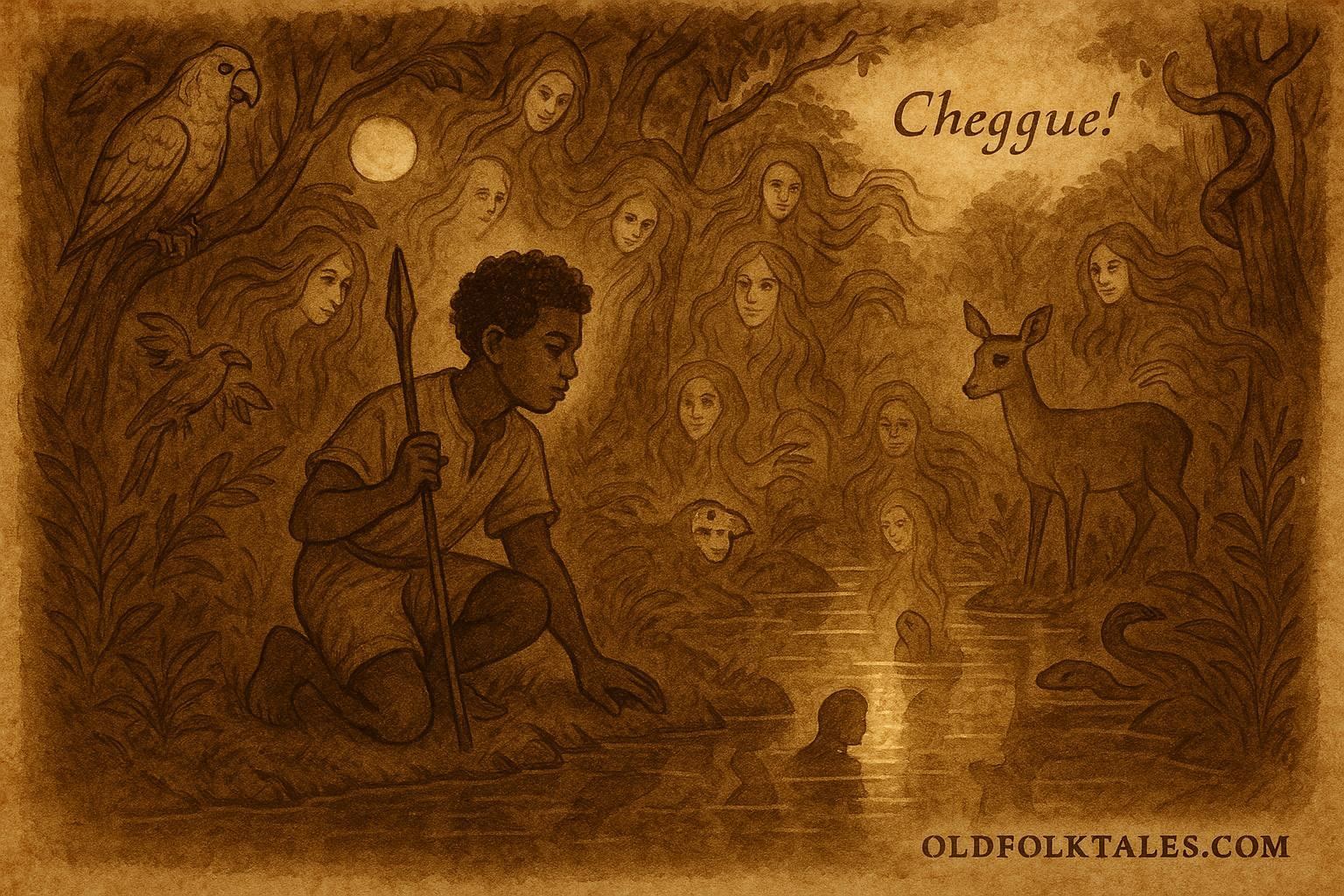
Hours passed. The sun climbed, then dipped. The deer vanished. A chill began to creep through the air, and Chéggue found himself near a stream that murmured softly, as though telling secrets. He bent to drink. The water shimmered strangely, and a whisper rose from its depths, a voice, low and ancient, singing:
“Chéggue… Tanike Chéggue nibe ún…
Chéggue… Chéggue lies within the stream…”
The young hunter’s blood ran cold. He looked around, but no one was there, only the rippling water and the rustle of leaves. “Who calls my name?” he demanded, his voice trembling. The forest gave no answer. He turned to run, but his legs felt heavy, as though the earth itself were holding him.
Back in the village, the father awoke with a start. He had dreamed of the same voice, of dark waters swallowing the light. His heart told him what his mind refused to believe, that Chéggue had broken the sacred law and entered the monte. Grabbing his staff, he set off down the old paths, calling out his son’s name.
“Chéggue! My son! Where are you?”
The forest did not answer. The trees seemed to lean away, their silence thick with sorrow. The father walked until his feet bled, until the shadows lengthened and night descended. At last, he reached the stream. There, in the moonlight, the water glowed pale and strange. A sudden chorus rose, the cries of the animals of the monte: the parrot, the snake, the antelope, and even the smallest cricket.
Together they sang, in a mournful chant that filled the night:
“Chéggue… Tanike Chéggue nibe ún…
Chéggue… lies in the stream…”
The father fell to his knees. “Olufi,” he cried, “if my son has disobeyed, forgive him. He is but a child of the earth, let him find rest among his ancestors.”
A gust of wind swept over the water. The stream shimmered once, then stilled. The animals withdrew into the shadows, their voices fading into the rustle of leaves. Only the old man remained, his heart broken, his tears mingling with the sacred river.
When he returned to the village, he spoke softly: “Let no one enter the monte when it sleeps. My son Chéggue lies there now, he who would not listen, he who thought himself greater than the spirits.”
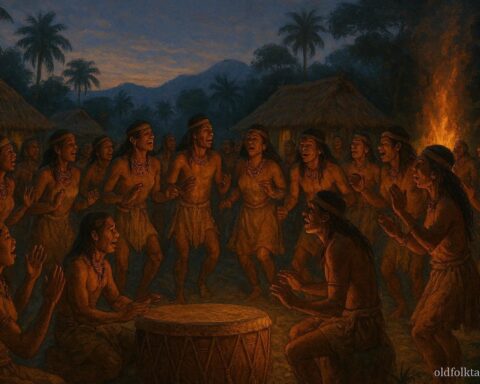
And so the story of Chéggue passed from tongue to tongue, from drum to drum, across Cuba’s hills and coastal plains, from the villages of Matanzas to the deep interiors where Yoruba songs still echo in the night. The people sang his name in remembrance, not in anger, but as a lesson: that even the bravest hunter must bow before the laws of nature, for disobedience can silence even the strongest heart.
Moral Lesson
The tale of Chéggue reminds us that courage without wisdom leads to ruin. Nature’s laws, and the guidance of elders, exist not to limit freedom but to protect it. Respect for taboo, tradition, and the unseen rhythm of the world is essential for harmony between humankind and the sacred forces of creation.
Knowledge Check
- Who is Chéggue in Afro-Cuban folklore?
Chéggue is a young hunter who defies sacred taboos and meets his fate in the forbidden forest, representing disobedience and pride in Afro-Cuban lore. - What moral lesson does the tale of Chéggue teach?
The story teaches respect for nature, obedience to spiritual laws, and humility before ancestral wisdom. - How does Chéggue’s father react to his disappearance?
Chéggue’s father, guided by dreams and sorrow, searches for his son and learns of his death through the voices of the animals and the forest spirits. - What is the cultural origin of the Chéggue story?
The tale comes from Afro-Cuban oral tradition, drawing from Yoruba ritual song adapted into narrative by Lydia Cabrera in Afro-Cuban Tales. - What role does the forest (monte) play in the story?
The forest is both sacred and sentient,a living space where divine and ancestral spirits dwell, enforcing the moral balance between humans and nature. - Why do the animals chant Chéggue’s name?
Their chant is both lament and revelation, a spiritual announcement of Chéggue’s death, echoing Yoruba ritual mourning songs.
Source:
Adapted from Afro-Cuban Tales (Cuentos Negros de Cuba) by Lydia Cabrera, English translation by J. Alberto Hernández-Chiroldes & Lauren Yoder (2004), University of Nebraska Press.
Cultural Origin: Cuba (Afro-Cuban, Yoruba-influenced folklore)