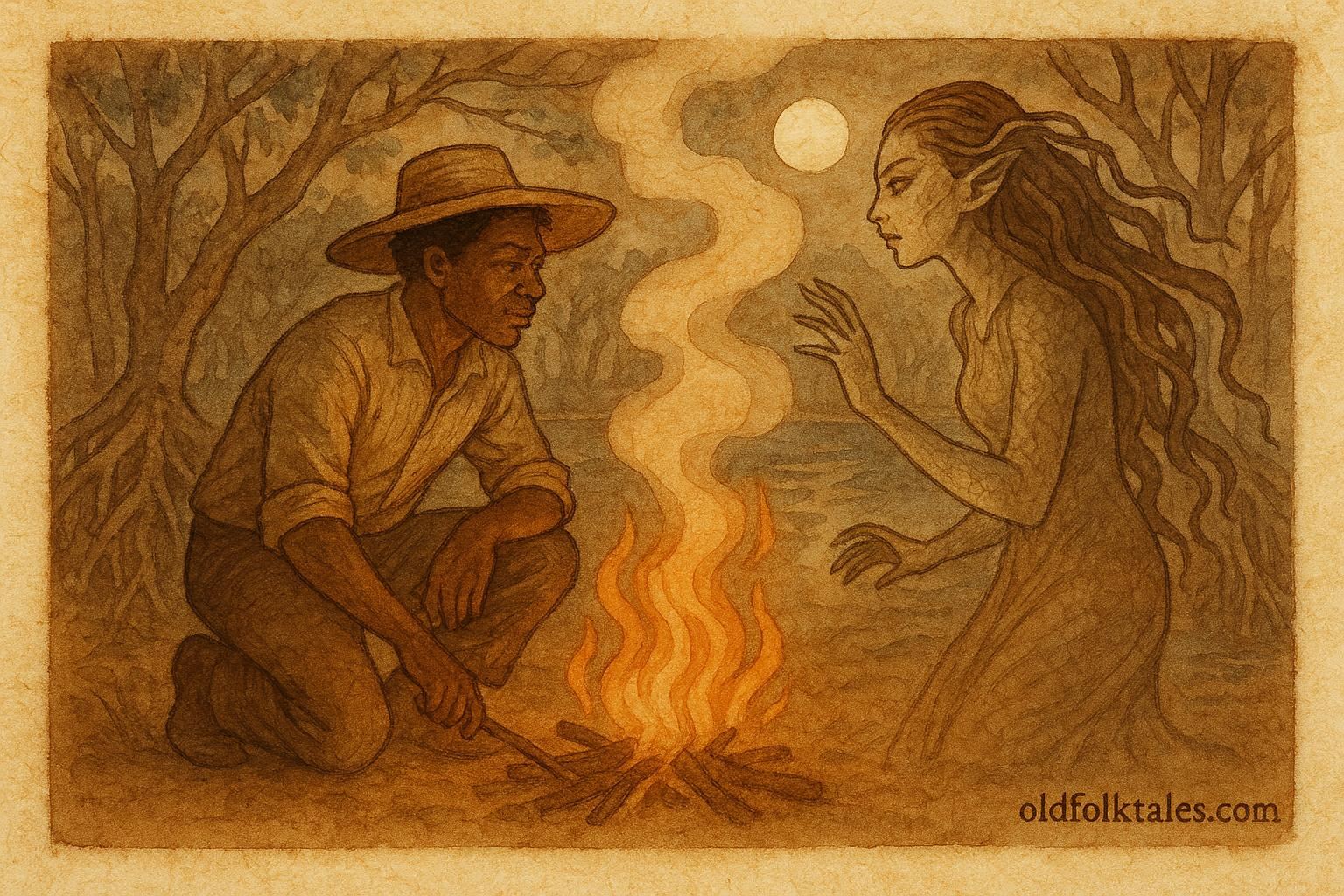
In the warm, humid air of Andros Island, where the mangrove roots twist like old fingers and the swamp water gleams under a silver moon, lived a man named B’Lijah. Folks around the island called him the trickster, for his sharp tongue and quick wit could outsmart any man or spirit. He was known to joke with the preacher, charm the market women, and tease the very wind when it howled through the pines. Yet behind his laughter was a watchful heart, for the elders always warned: “Beware what smiles at you in the swamp.”
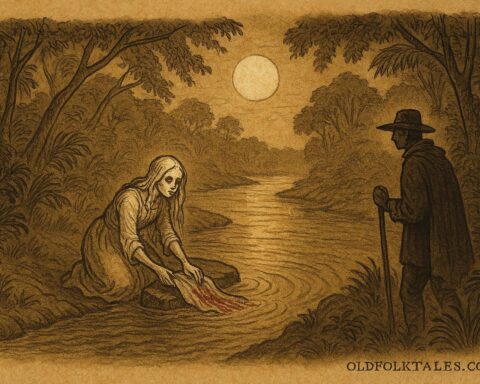
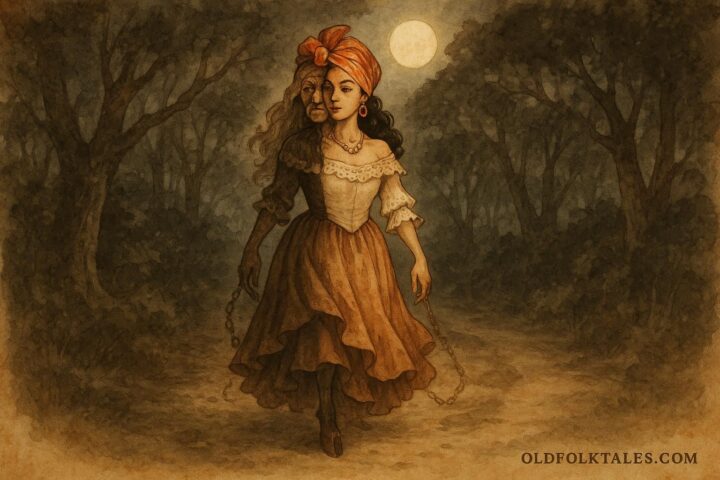
One sultry evening, after a long day gathering wood, B’Lijah wandered near the mangrove thicket. The air buzzed with mosquitoes, and the swamp shimmered in the half-light of dusk. Just as he was about to rest, he saw a woman standing by the water’s edge. Her skin gleamed like polished mahogany, and her hair fell down her back like black silk. She called out sweetly, “Good evening, B’Lijah. You have fire, yes? I been cold a long while.”
Now, B’Lijah knew most folks on Andros, but he had never seen this woman before. Still, he was bold and curious. He smiled, twirling the stick in his hand. “Fire you want, fire you get,” he said, kneeling to strike a spark. The woman stepped closer, her eyes glowing faintly green in the dimness.
When the flames caught, she leaned near, and that’s when B’Lijah saw them: her teeth, long and pointed like a snake’s. His grin froze. His heart skipped, but he didn’t flinch. He had heard tales of the snake-woman, a spirit said to haunt lonely places, luring proud or careless men to their doom.
“Well now,” B’Lijah drawled, hiding his fear behind his usual swagger, “fire makes friends of all creatures, don’t it?”
The woman smiled wider, her eyes gleaming. “Yes, B’Lijah. Sit closer, so I can warm myself.”
But B’Lijah wasn’t fooled. He remembered something his grandmother once told him: “Salt drives away wicked spirits, no ghost can stand its sting.” Slowly, he reached into his pocket, where he always carried a pinch of salt for his evening stew. “Just a little seasoning for the fire,” he said casually, tossing the grains into the flames.
The reaction was instant. The fire hissed and spat, and so did the snake-woman. Her smile twisted into fury, her body writhing as smoke curled around her. “You tricked me!” she hissed, her voice rising like the cry of a storm.
B’Lijah leapt back, laughing. “You thought you had B’Lijah fooled? Never that! A trickster knows when the devil dances too close!”
The snake-woman’s form flickered, her beautiful face melted away, revealing gleaming scales and a serpent’s eyes. With one last hiss, she sank into the muddy swamp, leaving only the ripples of her rage behind.
B’Lijah dusted off his trousers and spat into the water. “Pretty face by the swamp don’t mean safe company,” he muttered, his grin returning.
He hurried home through the moonlit forest, his laughter echoing between the trees. When he reached his village, he told the tale by the fire, his voice full of swagger but his eyes thoughtful. He ended every retelling with the same warning:
“When you see beauty shining where it shouldn’t, you best throw salt, not compliments.”
And so the people of Andros remembered B’Lijah’s wisdom. They taught their children to respect old warnings, to carry salt on moonlit nights, and to never let pride blind them to danger.
For though the swamps still whispered with unseen things, none ever caught B’Lijah again.
Moral Lesson
Wit and respect for tradition protect those who listen, while pride and carelessness invite danger. Cleverness must walk hand in hand with caution.
Knowledge Check
1. Who is B’Lijah in the story?
B’Lijah is a clever trickster from Andros Island known for his quick wit and ability to outsmart both humans and spirits.
2. What is the snake-woman in Bahamian folklore?
She is a spirit of the swamp who disguises herself as a beautiful woman to lure boastful or careless men.
3. How does B’Lijah defeat the snake-woman?
He cleverly throws salt into the fire, causing the spirit to hiss and vanish into the swamp.
4. What does the use of salt symbolize in the story?
Salt symbolizes purity, protection, and the wisdom of ancestral knowledge passed down through generations.
5. What is the main theme of the folktale?
The theme is that wit and humility protect people from harm, while vanity and disbelief in tradition lead to downfall.
6. What cultural influences shape this Bahamian folktale?
It reflects African trickster traditions and Caribbean spiritual beliefs blended with local island folklore.
Source: Adapted from the Bahamian folktale “B’Lijah and the Snake-Woman,” based on Zora Neale Hurston’s Bahamian fieldwork (1936–1937) in Tell My Horse: Voodoo and Life in Haiti and Jamaica, and materials from the Grand Bahama Museum Folktale Archive.
Cultural Origin: The Bahamas (Andros Island – Bahamian folklore)