There was a time in the old country when the line between the living and the dead was thinner, and the great mystery of death could still be spoken to, face-to-face. It was during such a time that a great sickness swept through the land. It found its way into the hut of Anansi the spider, touching his beloved children. One after another, they grew feverish and weak, their bright spirits dimming like guttering candle flames.
Anansi, who could trick a king out of his crown or a farmer out of his fattest yam, was powerless. His clever words could not cure; his cunning schemes could not mend. In his despair, a desperate, terrible idea took root. If he could not heal them, perhaps he could bargain for them. He would go to the source. He would go to the Land of the Dead and speak to Death himself.
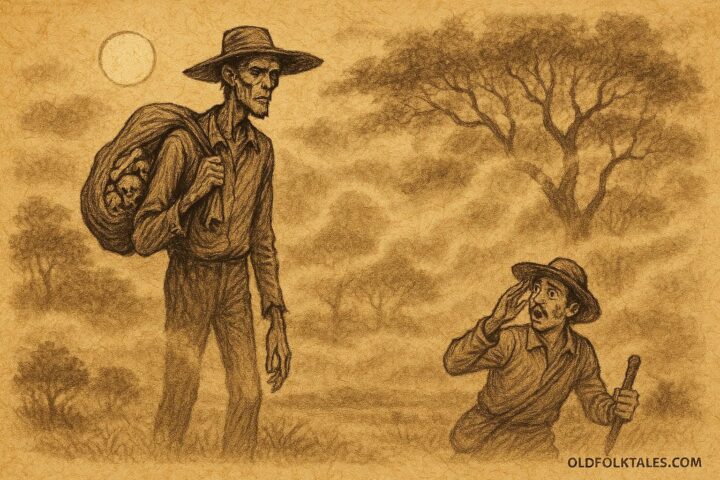
The journey was long and filled with shadows. He crossed rivers that flowed backwards and passed trees that whispered with the voices of those who slept beneath them. Finally, he came to a still, grey plain where a lone, tall figure stood. It was not a skeleton, but a man of immense and somber presence, dressed in a dark, seamless robe. His face was ageless, etched with an infinite patience, and his eyes held the quiet of a deep, starless night. This was Death.
“Great Lord of the Silent Land,” Anansi began, his voice trembling not with trickery, but with a father’s raw fear. “My children are dying. I have no magic to save them. I come to beg. Spare them. Take me instead, if you must have a life.”
Death regarded the small, trembling spider. He had heard many pleas, but rarely one so direct. “Your offer is noble, Anansi,” Death said, his voice like dry leaves settling. “But my order is not for trading one for another. Yet… I am a keeper of lists. I will make a bargain with you. I will spare your children. In return, you will become my messenger. Whenever a person is to die, you must come to me and whisper their name into my ear. Only when I hear the name from you will I come to collect them. Do we have an accord?”
Hope, fierce and wild, surged in Anansi’s heart. He could save his children! “Yes!” he cried. “It is a bargain! I will be your faithful namer!”
And so it was. Anansi returned home to find his children’s fevers breaking, their strength returning. He wept with joy. For a time, he kept his word faithfully. When old Nanny Parkinson took her final breath in her sleep, Anansi dutifully traveled to the grey plain and whispered, “Nanny Parkinson.” Death nodded and went about his work.
But as the years passed, the weight of the duty chafed against Anansi’s nature. A good, strong man in the village, a father of five, fell from a tree. He was not yet dead, but he would be soon. Anansi looked at the man’s weeping family and thought of his own children. His clever mind, which could not rest, began to work. What if I just… delay? What if I do not say the name right away? Perhaps Death will forget.
So, for the first time, Anansi hid a name. He did not go to the grey plain. And a miraculous thing happened, the man, against all hope, began to recover. He lived.
Emboldened, Anansi did it again. A kind young mother grew terribly ill. Anansi held her name on his tongue. She, too, rallied and lived. Anansi began to feel not like a messenger, but like a savior. He was cheating the great ledger, stealing souls back from the brink. He grew secretive and proud, believing he had outwitted the universe itself.
But Death does not forget. Death’s lists are eternal. One day, as Anansi was skulking near the village well, the air grew cold and still. Death stood before him, his patience finally worn thin.
“Anansi,” Death intoned, and the voice held a finality that made the spider’s very soul shiver. “You have broken our bargain. I have found names on my list that never reached my ear. You sought to hide them from me.”
Anansi could only bow his head, his clever tongue stilled by truth.
“Your trickery has poisoned the well,” Death declared. “The bargain is void. From this day forward, I will no longer wait for a messenger. I will take whom I will, when the time is written, and no plea, no bargain, and no trick will stay my hand. Your children were spared once. They, like all living things, are now mine to claim when their season ends.”
With those words, Death turned and faded into the grey air, leaving Anansi utterly alone.
He returned to his village, a profound sorrow upon him. He had succeeded in saving his children once, but in his arrogance, he had stripped all of humanity of the chance to beg, to bargain, to delay the inevitable. He had made death universal, absolute, and un-negotiable.
And so, the people learned to mourn without recourse. They understood that death comes for all, not because it is cruel, but because a spider, in his love and his pride, tried to cheat an un-cheatable system. Anansi’s greatest trick had been his last, and its cost was borne by every living soul forever after.
The Moral Lesson:
This profound tale teaches that there are fundamental laws of existence that cannot be outwitted, even by the cleverest among us. It warns that attempts to cheat a necessary, if painful, natural order, especially through deceit and arrogance, can lead to worse consequences for everyone, removing mercy and making absolute what might have been negotiable.
Knowledge Check
Q1: Why does Anansi seek out Death in the beginning of the story?
A1: His children are sick and dying from a great sickness, and in his desperation, he goes to the Land of the Dead to plead with Death personified to spare their lives.
Q2: What is the specific bargain Death offers to Anansi?
A2: Death will spare Anansi’s children if Anansi becomes his messenger, responsible for coming to Death and whispering the name of every person who is meant to die, so Death knows whom to collect.
Q3: How does Anansi initially break his bargain with Death?
A3: Driven by pity and a growing sense of power, Anansi begins to withhold the names of people who are dying, hiding them from Death in the hope that they will recover and live, which some do.
Q4: What is Death’s final judgment and declaration after discovering Anansi’s deceit?
A4: Death declares the bargain void. He states he will no longer wait for a messenger but will take everyone when their time comes, making death universal, inevitable, and non-negotiable for all humanity.
Q5: How does this story transform the character of Anansi?
A5: It elevates him from a comic trickster to a tragic figure. His cunning, motivated by a father’s love, ultimately leads to a cosmic consequence—the loss of any possible negotiation with death for all people.
Q6: What existential reality does this tale explain within Jamaican folklore?
A6: It serves as a “pourquoi” story explaining the universality and inevitability of death, answering why no one can bargain or cheat their way out of dying when their time comes.
Cultural Origin: Jamaican Folktale (of Akan-Ashanti origin).
Source: Adapted from Story #118 and variants in Jamaica Anansi Stories by Martha Warren Beckwith, and common oral tradition.