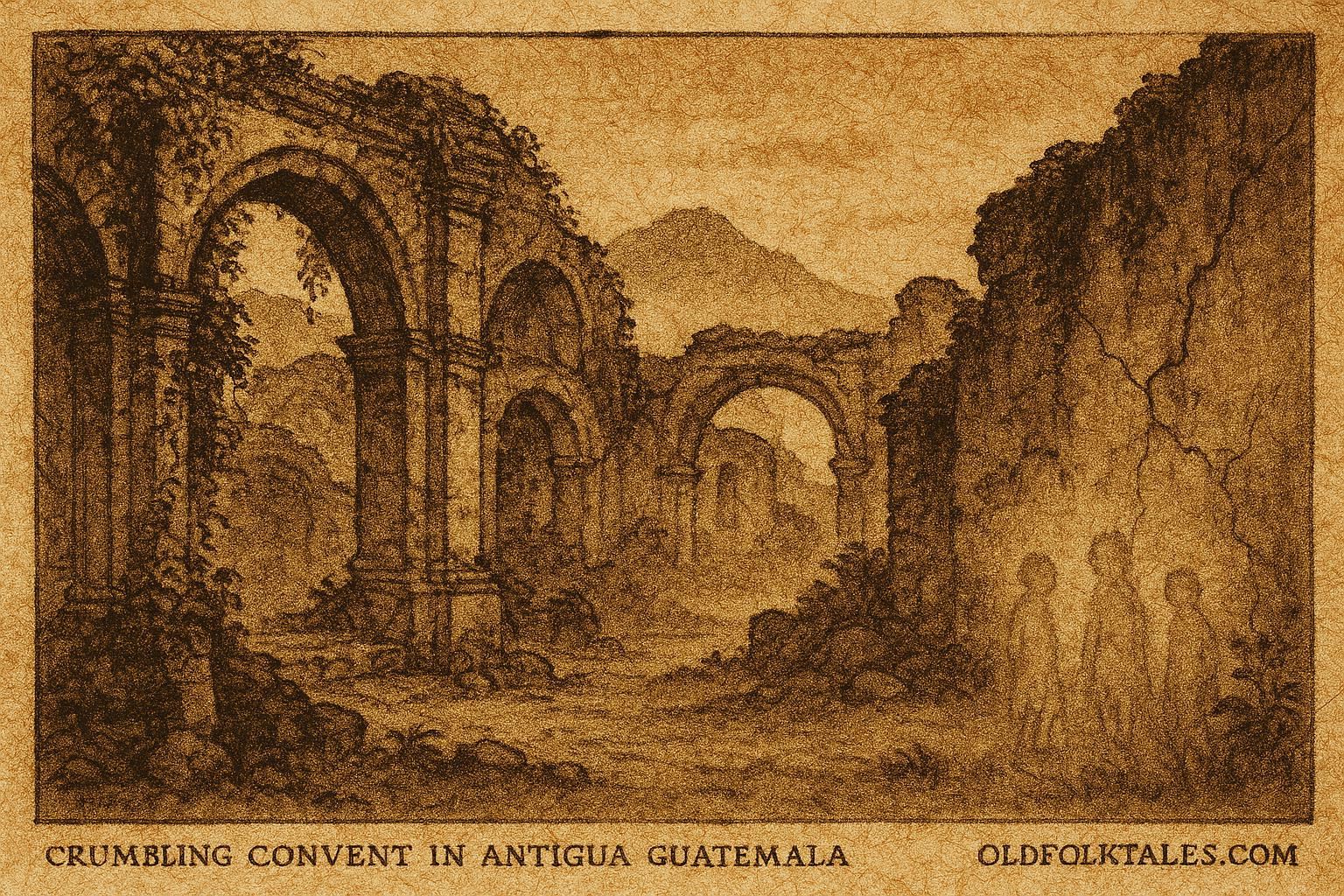
Silence ruled the convent long before death ever entered its walls. In eighteenth century Antigua Guatemala, the cloistered convent near what are now the Capuchinas and Santa Clara ruins was known for its rigid devotion to quiet. The nuns who governed it believed that discipline of the tongue purified the soul, and the orphaned girls taken into their care were raised within that rule. Words were spoken only in prayer. Even footsteps were softened, and laughter was considered a sin of excess.
The girls learned to move through stone corridors without sound. They folded their hands, lowered their eyes, and memorized the Ave Maria and the Credo until the prayers lived in their breath. Though young, they understood that obedience was their only protection in a world that had already taken their families from them.
In 1773, the earth betrayed that obedience.
The great earthquake struck Antigua with violence that shattered churches, homes, and monasteries alike. Bells rang without hands. Walls split open. Roofs collapsed in clouds of dust and prayer. As the city screamed, one wing of the convent fell inward, sealing an underground cellar beneath stone and rubble.
Inside that cellar, a group of orphaned girls were trapped.
They whispered prayers as they had been taught, their voices low and respectful even as fear tightened their throats. They called out softly, believing that to shout would be wrong. Above them, chaos drowned everything. No one heard their prayers. No one heard their voices. When the rescue came days later, it came too late.
The convent was abandoned. Time passed. Antigua was rebuilt elsewhere. The ruins were left to ivy, moss, and memory.
Yet Silence did not remain complete.
Visitors to the ruins in later centuries began to notice something strange. Those who stood perfectly still, especially in the early evening when sound carries easily, sometimes heard faint whispers drifting through the broken chambers. The voices were small, rhythmic, repeating fragments of prayer. Ave Maria. Credo. Over and over, as if caught in a loop.
The whispers did not respond to noise. If a visitor spoke loudly, they faded. But if someone whispered a prayer back, even softly, the voices stopped at once. The sudden absence was often more frightening than the sound itself.
Some reported feeling the brush of cold fingers against their sleeves. Others felt gentle tugs, as though a child were guiding them. Those who followed the sensation were often led to the same place: a particular wall in the ruins, cracked and uneven, marked by age but not by any sign.
Local psychics and elders claim the children remain bound to the cellar beneath that wall. Their bones were never properly recovered. Their burial was incomplete. Their prayers unfinished. According to belief, the girls seek not attention but completion.
They want the rosary.
It is said that if a full rosary is recited in silence near the wall, the whispers soften. Some swear they fade entirely for a time. The spirits are not malicious. They do not chase, threaten, or harm. They remain as they were in life: obedient, frightened, and unheard.
The legend teaches visitors to respect the ruins not as tourist sites but as graves. Silence is not emptiness there. It is crowded with memory. Those who mock or disturb the place often report sleepless nights filled with whispered prayers they cannot forget.
The children do not scream. They never learned how.
Moral Lesson
The tale teaches that enforced silence can become a prison, and that voices ignored in life may echo endlessly until acknowledged with compassion and respect.
Knowledge Check
Q1: Where does the legend take place?
A1: In the ruins of a colonial convent in Antigua Guatemala.
Q2: Who are the spirits in the story?
A2: Orphaned girls trapped during the 1773 earthquake.
Q3: What sounds are associated with the legend?
A3: Whispered prayers, including the Ave Maria and the Credo.
Q4: What happens if a visitor whispers back?
A4: The voices abruptly stop.
Q5: What do psychics say the children want?
A5: A proper burial and the recitation of a full rosary.
Q6: What does the legend symbolize?
A6: Unheard suffering and the lasting impact of suppressed voices.
Cultural Origin and Source
Source: Colonial Criollo folktale, Guatemala
Associated with the ruins of Antigua Guatemala, recorded in local historical society archives.