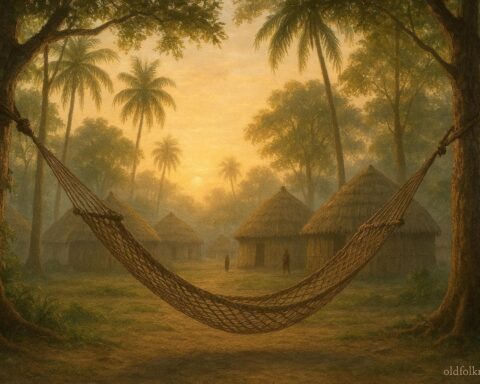
In the humid lowlands of southern Belize, elders still speak of the Duppy Banana, a cautionary tale whispered to careless farmers and impatient planters. The story is rooted deep in the Stann Creek Valley, where bush, soil, and spirit share long memory, and where the land itself is believed to watch how it is treated.
There once lived a man known for avoiding effort whenever possible. Wanting the reward of farming without the discipline it required, he planted a single banana tree near the edge of his yard. He did not clear the surrounding bush, nor did he mark the land properly or tend the soil with care. Vines crept close, roots tangled freely, and the boundary between yard and jungle remained blurred. Satisfied with doing the bare minimum, the man left the tree to grow on its own.
Click to read all South American Folktales — timeless stories from the Andes to the Amazon.
Grow it did.
The banana tree rose with unnatural speed, its leaves broad and glossy, its trunk thick and heavy. In time, it bore one enormous bunch of bananas, far larger than any the man had ever seen. The fruit carried a rich, sweet fragrance that drifted through the night air, drawing attention from far beyond the yard. The man watched it closely, counting the days until harvest, already planning how much he would sell and how little work he had truly done.
On the night before he intended to cut the bunch, the man was woken by a strange sound. It was not the cry of an animal or the rustle of wind, but a slow dragging noise, like feet pulled reluctantly across damp earth. Fear held him still in his bed. He told himself it was nothing and waited for morning.
At dawn, the banana bunch was gone.
The tree stood stripped and bare. On the ground beneath it were enormous footprints, shaped like a man’s but far too large, pressed deep into the soil. The tracks led away from the yard and into the bush. Angry and determined to reclaim what he believed was his, the man followed the trail.
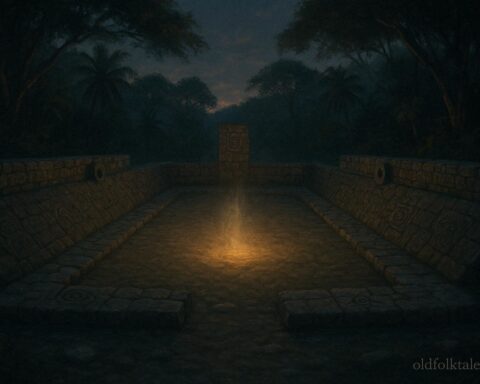
The footprints ended in a clearing he had never seen before. At its center stood a wild fig tree, ancient and wide, its roots exposed like knotted hands gripping the earth. Hanging from its branches was the missing banana bunch, untouched and glowing in the filtered light. The man stepped forward and reached out.
Before his fingers touched the fruit, a voice filled the clearing.
“You plant in my yard, you take from my table?”
The air grew heavy. From beneath the fig tree, a figure emerged, neither fully solid nor fully smoke. It was a Duppy, the spirit of an old Mayan farmer who had once cultivated that land long before fences, titles, or careless shortcuts. His presence carried the weight of ownership earned through respect, not claim.
The spirit spoke plainly. The land had never been asked. The bush had never been cleared properly. The man had planted where others once worked and died, treating the soil as empty simply because he did not understand its history.
As punishment, the Duppy placed a curse upon him. From that day forward, everything the man planted would grow tall and strong. His fields would look prosperous, and his labor would seem successful. But on the night before harvest, the fruits would rise on phantom roots and walk away, returning to the bush from which they came.
The man begged for mercy. The Duppy did not refuse him outright, but set conditions. To lift the curse, the man had to learn respect. He must formally ask the land for permission before planting. He must clear a proper field, marking boundaries with care. And above all, he must always leave the first fruit of every harvest in the clearing beneath the fig tree as acknowledgment of what was taken and what was shared.
The man agreed.
From that day on, he worked differently. He cleared his fields fully. He spoke words of permission before planting. And when harvest came, he left the first fruit behind, untouched, as promised. The walking fruit stopped, and the land yielded fairly again.
Elders say the clearing still exists, and that careless planters sometimes hear footsteps at night when the bush is not respected.
Moral Lesson
This folktale teaches that cultivation requires respect, ritual, and acknowledgment of the land’s history. Labor alone is not enough; stewardship demands humility and permission.
Knowledge Check
1. What is the Duppy Banana?
It is a supernatural banana bunch that walks away before harvest.
2. Why did the banana tree grow unnaturally fast?
Because it was planted on spiritually claimed land without respect.
3. Who was the Duppy in the story?
The spirit of an old Mayan farmer connected to the land.
4. What curse was placed on the man?
All his crops would grow but leave before harvest.
5. How could the curse be lifted?
By respecting the land, clearing fields properly, and offering first fruit.
6. What does the walking fruit symbolize?
The land reclaiming what was taken without permission.
Source and Cultural Origin
Source: Afro-Belizean (Kriol) folktale, Belize
Collected by B. N. Collymore in Busha’s Mistress under the title “The Walking Fruit”
Cultural Origin: Kriol folklore influenced by Mayan land stewardship traditions