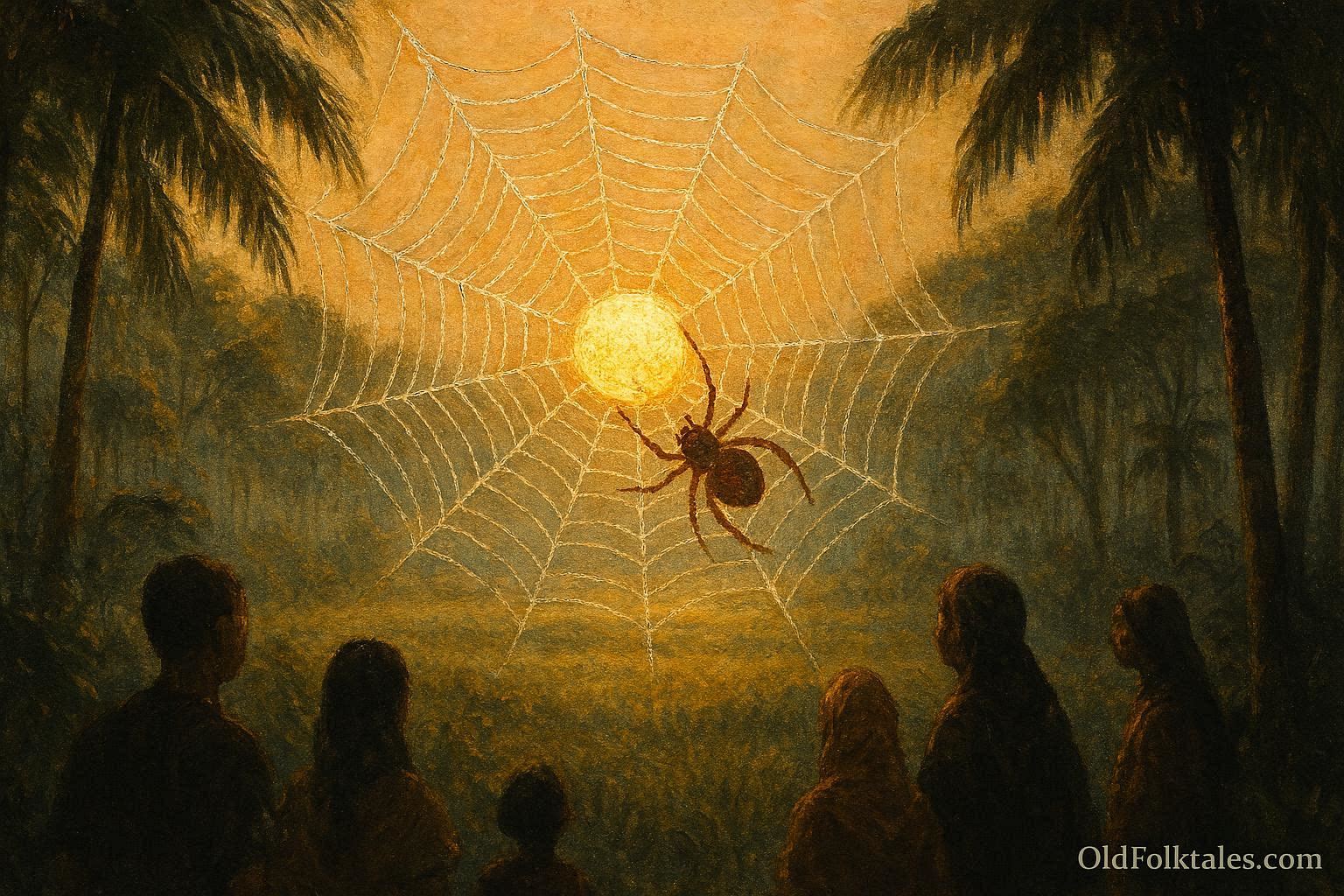
Long ago, when the world was still young and the sun often hid behind clouds, the people of the islands struggled to grow crops, find their way, and light their homes. Darkness lingered longer than it does now, and the warmth of the sun was a rare blessing. Villagers often wondered why the sun was so fleeting, hiding from their eyes. They prayed to the spirits, but the sun remained elusive.
High in the forest, in a quiet clearing surrounded by towering palms and fragrant hibiscus, lived a small spider named Itiba. Unlike the other creatures, Itiba was clever, patient, and always curious. She watched the people from her web above the clearing, noticing how they struggled in the dim light and how often they quarreled over scarce sunlight.
One evening, as the villagers slept, Itiba spoke to the spirits of the sky:
“Why does the sun hide? Why does it refuse to shine for the people who need it most?”
Discover the diverse storytelling traditions of Canada — from the icy North to the Maritimes
The spirits answered only with whispers through the rustling leaves. The spider listened carefully, learning that the sun could be captured only through patience, cleverness, and careful planning. The sun was playful, quick, and would not settle for anything less than ingenuity.
Itiba thought long and hard. She began to spin a web unlike any other web of silver threads so fine that it shimmered faintly in the moonlight. Each strand was carefully placed, twisting around invisible points, forming a net that could hold something bright and lively without crushing it. She worked day and night, pausing only when she needed to gather silk from her own body. Her neighbors laughed at her, wondering why such a small creature attempted such an impossible task.
When the web was complete, Itiba waited for the moment the sun peeked through the horizon. The first rays of light touched her web, and she carefully guided the threads so that the sunlight would settle into her creation. The sun tried to escape, flickering and twisting, but Itiba remained calm. She adjusted each line, moved slowly, and let the sun flow into the web naturally.
Finally, the sun was caught, shimmering in her silver threads, safe and glowing. Itiba carefully lowered the web into the clearing, making sure not to harm the sun’s warmth or brightness. When the villagers awoke, they saw the sun dancing in the spider’s web, casting golden light across the forest.
They gasped in wonder. Itiba had done what no human or animal could: she captured the sun without force, using patience and cleverness. The people learned immediately that the spider’s success was not the result of strength, but of observation, ingenuity, and care.
Over the following days, the villagers used this lesson in all parts of their lives. They worked together, listened more closely, and practiced patience in fishing, planting, and building. Children learned to watch and wait, understanding that hasty actions often led to mistakes. Hunters observed the behavior of birds and animals before making decisions. Artisans shaped their tools with thoughtful care, following Itiba’s example.
The sun, freed by the villagers’ newfound respect, began to rise fully each morning, bringing warmth and light in abundance. It danced on the waves, glistened on leaves, and guided travelers along the forest paths. Itiba remained in her web, watching quietly, knowing that the people had learned the importance of patience and cleverness in their daily lives.
Years later, the story of the clever spider spread across the islands. Parents told it to children to remind them that small beings could achieve great things if they were thoughtful, careful, and determined. Travelers spoke of the spider who wove the sun, sharing the tale with distant islands and communities. Even now, some say that when the first sunlight hits a silver strand of morning dew, Itiba smiles, reminding all who see it that intelligence and patience can shape the world.
The spider never asked for reward. She understood that her task was not about fame or recognition, but about teaching. The sun, once elusive and hidden, became a friend to the people because Itiba chose to act with care, creativity, and respect for the forces of nature.
And so, the sun rises and sets in balance, a reminder of one small spider whose cleverness captured light and changed a community forever.
Explore the ancestral legends of Canada, Mesoamerica, and South America’s Indigenous tribes.
Moral Lesson
Patience, careful planning, and ingenuity can achieve what brute force cannot. Even the smallest creature can accomplish great things if guided by wisdom and respect for the natural world.
Knowledge Check
1. Why did Itiba the spider decide to capture the sun?
To help the villagers who struggled with darkness and to teach a lesson in patience and cleverness.
2. How did Itiba successfully catch the sun?
By spinning a delicate web of silver threads and guiding the sun slowly, using observation and care.
3. What lesson did the villagers learn from Itiba’s actions?
That patience, ingenuity, and careful planning are more effective than rushing or force.
4. How did the sun behave before being captured?
It was elusive, flickering, and often hidden, refusing to stay in one place.
5. What qualities of Itiba were essential for her success?
Patience, intelligence, observation, and respect for natural forces.
6. How is the story still relevant for future generations?
It teaches that thoughtful action, respect, and cleverness can solve difficult problems, regardless of size or power.
Source
Adapted from Caribbean Oral Traditions Collection; Smithsonian Caribbean Studies.
Cultural Origin
Taíno peoples, Greater Antilles.