In the heart of the Guatemalan highlands, where the air is thin and the clouds cling to the shoulders of mountains, three great volcanoes stand as silent, eternal witnesses. To the Kaqchikel Maya and Ladino people, they are not just mountains of rock and fire. They are a love story, a tragedy, and a myth of creation all in one. This is the legend of the Princess, the Warrior, and the Farmer.
Long ago, in a verdant valley watched over by a stern, mighty warrior named Tziquín, there lived a princess of breathtaking beauty named Ixmucané. She was promised to Tziquín, the guardian of the land, whose strength was as solid as stone and whose pride was as fierce as flame. He saw her as the ultimate prize for his protection and valor.
Click to read all South American Folktales — timeless stories from the Andes to the Amazon.
But Ixmucané’s heart followed a different path. She fell deeply in love with Acotenango, a commoner who worked the earth. He was not a man of sword and shield, but of seed and harvest. His hands were calloused from the soil, and his heart was as gentle and fertile as the fields he tended. Their love grew in secret, a quiet, green shoot in the shadow of the warrior’s looming claim.
When Tziquín discovered their love, his pride ignited into a fury as violent as a sudden earthquake. He confronted Acotenango, his voice a thunderous roar across the valley. “You dare to steal what is mine?” he bellowed. “I am the guardian! She is my promised bride!” He challenged the humble farmer to a duel to the death, a contest to be decided by the gods at the hour of dusk.
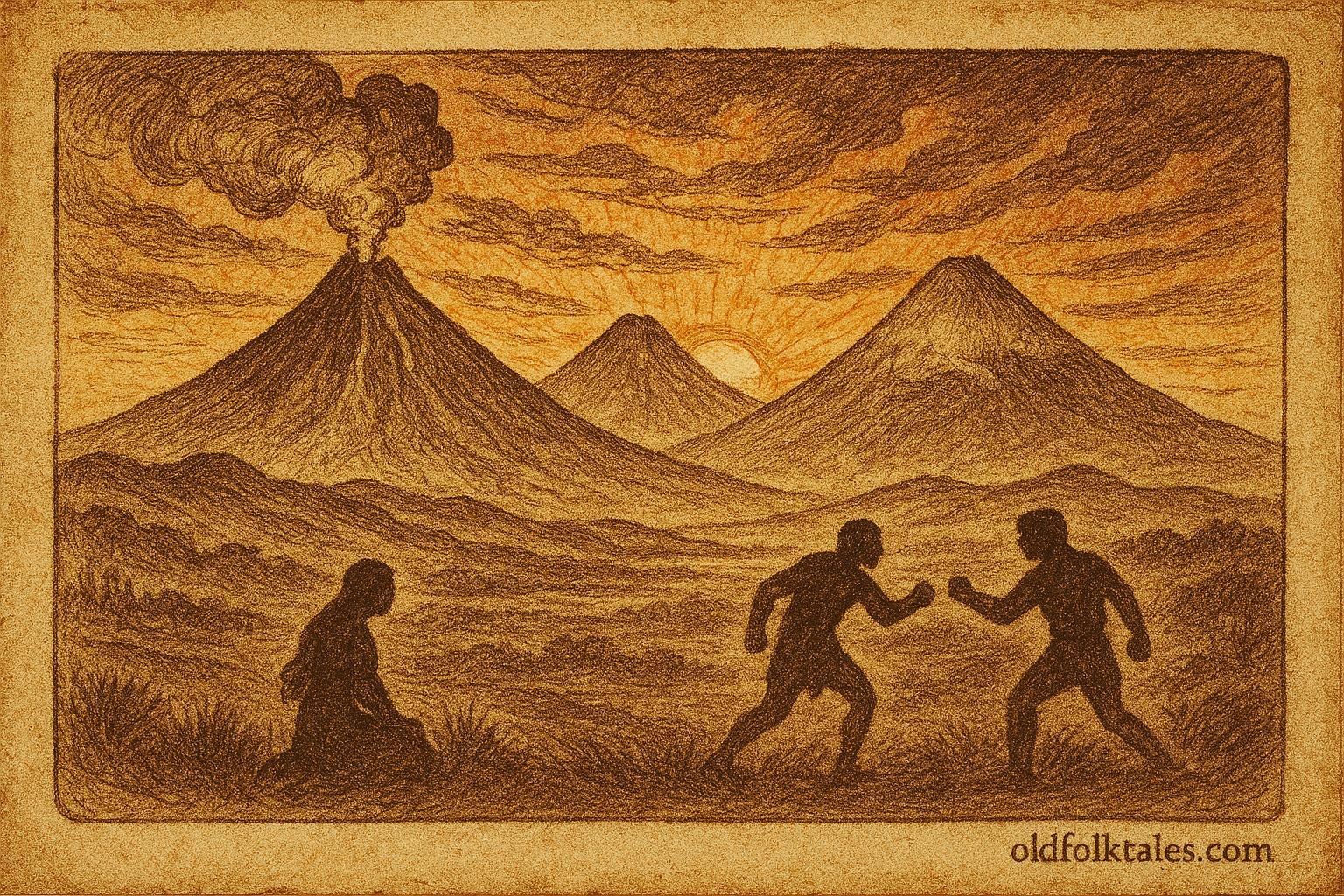
Ixmucané wept and pleaded, but the warrior’s honor and the farmer’s love were both unyielding. As the sun began its descent, painting the sky in the colors of blood and ochre, the two men faced each other on the plain. Tziquín fought with the relentless, explosive rage of a tempest, his blade flashing like lightning. Acotenango, defending his love and his life, fought with the deep, resilient strength of the ancient earth itself. The clash was titanic, shaking the very ground.
Princess Ixmucané watched from a high ridge, her heart tearing in two with every blow. She could not bear to see the gentle Acotenango harmed, nor could she bear the chaos unleashed by the jealous Tziquín. As the battle raged and the last light of day began to fail, she fell to her knees and raised her arms to the heavens. “Gods of the sky and earth!” she cried, her voice a pure, desperate song of sorrow. “End this! Please, end this suffering before it consumes us all!”
The gods heard her anguished prayer. They looked upon the tragic triangle, the furious warrior, the steadfast farmer, and the heartbroken princess, and chose to end the conflict not with a victor, but with a transformation.
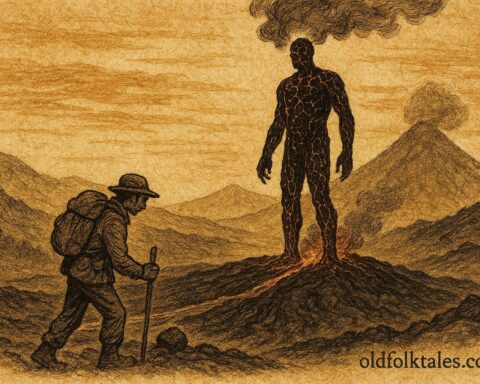
A great, rumbling sigh echoed from the depths of the world. Where Tziquín stood, his body frozen mid-snarl of rage, the earth swelled and rose. He became a mountain of perpetual fury: Volcán de Fuego, the Volcano of Fire. To this day, he roars and erupts, spewing ash and glowing lava, his eternal wrath made manifest in smoke and flame. The constant steam rising from his peak is said to be his hot, angry breath, still trying to claim his stolen bride.
Beside him, where Acotenango had stood his ground, the earth rose in a calmer, more stoic form. He became Volcán de Acatenango, tall, quiet, and dignified. He does not rage, but he occasionally rumbles deep within his core, a low, empathetic growl of solidarity and memory for the love he once defended.
And the princess, Ixmucané, where she knelt weeping, the earth rose with a gentler touch. She became Volcán de Agua, the Volcano of Water. Her slopes are soft and lush, fertile and welcoming. But her deep, wide crater is a basin for the heavens. It fills with the rains, the snows, and the constant mists, the eternal tears she weeps for her lost Acotenango, a sorrow so vast it has become a lake in the sky.
So they stand forever, a family of stone and spirit. The fire of jealousy, the quiet earth of true love, and the endless water of sorrow. They teach that love can shape the world, but so can pride and rage. The landscape itself is their monument, a reminder that the greatest passions of the heart are written not only in stories, but in the very bones of the earth.
The Moral Lesson:
This foundational myth teaches that pride, jealousy, and rage are destructive forces that can lead to eternal sorrow, while true love, though it may end in tragedy, endures in a noble and dignified form. It illustrates that uncontrolled passions can literally reshape the world, leaving a permanent mark of conflict and grief for all generations to witness.
Knowledge Check
Q1: Who are the three main characters in the volcano legend, and whom was the princess promised to marry?
A1: Princess Ixmucané, the warrior Tziquín (her promised husband), and the common farmer Acotenango (her true love).
Q2: What event triggers the fatal duel between Tziquín and Acotenango?
A2: Tziquín discovers that Princess Ixmucané has fallen in love with Acotenango. Enraged by this betrayal of his claim, he challenges the farmer to a duel to the death.
Q3: How does Princess Ixmucané react to the duel, and what does she do?
A3: She is heartbroken and unable to bear the sight. She begs the gods to intervene and stop the conflict before one or both men are killed.
Q4: Which volcano did each character become?
A4: Tziquín became Volcán de Fuego (Fire). Acotenango became Volcán de Acatenango. Princess Ixmucané became Volcán de Agua (Water).
Q5: What specific natural phenomena are explained by their transformed states?
A5: Fuego’s constant eruptions are Tziquín’s eternal rage. Acatenango’s occasional rumbles are Acotenango’s solidarity. Agua’s crater fills with rain, representing Ixmucané’s endless tears.
Q6: What two cultural traditions does this foundational myth come from?
A6: It originates from both Kaqchikel Maya and Ladino (Spanish-influenced) traditions of Guatemala, blending indigenous and colonial storytelling to explain a major geographical feature.
Cultural Origin: Guatemalan Folktale (Kaqchikel Maya & Ladino).
Source: Recorded in collections like Miguel Ángel Espino’s Leyendas de Guatemala and documented in Revista Tradiciones de Guatemala (USAC).