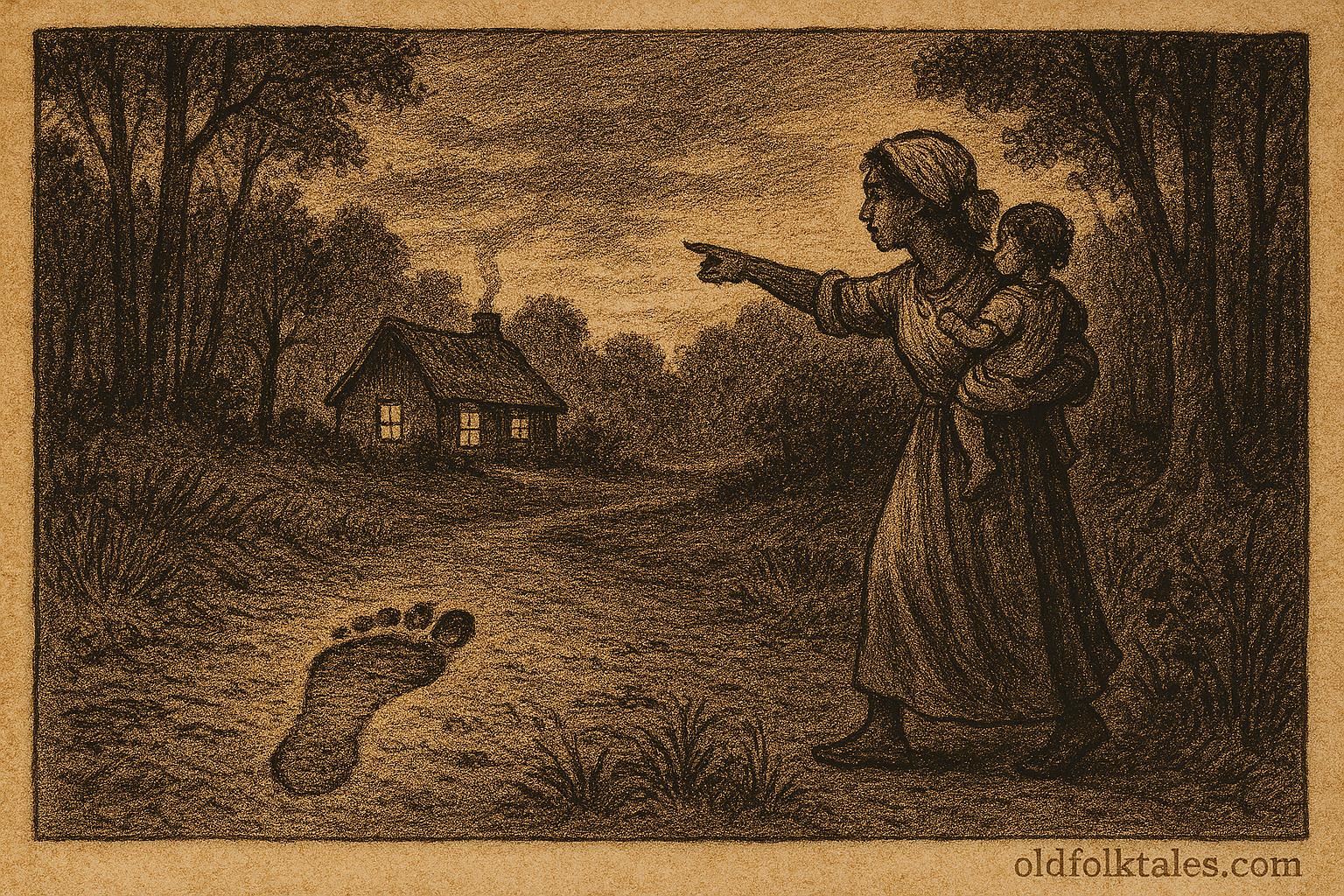
In the soft, purple light of a Trinidadian dusk, when the day creatures grow quiet and the night chorus has not yet begun, a different kind of sound can sometimes be heard from the edge of the forest. It is not the call of a bird or the rustle of an animal. It is a small, plaintive voice, calling a child’s name with perfect, heartbreaking familiarity. The wise know to close their windows tight and gather their young close, for that voice belongs not to a friend, but to a Douen.
The Douen are perhaps the most sorrowful of all the island’s spirits. They are not monsters of malice, but children of profound loss. In the old beliefs, they are the souls of infants and young ones who died before they could be baptized, before they received a Christian name and blessing. Denied entry into heaven, they are trapped forever on the edges of our world, unable to move on, caught in a twilight existence.
Their appearance is a reflection of their incomplete state. They are small, child-sized figures, forever naked, their skin the color of dusk-shaded earth. But their faces are blank and smooth, lacking the features that define a person, they have no nose, no mouth, only the suggestion of hollows where eyes might be. This gives them a silent, watching stillness that is deeply unnerving. Their most famous and unsettling feature is their feet. They are turned completely backward, so that their heels point forward and their toes point behind them. When they walk, their footprints in the soft mud or sand appear to be heading in the direction opposite to their travel, a confusing and ghostly trail.
They dwell in the liminal spaces, the shadowy fringes where the forest meets the cleared land, the tangled banks of slow-moving rivers, and the misty edges of swamps. They do not live; they linger. Their existence is one of profound loneliness and yearning, and this defines their only real activity: mimicry.
As darkness deepens, a Douen will hide in the tall grass or behind a mango tree, watching a village home where living children play. It will listen, learning the voice of a mother calling her son to supper, or the sing-song call of a sister to her brother. Then, it will use that stolen voice. “Come, come with me!” it will call, sweet and clear, from the deepening shadows of the bush. “Look what I have found over here!” The voice is an exact replica, a perfect, loving trap.
A child, not yet wise to the world’s deceptions, might hear their own mother’s voice and run toward it without thinking, leaving the safety of the yard. The Douen will continue to call, leading the child deeper and deeper into the wilderness, its backward-footed form always just out of sight, a flicker among the trees. The path grows unfamiliar, the lights of home vanish, and the child becomes utterly, hopelessly lost in the dark.
That is the Douen’s sad magic. It does not wish to harm the child, but to claim it as a companion for its eternal loneliness. Some tales say that a child lost to the Douen for too long may fade from our world entirely, becoming a Douen themselves, another nameless, faceless soul added to the mournful troop on the forest’s edge.
Because of this, the legend served a vital, protective purpose. Parents would use the story as a firm warning to their children: Never answer a call from the bush after dark. If you hear your name, run inside, not out. It taught children critical discernment and the danger of straying from known safety. More profoundly, it reinforced a powerful cultural and religious imperative: newborns must be christened quickly. The ceremony was not just a formality; it was a spiritual safeguard, a shield that would secure the child’s soul against this tragic, ghostly fate, no matter what might come.
So, the Douen remain, a whisper on the wind, a set of backward footprints leading nowhere. They are a reminder of loss, a caution against the dangers of the untamed edges, and a poignant lesson in the responsibilities of the living to protect the most vulnerable among them, in this life and for the next.
The Moral Lesson:
The legend of the Douen serves as a powerful cautionary tale with dual purposes. It teaches children the critical importance of obeying parental warnings, staying within safe boundaries, and being wary of deceptive calls. For adults, it reinforces the profound communal and spiritual responsibility to properly integrate new life through ritual (christening), thereby protecting the innocent from a lost and lonely fate.
Knowledge Check
Q1: Who are the Douen in Trinidadian folklore?
A1: They are the sorrowful, trapped spirits of children who died before being baptized. They are forever stuck between worlds, unable to enter heaven.
Q2: What are the two most distinctive physical features of a Douen?
A2: They have featureless faces (no nose or mouth) and, most famously, their feet are turned completely backward.
Q3: What is the primary behavior of a Douen, and what is its goal?
A3: They mimic the voices of parents or friends to lure living children away from home and into the wilderness. Their goal is not to harm, but to gain companionship for their eternal loneliness.
Q4: What specific danger do the Douen pose to a living child?
A4: They lead children deep into the forest or swamps until the child is hopelessly lost. In some tellings, a child lost for too long may themselves become a Douen.
Q5: What practical warning did this legend provide to children?
A5: It warned them never to answer a call from the bush or forest after dark, even if it sounded like a loved one, and to always run toward home, not toward the voice.
Q6: What cultural and religious practice does this legend directly reinforce?
A6: It reinforces the critical importance of quickly christening or baptizing newborns. The ritual was seen as a necessary spiritual protection to ensure the child’s soul would not become a Douen if they died young.
Cultural Origin: Trinidadian Folklore (Afro-Trinidadian Creole).
Source: Collected in works like Mavis Sieiro’s A Treasure of Trinidad Folk Tales and documented by folklorist J.D. Elder.