At the quiet edge of a Trinidadian village, where the chattering of the day gave way to the chorus of crickets and tree frogs, there often lived an old woman. She was a solitary figure, seen rarely in the bright sun, her form bent and her face a map of deep wrinkles. The villagers gave her a wide berth, speaking in hushed tones. For she was not what she seemed. She was a Soucouyant, one of the most feared beings in all of Caribbean lore.
By day, she was just an old woman, perhaps a bit strange, but harmless. She lived alone in a shack with shuttered windows, the air inside thick with the smell of old herbs and dust. But as the last light of the sun vanished and the moon took its throne, a terrible transformation began. Inside her dark home, she would begin to chant low, forgotten words. Then, with a sound like tearing parchment, she would grasp the wrinkled skin at her neck and peel her entire human form away, shedding it like a snake sheds its old scales. She would carefully hide this empty skin, often in a wooden mortar or a calabash hidden in the rafters.
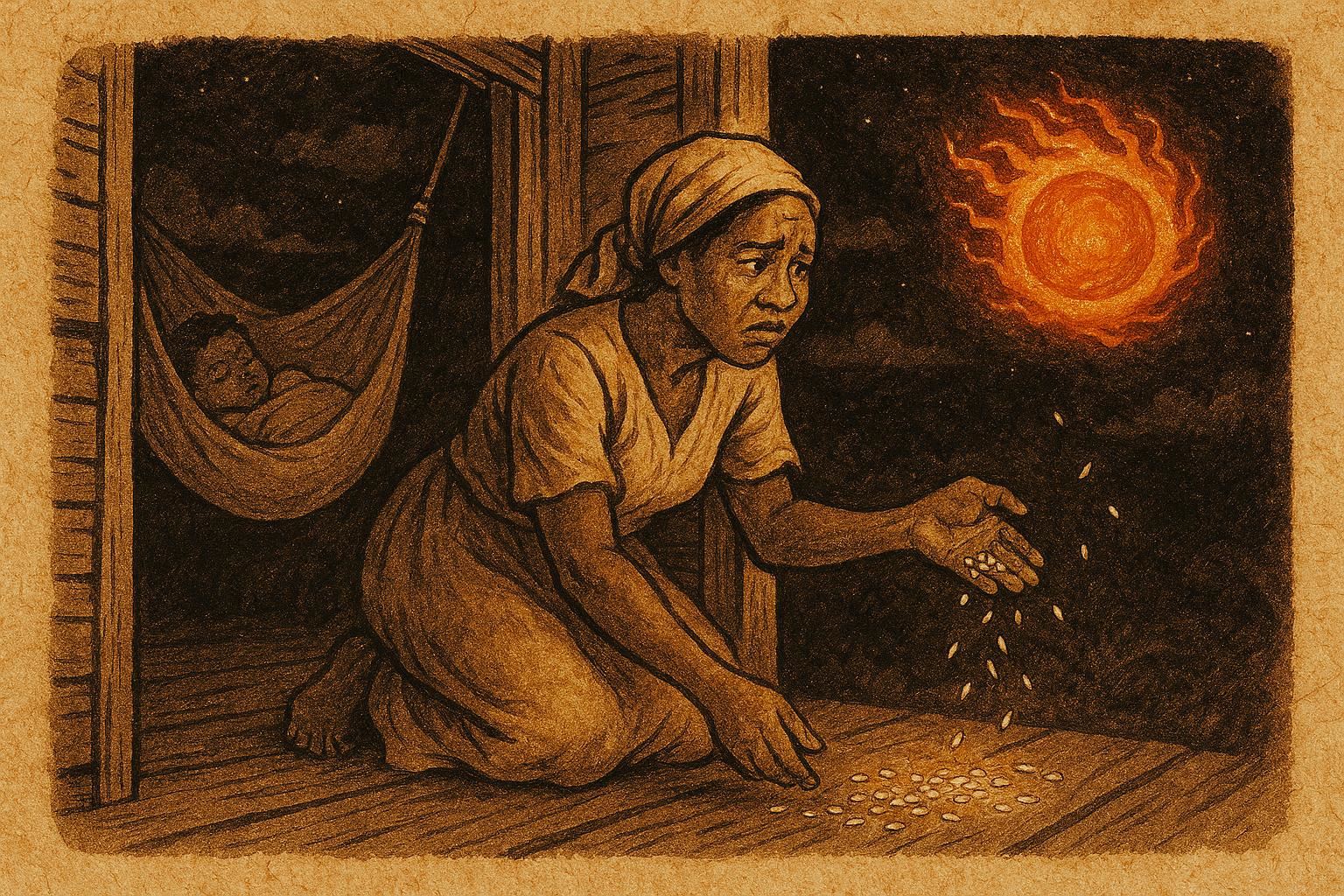
What emerged was a thing of pure nightmare: a searing, silent ball of orange fire, about the size of a large fruit. This was her true form, a blazing orb of malevolent spirit. She would slip through the tiniest crack in her own wall, or through the keyhole of her door, and take to the night sky, moving with a ghostly, floating speed.
Her hunger was for blood, the very life-force of the living. She would seek out homes where people slept soundly, particularly targeting the young, whose blood was rich and pure. Floating through the cracks of a window frame or under a door, she would hover over a sleeping child or infant. Her fire would dim to a soft, haunting glow as she drew close, and she would begin to siphon their blood slowly, leaving them weak and pale. The victim would wake at dawn feeling drained and listless, with tiny, inexplicable pinpricks on their skin,the mark of the Soucouyant’s feast. In the old days, this unexplained weakness was called “fading,” and the diagnosis was whispered with dread.
But the folklore of the people is not just about fear; it is a manual of survival. Knowledge was the first defense. To keep a Soucouyant at bay, you could scatter grains of uncooked rice or coarse salt across your threshold or windowsill. The Soucouyant, in her fiery form, was cursed with a compulsive mind. Upon encountering the scattered grains, she was forced to stop and count every single one before she could enter. It was an impossible task, often lasting until the first rooster’s crow signaled the approaching dawn, forcing her to flee back to her skin before sunrise.
The more permanent solution was destruction. To kill a Soucouyant, one had to be brave and cunning. You had to discover where she hid her human skin. Under the cover of day, when she was at her weakest in her old-woman guise, you would have to search her home. Finding the hidden skin, limp, wrinkled, and empty in its mortar, you would fill it with coarse salt or hot, grinding pepper. Then, you would place it back exactly as you found it.
As dawn approached, the fiery ball would streak back to her home, weary from the hunt. She would rush to her mortar to clothe herself again in her human form. But as she tried to slip back into the skin, the salt or pepper would scorch her spiritual essence with a terrible, burning agony. She would be trapped outside her own flesh, writhing in pain. As the first rays of the sun broke over the mountains, she would begin to plead and beg in a thin, desperate voice for her skin. But if you held strong and did not relent, the sunlight would strike her formless spirit. With a final, sizzling whisper, she would dissolve into nothingness, leaving behind only the scent of sulfur and burnt hair.
The old, empty skin would remain, just a dry, papery thing, proof that the evil had been vanquished.
The Moral Lesson:
The legend of the Soucouyant serves as a powerful cultural warning about the hidden dangers that may lurk within a community and the importance of vigilance. It empowers people with specific, actionable knowledge to protect their families, teaching that even the most terrifying supernatural threats have defined weaknesses that can be exploited through courage, cleverness, and collective wisdom.
Knowledge Check
Q1: What is a Soucouyant, and where does this legend originate?
A1: The Soucouyant is a feared vampire-like creature from Trinidadian folklore, with roots in West African and European vampire lore. By day she appears as an old woman; by night she becomes a fiery ball that seeks blood.
Q2: What is the Soucouyant’s primary method of transformation?
A2: At midnight, she sheds her human skin, hiding it in a container like a mortar. She then transforms into a ball of fire, which is her true, mobile form for hunting.
Q3: Who are the Soucouyant’s preferred victims, and what are the signs of her attack?
A3: She prefers infants or the young. Victims wake feeling weak and anemic (“fading”) with tiny pinprick marks on their skin from where she slowly drained their blood.
Q4: What is one common folk method to prevent a Soucouyant from entering a home?
A4: Scattering uncooked rice or salt at the threshold. The Soucouyant is compelled to stop and count every single grain, a task that delays her until sunrise.
Q5: How can a Soucouyant be permanently destroyed?
A5: By finding her hidden human skin during the day and filling it with coarse salt or pepper. When she tries to re-enter it at dawn, the substance burns her spiritual form, and she perishes with the sunrise.
Q6: What does the Soucouyant legend symbolize in a broader cultural context?
A6: It symbolizes hidden societal dangers, the fear of predation from within the community, and the empowerment that comes from possessing specific knowledge to combat even the most insidious threats.
Cultural Origin: Trinidadian Folklore (Afro-Trinidadian Creole).
Source: Compiled from descriptions in collections like J.D. Elder’s work (via the Caribbean Folklore Project) and C.R. Ottley’s Folklore of Trinidad.