In the beginning, there was Bondye, the Good God, the Gran Mèt, who is so vast and powerful that His presence is like the sky, everywhere, yet impossible to grasp. After He spun the world into being, shaping the mountains of Haiti and filling the seas around her, He saw that the world was beautiful but silent. The deep waters had no ruler; the forests held no guardian; the fiery heart of the forge had no master.
So, from His own boundless spirit, Bondye called forth His children. These were not mortal beings, but the lwa, powerful, immortal spirits, each a blazing facet of His divine will. He gathered them in the misty space between the stars and the sea, a place outside of time.
“My world is complete, yet it is empty of guidance,” Bondye’s voice echoed, calm as a timeless river. “You are my first children, my emissaries. You will go down and give the world its character. You will become its might, its beauty, its essence.”
To the eldest and most commanding, He gave a trident forged from coral and wave. “You, Agwé, shall be Admiral of the Seas. Rule the depths, guide the ships, and command the tides. Your palace is beneath the waves, and your color is the blue of the abyss.” Agwé bowed, salt spray already forming in his beard.
To a spirit with eyes like glowing coals and a stance unyielding as bedrock, He gave a machete of pure iron. “You, Ogou, are the Spirit of Iron, War, and Fire. You are the soldier, the blacksmith, the defender. Your domain is the forge, the battlefield, and all things of strength and justice. Your color is the red of flame and blood.” Ogou saluted, the scent of ozone and hot metal rising around him.
Then came a spirit of breathtaking beauty, whose smile could bring peace and whose tears could bring floods. Bondye presented her with a heart-shaped mirror and a perfumed fan. “You, Ezili Freda, are the Spirit of Love, Beauty, and Desire. You shall hold sway over matters of the heart, over luxury, and sweet waters. Your colors are the pink of roses and the soft white of lace.” Ezili gazed into her mirror, and the first feeling of human longing bloomed in the world.
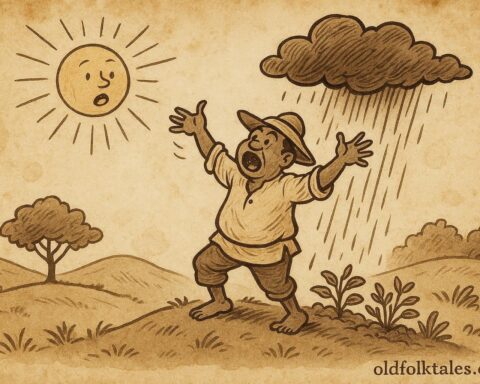
To a spirit with earthy, calloused hands and a simple straw satchel, Bondye gave a sack of seeds and a gourd drinking cup. “You, Azaka, are the Spirit of Agriculture. You are the peasant, the farmer, the provider. Your domain is the fertile field, the harvest, and the humble, sustaining meal. Your colors are the blue of denim and the brown of good soil.” Azaka nodded, the wholesome smell of fresh earth and ripe mangoes following him.
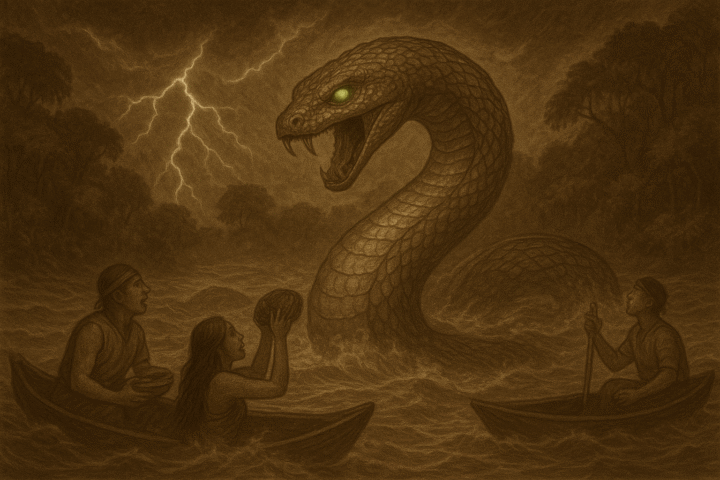
And so it went. Bondye appointed Damballa, the great serpent, as the primal spirit of wisdom and creation, whose color is white. He assigned Ayizan, the elder, as the protector of the marketplace and tradition. To Legba, the eldest, he gave the crucial role of gatekeeper, the opener of doors between worlds, who must always be addressed first.
Finally, there was a group of spirits who hung back, irreverent, grinning, dressed in rags and tall hats. These were the Gede, the spirits of death and rebirth. Bondye turned to them. “Yours is the final domain,” He said, not with sternness, but with understanding. “You are the guardians of the crossroads where life ends. You will oversee the cemetery, the ancestors, and the great turning wheel. Because you face what all others fear, you may speak the raw truth, mock pretension, and remind all that from death comes new life. Your color is the purple of mourning and the black of the tomb.”
The Gede laughed a crackling, bony laugh and began to dance a scandalous, hip-rolling dance right there in the cosmos. For they knew their power: they were the necessary end, the great comedians who make the unbearable bearable.
With their domains assigned, the lwa descended to the world. They did not live apart from it; they became its very nature. Agwé was the commanding storm over the ocean. Ezili was the overwhelming rush of first love. Azaka was the satisfaction of a full belly after hard work. Ogou was the righteous anger against oppression. The Gede were the laughter at a funeral that turns grief into memory.
And that is why, in Haiti, the world is alive with spirit. The sea has a temper, the forest holds wisdom, the soil has generosity, and even death has a sense of humor. For the world is not ruled by a distant, silent god, but is tended by His mighty, passionate, and sometimes rowdy children, the lwa, who walk the line between the divine and the human, forever part of the land they call home.
The Moral Lesson:
This foundational myth explains the order and personality of the natural and spiritual world. It teaches that divine power is not singular and remote, but is distributed into specific, accessible forces that govern every aspect of life, death, and the human experience, requiring respect, acknowledgment, and relationship.
Knowledge Check
Q1: Who is Bondye in Haitian Vodou cosmology, and what is His primary action in this myth?
A1: Bondye is the supreme, distant creator God. In this myth, His primary action is creating the lwa (spirits) as His children and assigning them specific domains to rule over and embody within the world.
Q2: What are the lwa, and how do they differ from Bondye?
A2: The lwa are the powerful spirit children of Bondye. They act as intermediaries between humans and the supreme God, each possessing distinct personalities and ruling over specific aspects of nature and human life (sea, war, love, agriculture, death, etc.).
Q3: What is the domain of the Gede spirits, and why is their behavior often crude or comedic?
A3: The Gede rule over death, the cemetery, and rebirth. Their crude, sexual, and comedic behavior embodies the cycle of life and death, using humor and shock to demystify death, break down barriers, and affirm that regeneration follows endings.
Q4: Name three lwa mentioned in the tale and their primary associations.
A4: Agwé (the sea/sailors), Ogou (iron/war/fire), Ezili Freda (love/beauty), Azaka (agriculture), Legba (gatekeeper/crossroads), Damballa (wisdom/creation). (Any three suffice).
Q5: What is the core purpose of this type of mythological story within Haitian culture?
A5: Its purpose is to explain the origin and functions of the Vodou spirits, forming the foundational cosmology that describes how the spiritual world is structured and how it interacts with and influences the human world.
Q6: How does the myth explain the “character” or personality of the natural world in Haiti?
A6: It asserts that the natural world has character because it is inhabited and governed by the lwa. The sea has Agwé’s temper, love carries Ezili’s passion, and the soil holds Azaka’s generosity, making the world spiritually alive.
Cultural Origin: Haitian Vodou Mythology, Haiti.
Source: Based on common tales from the oral tradition of Haitian Vodou, as reflected in collections by Suzanne Comhaire-Sylvain and others.