In the depths of the great Amazon forest, where the rivers twist like silver serpents and the trees rise higher than smoke, there once lived a boy named Arua. He was quiet and gentle, often found wandering alone near the forest edge, listening to the sounds that others ignored. While other children laughed and played, Arua would sit beneath the trees, whispering softly to the animals.
The people of his village thought him strange. “He talks to birds and frogs,” they said. “He does not belong with us.” But Arua did not mind. He felt the forest listening. The rustle of leaves, the murmur of the wind, and the distant growl of jaguars all seemed to speak in a language he could almost understand.
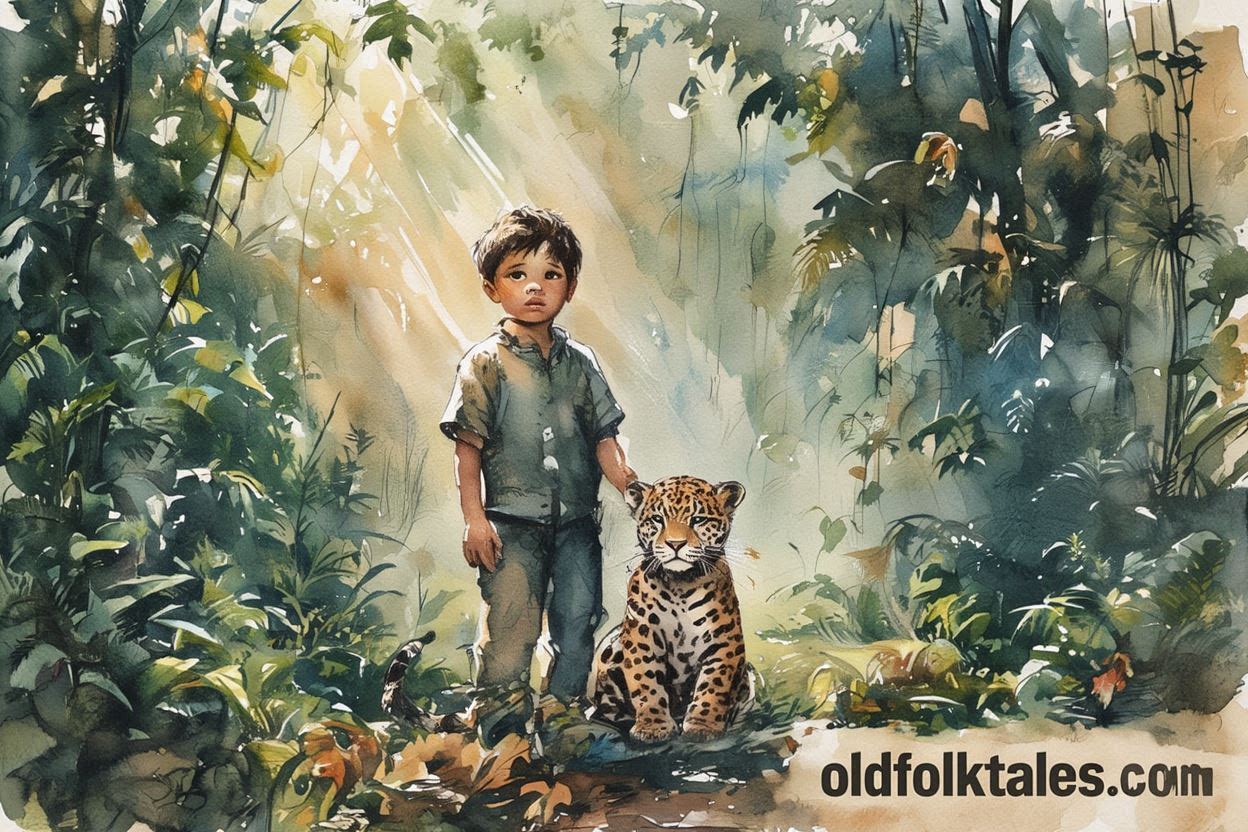
One evening, while collecting fruit, Arua heard a faint cry nearby. Following the sound, he found a small jaguar cub caught in a hunter’s snare. Its golden fur was matted with dirt, and its eyes were wide with fear. Carefully, Arua knelt beside it. “Do not be afraid,” he whispered. “I will help you.”
Explore French-Canadian legends and First Nations myths in our Canadian Folktales collection
The cub stopped struggling and stared at him. To Arua’s surprise, he heard a voice in his mind. “You are not like the others,” the cub said. “They bring pain. You bring quiet.”
Arua’s heart filled with wonder. “I can hear you,” he said softly. “You can speak.”
“I can speak because you listen,” the cub replied.
Arua freed the snare, and the little jaguar limped into the shadows. But it returned the next morning, waiting by the river. From that day on, Arua and the cub became inseparable. They roamed the forest together, sharing food and stories. The boy learned the ways of the jungle from his new friend, how to track by scent, how to move without sound, and how to drink from the dew of leaves when rivers ran low.
Seasons passed, and the cub grew strong and sleek, his fur shining like the sunlit canopy. But trouble came when hunters from a faraway village entered the forest. They set traps and carried spears tipped with poison, seeking jaguar skins to trade for silver. One night, as Arua slept, distant cries shattered the silence. He ran toward the sound and found the mother jaguar—great and beautiful—fallen under the hunters’ weapons. The cub roared in grief, and Arua felt the pain pierce his own heart.
The hunters saw the boy and shouted. “Keep away! This beast is dangerous!” But Arua stood between them and the cub. “She was not your enemy,” he cried. “She hunted only what she needed. You have taken what cannot be replaced.”
The hunters turned away, muttering that the boy had lost his mind. When they were gone, Arua knelt beside the fallen jaguar and wept. The cub pressed close to him, trembling. “They will never understand,” it said. “Their hearts are full of fear.”
Arua looked to the sky. “Then I will make them understand,” he whispered.
He climbed the tallest tree, higher and higher until the branches trembled beneath him. He raised his voice to the heavens, calling to the spirits of the forest. “Ancient ones,” he cried, “let my words be carried by the wind. Teach humans and animals to live as one. Let fear become peace.”
The air grew still. Then the forest began to hum a deep, low sound that echoed through the roots of trees and the wings of birds. From the mist rose the Spirit of the Forest, shimmering in green and gold.
“You have spoken with a heart pure and full of love,” the Spirit said. “You shall not be forgotten.”
The Spirit touched Arua’s forehead, and his voice spread across the jungle, carried by the leaves and the river. Every creature heard it, from the smallest insect to the mightiest jaguar. Even the hunters, deep in their camp, paused as a strange calm washed over them. They looked into the darkness and saw not enemies, but kin.
When the dawn came, Arua and the cub were gone. Some say the boy became a spirit himself, guardian of the jaguars. Others say he still walks the forest paths, his eyes glowing faintly in the moonlight, ensuring that balance is kept between all living things.
And in the deepest parts of the Amazon, when the wind sighs through the trees, the elders say you can still hear his soft and steady voice reminding all who listen that peace is born not from power, but from understanding.
Explore the ancestral legends of Canada, Mesoamerica, and South America’s Indigenous tribes.
Moral Lesson
True harmony begins when we listen with compassion. The bond between humans and nature is sacred, and balance can only be kept through respect and understanding.
Knowledge Check
1. Who is Arua in the story?
Arua is a boy who can communicate with animals and becomes a friend to a jaguar cub.
2. What does Arua do when he finds the cub?
He frees it from a hunter’s trap and befriends it.
3. What tragedy happens in the story?
Hunters kill the cub’s mother, causing grief for both the boy and the jaguar.
4. What does Arua ask the forest spirits for?
He asks for peace and understanding between humans and animals.
5. How does the Spirit of the Forest respond to Arua’s plea?
It spreads his voice across the jungle, teaching balance and empathy to all beings.
6. What is the lasting message of Arua’s story?
That coexistence is possible when humans treat nature with respect and compassion.
Source: Adapted from Yanomami oral traditions in Shamanic Tales of the Amazon by Bruce Albert (1995), Caracas: Fundación La Salle de Ciencias Naturales.
Cultural Origin: Yanomami (Brazil and Venezuela)