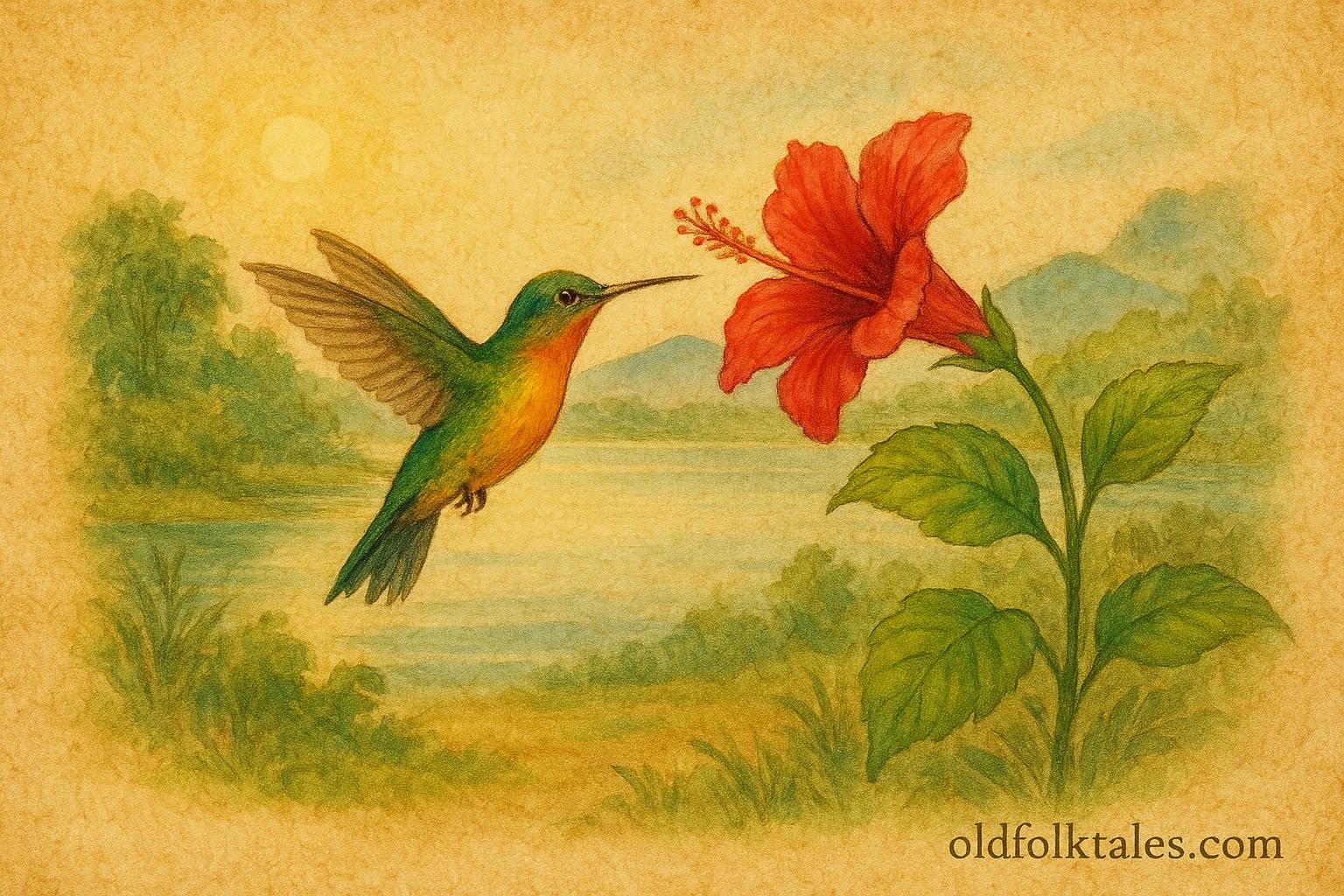
In the lush, green heart of ancient Guatemala, where the winds carried songs from the mountains and the sun painted gold across the fields, the hummingbird came to life. The gods, seeing the earth covered in silent flowers that could not move or speak, decided to create a small, swift creature to bring them joy.
From sunlight and wind, they shaped a tiny bird, delicate as a whisper, bright as a jewel. The hummingbird shimmered in hues of emerald, sapphire, and ruby, its wings beating so fast that it seemed to float in midair. Wherever it flew, it carried laughter, warmth, and a touch of divine magic.
The flowers, though rooted in the soil, now had reason to smile. The hummingbird visited each one, telling stories of faraway meadows and the secrets of the breeze. He sipped nectar gently and carried their pollen to others, connecting the silent beauties of the land in a cycle of color and life. The gods watched with delight, for harmony had come to the world.
Among the flowers, one was different, a radiant red blossom that grew at the edge of a tranquil lake. Each morning, she waited eagerly for the hum of wings and the flash of iridescent color. When the hummingbird hovered near, her petals trembled with joy. She began to love him, not only for his beauty but for the spirit of life he carried wherever he went.
“Stay with me,” she whispered one day as the morning sun glistened upon her dew-draped petals. “Do not fly away. Let us share our days together.”
The hummingbird paused, his tiny heart full of kindness. “Dear flower,” he said softly, “I cannot stay. I was made to move, to visit every bloom, to carry their joy from one to another. If I stop flying, I will die.”
Tears welled within the flower’s heart. She wanted to hold him close, to keep him always near, but she saw the truth in his eyes, love could not grow in captivity. “Then go,” she whispered, “and take my love with you. Let it bloom in every place you visit.”
The hummingbird touched her petals one last time, a kiss as fleeting as the breath of dawn, and darted into the golden sky. From that day, every time a hummingbird visits a flower, it is said to be a brief reunion, a kiss of remembrance between two souls who once loved purely.
And when the wind carries the hum of tiny wings through the gardens of Guatemala, the flowers still whisper to one another: “Love is not possession, but freedom, a gift to cherish and release.”
Moral Lesson
True love is not about holding on but allowing freedom to flourish. Affection is most beautiful when it is selfless and free, just like the hummingbird’s dance among the flowers.
Knowledge Check
1. Who created the hummingbird in the folktale?
The gods created the hummingbird to bring joy and connection to the flowers of the world.
2. What emotion does the story primarily explore?
The folktale explores love, particularly the balance between affection and freedom.
3. Why couldn’t the hummingbird stay with the flower?
The hummingbird explained that he was created to fly and spread life among flowers; if he stopped moving, he would die.
4. What does the flower’s acceptance symbolize?
It symbolizes understanding, selfless love, and the wisdom to let go for the happiness of another.
5. What lesson about love does the folktale teach?
It teaches that true love is not about possession but about allowing others the freedom to fulfill their purpose.
6. Where does this story originate?
The story originates from the Kaqchikel-Maya people near Lake Atitlán, Guatemala.
Source: Adapted from the Kaqchikel-Maya folktale “The Hummingbird and the Flower” in Mayan Folktales: Folklore from Lake Atitlán, Guatemala, ed. James D. Sexton.
Cultural Origin: Guatemala (Kaqchikel-Maya folklore)