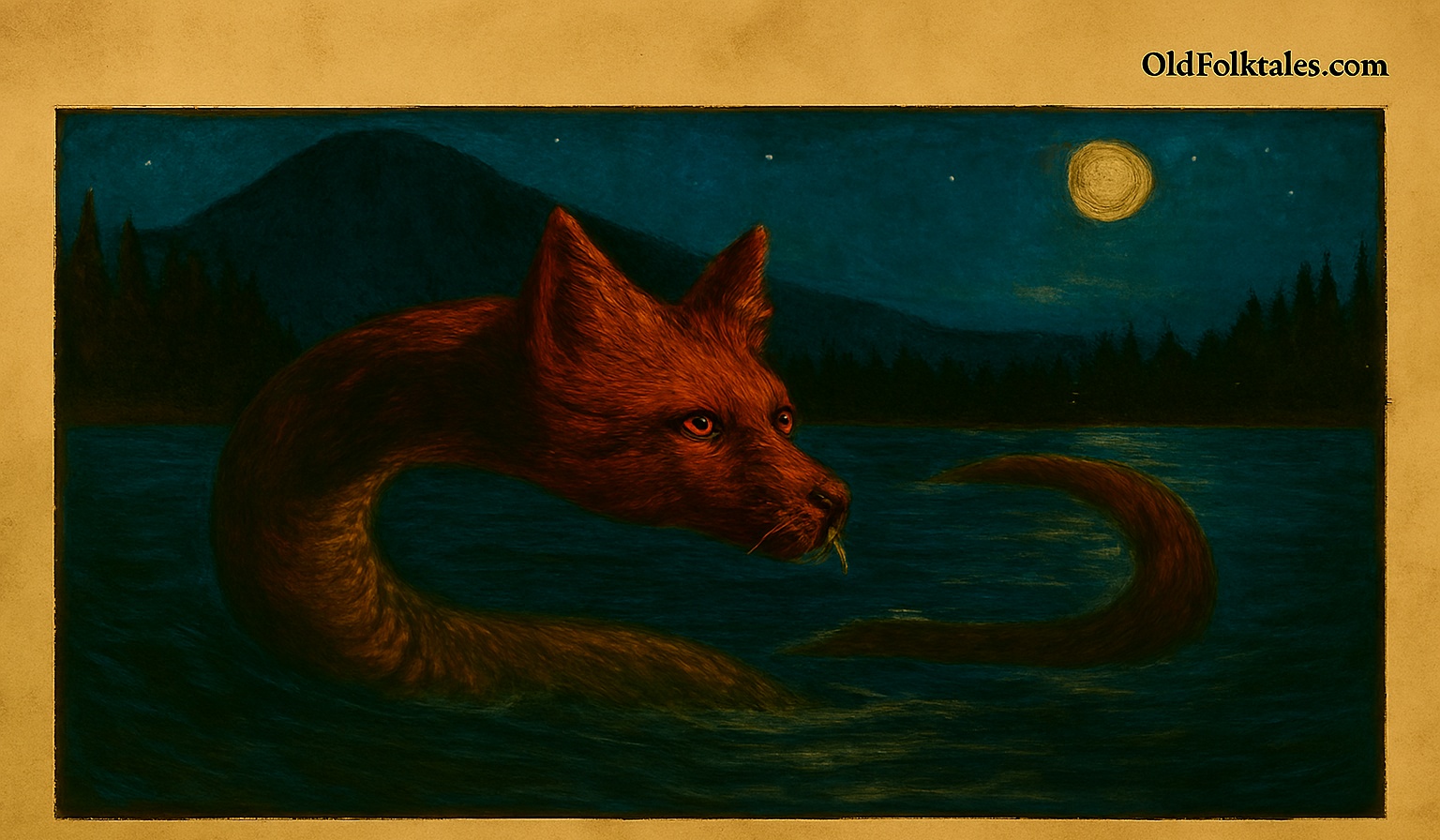
In the cool, rushing rivers that cascade down from the Andes mountains through the forests of southern Chile, the Mapuche people have always known that not everything beneath the water’s surface is what it seems. Among the most feared and respected of all the spirits that inhabit these waterways is the Nguruvilu, a creature whose very name, meaning “fox-serpent,” hints at its dual nature and deadly cunning.
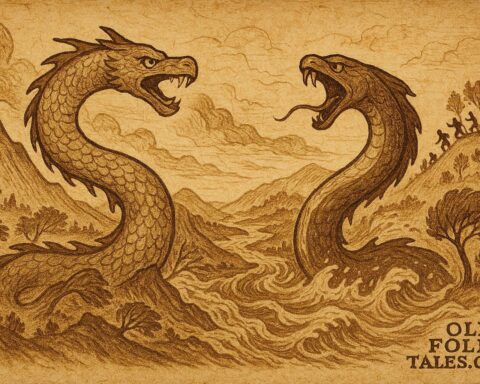
The Nguruvilu is no ordinary river dweller. Its body is a strange and unsettling fusion of two powerful animals: it possesses the clever, alert head of a fox, complete with pointed ears and sharp, knowing eyes that gleam with intelligence. Its front legs, too, are those of a fox, strong and agile. But where a fox’s body would taper to a bushy tail, the Nguruvilu’s form extends into a long, sinuous serpent’s body that coils and twists through the river currents like a living rope. Most fearsome of all is its tail tipped with a curved, hooked claw as sharp as any blade, capable of snagging anything that comes within reach.
Click to read all South American Folktales — timeless stories from the Andes to the Amazon.
For generations, Mapuche families living near certain rivers knew which fords and crossing points demanded special caution. A river might appear shallow and peaceful on the surface, its water sparkling innocently in the sunlight, its current seeming gentle enough for a child to wade through. But appearances in Nguruvilu territory were always deceiving. Beneath that placid surface, the fox-serpent waited, an animate presence bound to its particular stretch of water as firmly as the rocks that lined the riverbed.
The elders would tell stories around evening fires, warning the young ones about the creature’s methods. The Nguruvilu did not simply attack, it was far too clever for that. Like the fox whose head it bore, it was patient, strategic, calculating. It would lie in wait beneath the surface, its serpentine body pressed against the river bottom, invisible to those above. When a person or animal entered the water to cross, thinking the ford safe and the journey easy, the Nguruvilu would strike.
With a powerful lash of its tail, the creature could whip the water into a sudden, violent whirlpool. What had been calm would become chaos in an instant water churning, current pulling, the solid ground beneath one’s feet suddenly unreliable. Those caught in such a whirlpool would struggle, disoriented, as the water seemed to turn against them with malevolent intent.
But the whirlpool was not the Nguruvilu’s only weapon. That hooked claw at the end of its tail was designed for a more direct assault. As a person or animal waded through what they believed to be safe water, the creature would swing its tail through the current and snag their legs with that terrible hook. Once caught, there was little hope. The Nguruvilu would pull with the strength of the river itself, dragging its victim beneath the surface, down into the dark depths where the current was strongest and escape was impossible.
Livestock were particularly vulnerable. Horses being led across fords would suddenly rear and scream, their legs seized by something unseen beneath the water. Cattle crossing to graze on the far bank might disappear without warning, pulled under so quickly that those watching from shore could do nothing but witness the tragedy. Dogs that ventured too deep to drink or play would yelp once and vanish into a sudden swirl of disturbed water.
The Mapuche understood that the Nguruvilu was not merely wild magic or random danger, it was an animate presence, a being with its own will and territorial nature, bound to specific streams and passes. Different rivers had different spirits, and some were known to be home to particularly aggressive or powerful Nguruvilu. These were not creatures that roamed freely; each was anchored to its domain, a guardian or perhaps a predator of its particular stretch of water.
Because of this, communities developed specific practices for dealing with the fox-serpent. Certain fords known to be Nguruvilu territory were approached with ritual caution. Before crossing, travelers might leave small offerings at the water’s edge food, flowers, or other tokens asking the spirit’s permission to pass safely. These were not superstitious gestures but practical acknowledgments of the power that dwelt in that place.
Some communities were fortunate enough to have specialists among them wise people or ritual experts who knew the proper rites to placate an angry Nguruvilu or, in extreme cases, to drive one away from a crossing that had become too dangerous. These individuals possessed knowledge passed down through generations, understanding the words that needed to be spoken, the gestures that must be made, the offerings that would satisfy the spirit’s demands.
When unexplained whirlpools appeared in previously calm waters, or when a particular ford became the site of repeated drownings and disappearances, people would point to the Nguruvilu as the cause. The creature’s activity explained the geography of danger in the rivers why one crossing was safe while another, seemingly identical, was deadly. This understanding shaped how communities interacted with their waterways, where they built their settlements, which routes they took, and how they taught their children to respect the water.
Parents would take their children to the riverbank and speak seriously about what lived beneath the surface. They would point out the places where the water swirled in odd patterns, where the current seemed stronger than it should be, where the depth was difficult to judge. “The Nguruvilu may be there,” they would say, and the children would learn to read the river not just as water and rock, but as the home of a powerful spirit that demanded respect.
The fox-serpent’s legend served multiple purposes in Mapuche life. It was a cosmological explanation for natural phenomena the dangerous currents and whirlpools that appeared without obvious cause. It was a practical warning system, teaching people to approach certain waterways with heightened awareness and caution. And it was a reminder of the Mapuche worldview, in which spirits were not abstract concepts but real beings intimately tied to specific places in the landscape.
The rivers themselves were seen differently through the lens of the Nguruvilu’s presence. They were not simply resources to be used or obstacles to be crossed, but living places inhabited by beings with their own agency and power. A river with a Nguruvilu was a river that must be negotiated with, respected, and sometimes avoided altogether.
Explore myths and legends from Brazil, Peru, and Argentina rooted in spirit and survival.
The Moral Lesson
The legend of the Nguruvilu teaches us profound respect for the natural world and the hidden dangers it may contain. Appearances can be deceiving what seems safe and peaceful may harbor real threats beneath the surface. The story reminds us that wisdom comes from listening to those with experience, honoring the knowledge passed down through generations, and approaching unfamiliar territories with appropriate caution and humility. It also illustrates the importance of ritual and respect when engaging with forces more powerful than ourselves, showing that acknowledgment and proper conduct can mean the difference between safety and disaster.
Knowledge Check
Q1: What does the Nguruvilu look like in Mapuche mythology? A: The Nguruvilu is a hybrid creature with the cunning head and forelegs of a fox, combined with a long serpentine body. Its most distinctive feature is its tail, which ends in a sharp, hooked claw used to snag victims and drag them underwater.
Q2: What does the name “Nguruvilu” mean and why is it significant? A: “Nguruvilu” means “fox-serpent” in the Mapuche language, directly describing the creature’s dual nature. This name is significant because it captures both aspects of the spirit the fox’s cunning intelligence and the serpent’s aquatic, sinuous danger.
Q3: How does the Nguruvilu attack people and animals crossing rivers? A: The Nguruvilu uses two primary methods of attack: it can lash its tail to create sudden whirlpools that disorient and overwhelm victims, or it can use the hooked claw at the end of its tail to snag the legs of people and animals, dragging them beneath the water’s surface to drown.
Q4: Why are certain river crossings more dangerous than others in Nguruvilu territory? A: Each Nguruvilu is bound to a specific stretch of river or particular ford, making some crossings more dangerous than others. The creature is a territorial spirit that inhabits certain waterways, so communities learned which specific locations required extra caution or ritual preparation.
Q5: How did Mapuche communities protect themselves from the Nguruvilu? A: Communities would leave offerings at the water’s edge before crossing, asking the spirit’s permission to pass safely. Some communities had ritual specialists or wise people who knew proper rites to placate an angry Nguruvilu or drive it away from dangerous crossings. People also learned to read rivers carefully and avoid known Nguruvilu territory when possible.
Q6: What cultural and practical purposes does the Nguruvilu legend serve? A: The legend serves as both a cosmological explanation for dangerous river currents and whirlpools, and a practical warning system teaching people to approach waterways with caution. It encodes respect for rivers as living places inhabited by powerful spirits, and reinforces the Mapuche worldview that spirits are bound to specific geographical locations and must be properly acknowledged.
Source: Adapted from Mapuche oral traditions as documented in ethnographic sources including early informants such as Lehmann-Nitsche and Tomás Guevara,.
Cultural Origin: Mapuche Indigenous People, Southern Chile and Argentina (Araucanía Region and Patagonia)