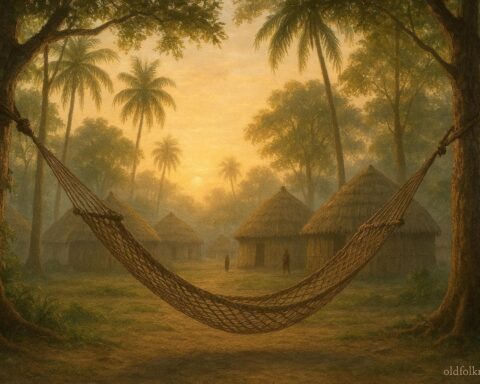
Long ago, in the ancient city of Mexico-Tenochtitlán, when its canals still mirrored the stars and the scent of copal drifted from temple fires, there lived a woman whose beauty was known across the land. She was of noble Indigenous birth, proud, graceful, and kind, beloved by her people and admired even by the Spaniards who had newly come to conquer her world.
When the soldiers of Spain took the city, one among them, a young Spanish cavalier, saw her and was entranced. He wooed her with the polished words of his homeland, promising eternal love, marriage, and a life of comfort. His charm and fine clothes dazzled her, and his vows melted her heart. Against the warnings of her elders, she trusted him, believing that love could bridge the gulf between conqueror and conquered.
Click to read all South American Folktales — timeless stories from the Andes to the Amazon.
From their union came two children, whose laughter filled her humble home by the water’s edge. To them, she gave all her tenderness; to him, all her devotion. For years she lived in hope that he would make good on his promises, that she, though born of the old world, would be received into the new.
But the day of betrayal came, as surely as a storm breaks calm skies.
One morning, as she carried fresh flowers to his house, she found it adorned for a wedding. The Spanish cavalier, her lover, the father of her children, was marrying a woman of his own race, a noble lady brought from across the sea.
Her heart shattered. The world that had once been her home now felt like a cage.
The Descent into Sorrow
For days, she wandered the streets in silence, her hair unbound, her eyes hollow. The people who saw her whispered of madness, for she no longer ate or slept. She roamed the edges of the lake, clutching her children to her breast, whispering prayers that turned to sobs.
One moonlit night, under a sky heavy with stars, grief overcame her reason. Standing at the water’s edge, her reflection trembling on the surface, she cried to the heavens:
“If he has taken my heart, what remains for me in this world?”
The wind gave no answer. Only the rippling of the lake replied, like a thousand sighs.
In a frenzy of anguish and despair, she turned upon her children, not in hatred, but in the terrible blindness of pain, and one by one, she drowned them in the dark waters. When the last ripple faded, she fell to her knees, her cry echoing across the sleeping city.
At dawn, the fishermen found the lake still and her shawl tangled among the reeds. She was gone. Some said she sank into the depths, others that the spirits took her away.
But that night, a sound rose over the water, a long, piercing wail, neither of this world nor the next:
“¡Ay, mis hijos! ¡Mis hijos!, Oh, my children! Where shall I find them?”
From then on, the people of the valley said her soul could find no rest.
The Haunting of the Canals
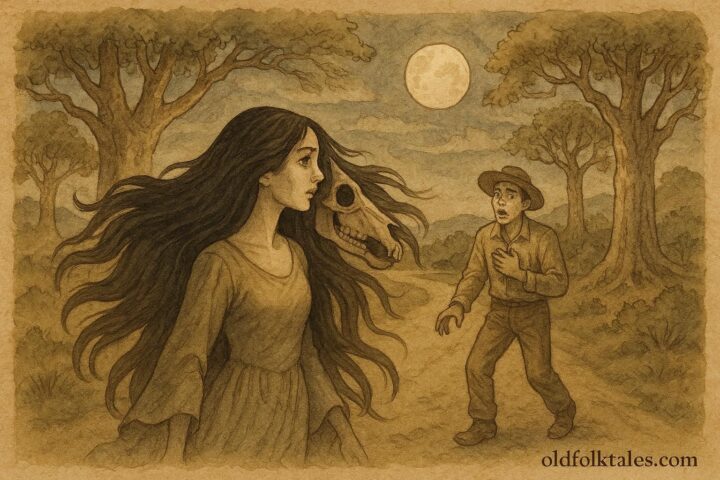
Each night, as the mist curled along the canals, her ghost returned, a woman in white, veiled and weeping. She glided past the stone bridges and shadowed alleys, her footsteps silent, her tears endless. Those who dared follow her vanished before the dawn.
Some said she searched for her lost children, doomed to wander until she found them. Others whispered that she took other children to replace her own. Mothers began to warn their sons and daughters:
“Do not stray after dusk. Stay away from the riverbanks, for La Llorona walks when the moon is high.”
Even priests spoke of her from the pulpit, calling her the price of sin and sorrow, a soul trapped between guilt and grace. In her grief, she became both a warning and a prayer: a mother punished, a spirit pitied.
The Legend Lives On
Centuries passed, and the city grew, temples gave way to churches, canoes to carriages, and still the people of Mexico spoke her name in whispers.
Even now, on quiet nights when the wind stirs the jacaranda trees and the moon shimmers upon the lakes of Chapultepec, her cry is said to rise once more:
“¡Ay, mis hijos!”
It floats through time like a lament older than the conquest itself, the voice of a woman whose love, betrayed and broken, became eternal.
Moral Lesson
La Llorona reminds us that passion without wisdom and promises broken by betrayal bring only ruin. Her tale speaks of the fragile boundary between love and madness, sin and sorrow, a cry that still warns against deceit and faithlessness.
Knowledge Check
- Who is La Llorona in Mexican folklore?
La Llorona, or “The Weeping Woman,” is the spirit of a mother who drowned her children and wanders the night in sorrow. - What does La Llorona’s cry mean?
Her famous cry, “¡Ay, mis hijos!” (“Oh, my children!”), expresses eternal grief and remorse for her lost children. - What cultural traditions shaped the legend of La Llorona?
The tale blends Indigenous Nahua beliefs about female spirits (Cihuateteo) with Spanish Catholic teachings on sin, penance, and the afterlife. - What moral lesson does La Llorona teach?
It warns against uncontrolled passion, betrayal, and the spiritual consequences of broken promises. - Why do people still fear La Llorona?
Her ghost is believed to haunt rivers and lakes, especially at night, luring those who wander too close to the water. - What is the historical origin of La Llorona’s legend?
The story dates back to 16th–17th century colonial Mexico, during the merging of Indigenous and Spanish worldviews after the conquest.
Source: Adapted from Legends of the City of Mexico by Thomas A. Janvier (1890), Project Gutenberg.
Cultural Origin: Mexico (Colonial-era legend blending Nahua and Spanish traditions).