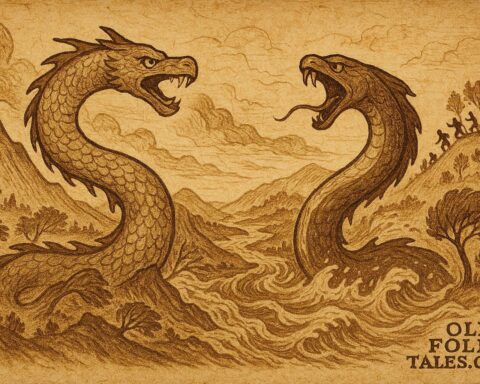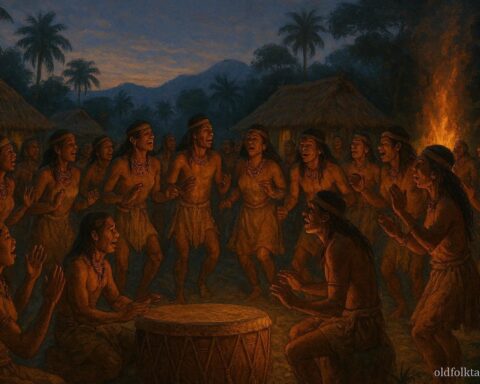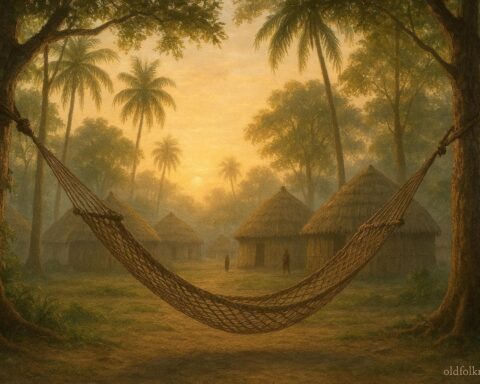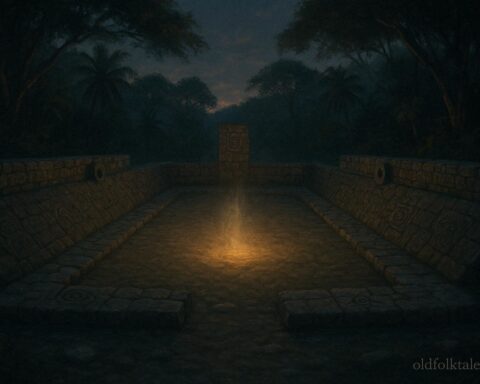
In the rolling foothills of southern Chile, where the Andes mountains cast long shadows over ancient forests and the wind carries whispers of old magic, the Mapuche people have long told stories of beings that walk between worlds. Among these tales, none is more haunting than that of the Anchimayén, the small transforming creature that dances through the night sky as a ball of fire.
Long ago, in a remote village nestled between mountains and rivers, there lived a kalku, a figure who walked the dangerous path between healer and sorcerer. The kalku possessed knowledge of both the medicine that saved lives and the dark arts that could bend the natural world to human will. This particular kalku had grown hungry for power, unsatisfied with the respect the community already offered. He wanted more, he wanted to command forces that others feared to touch.
Click to read all South American Folktales — timeless stories from the Andes to the Amazon.
In his obsession, the kalku turned his attention to the most forbidden of practices. He sought to create an Anchimayén, a being that would serve his purposes and extend his influence beyond the boundaries of ordinary life. To accomplish this terrible transformation, he would need to cross a line that should never be crossed, he would need a child.
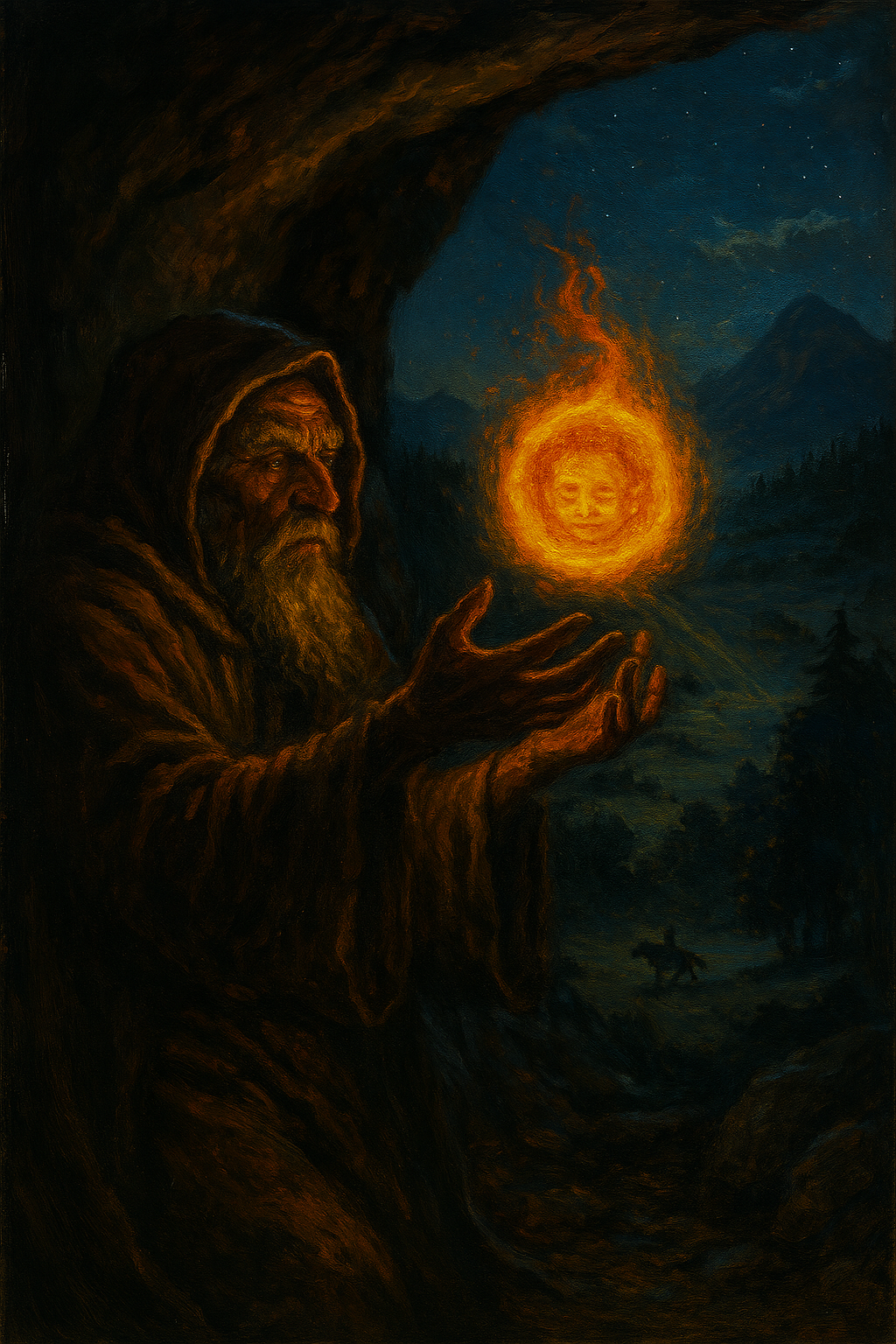
The kalku found what he sought: a young child from the village, innocent and unaware of the dark fate that awaited. Through rituals performed in the depths of a hidden cave, where sunlight never penetrated and the earth itself seemed to hold its breath, the sorcerer worked his magic. Ancient words were spoken, offerings were made to spirits that dwelt in shadow, and slowly, terribly, the transformation began.
The child’s human form became something else something that existed between the world of flesh and the world of spirit. By day, the Anchimayén remained in the cave, hidden away from the light that might reveal its true nature. But when darkness fell and the stars emerged above the Chilean landscape, the creature would emerge.
As it left its stone prison, the Anchimayén would transform into a brilliant, glowing orb, a fireball that streaked across the night sky. Witnesses who saw it described a luminous sphere that moved with purpose and intelligence, unlike any natural phenomenon. It would fly over the fields where farmers had worked during the day, soar above the forests where ancient trees stood sentinel, and weave between the peaks of mountains that had watched over the Mapuche people for generations.
Animals sensed the Anchimayén’s presence before humans did. Horses would whinny and stamp in their corrals, dogs would howl at the sky, and even the boldest hunting cats would retreat into the undergrowth. The livestock grew restless when the glowing being passed overhead, as if they could feel the wrongness of its existence, a child’s spirit trapped in a form created by dark sorcery.
The villagers soon began to notice the strange lights that appeared in the night. At first, they might have mistaken them for shooting stars or distant fires, but the pattern was too regular, too purposeful. The orbs would appear night after night, following paths that seemed to have meaning, hovering over certain homes or fields as if watching, waiting, serving some mysterious purpose known only to the kalku who controlled them.
Fear crept into the community like morning fog. Parents kept their children close after dark. Travelers refused to journey at night, preferring to make camp and wait for dawn rather than risk encountering the Anchimayén on lonely paths. The elders spoke in hushed voices about the thin boundary between the everyday world and the supernatural realm—a boundary that the kalku had violated with his forbidden transformation.
The presence of the Anchimayén served as a constant reminder of powers that humans should not wield. It represented the danger of seeking control over forces meant to remain wild and free. The glowing child-spirit became a symbol of what happens when ambition overrides wisdom, when the desire for power leads someone to sacrifice innocence itself.
In the Mapuche understanding of the world, night is not merely the absence of day, it is its own realm, with its own rules and inhabitants. The Anchimayén belonged to this night world, forever moving through darkness, neither fully alive nor truly free. Its existence spoke to the active presence of sorcery and the forces of nature that continued to shape the lives of the people, whether they acknowledged them or not.
The story spread from village to village, carried by traders and travelers, whispered around fires and taught to children as a warning. The Anchimayén remained in the cave during daylight hours, but its nocturnal flights continued, a reminder that the spiritual world pressed close against the physical, separated only by a veil that could be torn by those reckless or dark-hearted enough to try.
The Moral Lesson
The tale of the Anchimayén teaches us about the grave consequences of pursuing power without moral restraint. When we sacrifice innocence in our quest for control over forces beyond our understanding, we create something unnatural something that brings fear rather than benefit to our communities. The story reminds us that there are boundaries in life that exist for good reason, and crossing them in service of personal ambition corrupts not only ourselves but also those around us. True wisdom lies in respecting the balance between the seen and unseen worlds, and recognizing that some powers should remain untouched.
Explore myths and legends from Brazil, Peru, and Argentina rooted in spirit and survival.
Knowledge Check
Q1: What is an Anchimayén in Mapuche mythology? A: An Anchimayén is a supernatural creature in Mapuche belief, often described as a transformed child or child-like being that serves a kalku (sorcerer). It can transform into a glowing fireball or luminous orb that flies through the night sky, representing the dangerous intersection of sorcery and the supernatural world.
Q2: Who creates the Anchimayén and why? A: The Anchimayén is created by a kalku, a figure who practices sorcery and dark magic. In the story, the kalku creates this being from a child through forbidden rituals in pursuit of greater power and influence beyond normal human capabilities.
Q3: What does the Anchimayén’s transformation into a fireball symbolize? A: The transformation into a glowing orb symbolizes the corruption of innocence through dark magic and represents the thin boundary between the physical and spiritual worlds. It embodies the unnatural consequences of using sorcery to control forces that should remain free.
Q4: How do animals react to the presence of the Anchimayén? A: Animals sense the Anchimayén’s presence instinctively and react with fear and agitation. Horses become restless, dogs howl, and even predatory cats retreat, as they can feel the wrongness of this magically created being that exists between worlds.
Q5: What cultural significance does the Anchimayén have in Mapuche tradition? A: The Anchimayén represents the active presence of sorcery and supernatural forces in Mapuche cosmology. It serves as a reminder that the spiritual and physical realms exist side by side, and that night is its own domain with unique powers and inhabitants that must be respected.
Q6: What is the primary warning or lesson in the Anchimayén story? A: The story warns against pursuing power through immoral means and violating natural boundaries between worlds. It teaches that sacrificing innocence for personal ambition has terrible consequences, and that certain forces and practices should remain untouched out of respect for cosmic balance.
Source: Adapted from Mapuche oral traditions and mythology as documented in the “Anchimayen” article
Cultural Origin: Mapuche Indigenous People, Southern Chile and Argentina (Patagonia Region)