In the vast, windswept expanses of Patagonia, where the land stretches endlessly beneath skies so immense they seem to swallow the horizon, and where the cold waters of the Atlantic crash against rugged shores, the Tehuelche people made their lives as hunters and wanderers. They were a hardy folk, adapted to the harsh beauty of their homeland a place where guanacos roamed in herds across the plains, where rheas sprinted on powerful legs, where pumas stalked in shadows, and where survival required both courage and respect for the fierce powers that ruled land and sea.
The Tehuelche knew their world was populated not just by the animals they hunted and the plants they gathered, but by ancient spiritual forces beings of immense power who could intervene in human affairs, who could transform the natural world according to their will, who demanded acknowledgment and respect. Among these powerful beings was one named Gosye, whose authority extended across both terrestrial and aquatic realms, whose moods could reshape reality itself.
Click to read all South American Folktales — timeless stories from the Andes to the Amazon.
The story the elders tell begins with an act of injustice that would have terrible consequences. Gosye’s nephew, a young man of considerable promise, had been captured by a group of hunters. Whether this capture was the result of conflict, misunderstanding, or deliberate provocation, the tales do not say clearly. What matters is that Gosye’s nephew was held prisoner, and the powerful being would not tolerate such an affront.
Gosye’s rage was cold and calculated rather than hot and impulsive. He did not simply strike down the hunters who had dared to imprison his kinsman. Instead, he conceived of a punishment more terrible, more comprehensive something that would not just free his nephew but would teach all the Tehuelche people to fear his power and respect his authority.
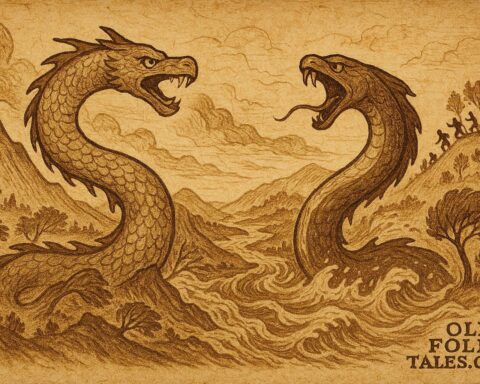
From the depths of the cold Southern Ocean, Gosye summoned forth a creature of nightmare the Tehuelche Whale, known in some versions of the tale as Goos. This was no ordinary whale that swam peacefully through the seas, no gentle giant that fed on tiny creatures strained through baleen. This was a monster, a corruption of nature, a being that embodied the most terrifying aspects of both land and sea.
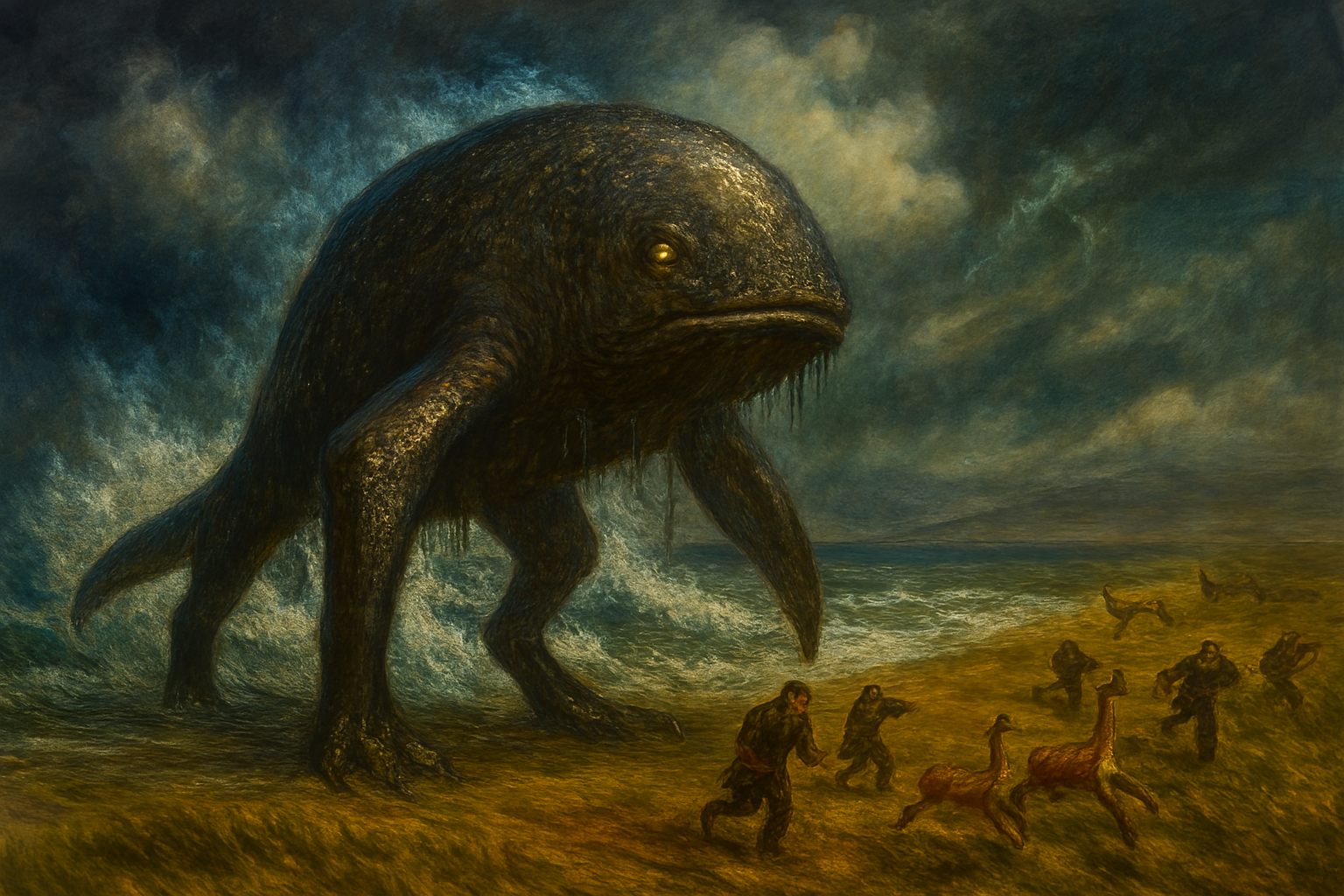
The Tehuelche Whale was immense beyond comprehension, its body as large as several guanacos placed end to end, its bulk sufficient to crush anything in its path. But what made it truly horrifying was not its size alone, it was its form. This creature, though clearly related to the whales that dwelt in the ocean, possessed something no whale should have: legs.
Thick, powerful limbs extended from its massive body not the elegant flippers that allow marine mammals to swim with grace, but actual terrestrial legs, slow and ponderous but undeniably functional. These legs allowed the Tehuelche Whale to leave the ocean’s embrace and move upon the land itself, crossing the boundary that should have separated the aquatic and terrestrial worlds.
The sight of this abomination emerging from the waves must have been beyond terrifying. Imagine standing on the Patagonian shore, perhaps hunting for seals or gathering shellfish, and seeing this enormous creature haul itself from the surf water cascading from its vast body, its legs moving with deliberate, unstoppable determination, its size blocking out the sun, its very existence a violation of natural order.
Gosye gave his creation a terrible mission: devour the hunters and animals of the region until his nephew was freed. The Tehuelche Whale was not simply an instrument of rescue it was an engine of devastation, a punishment visited upon an entire people for the actions of a few.
And so the monster began its reign of terror across Patagonia. It moved slowly across the land, its massive legs carrying its bulk with the inexorable patience of a glacier. Nothing could outrun it forever in that open landscape. Nothing could hide from something so large it could survey vast distances. Nothing could stand against its power.
The Tehuelche Whale devoured everything in its path. Hunters who had stalked guanaco across the plains found themselves becoming prey, swallowed whole by the creature’s cavernous mouth. The guanacos themselves, swift and alert as they were, fell victim to the monster. Rheas, despite their incredible speed, could not escape indefinitely. Even the fierce pumas, apex predators of the region, became meals for this greater predator.
The creature moved between land and sea with disturbing fluidity. When it had terrorized one area sufficiently, it would return to the ocean, its legs carrying it back into the waves, its body disappearing beneath the surface. Then it would emerge elsewhere along the coast, beginning its destructive march anew. No community was safe. No hunting ground remained secure. The entire region lived under a shadow of dread.
The Tehuelche people were faced with an impossible situation. They were hunters their entire way of life depended on pursuing game across the open plains. But how could they hunt when something far more dangerous was hunting them? They were a proud people who had survived countless hardships through courage and skill, but what courage could stand against a creature sent by divine power? What skill could defeat something that should not even exist?
Desperation spread through the scattered bands of the Tehuelche. Families debated whether to abandon their traditional territories entirely, to flee north or inland, away from the coast where the monster emerged. But where could they go? The Tehuelche Whale was not confined to the shore it roamed deep into the interior on its impossible legs. And besides, leaving their homeland meant abandoning everything that made them who they were the hunting grounds their ancestors had known for generations, the sacred sites where they communed with spiritual powers, the very land that held their identity.
Some among the Tehuelche understood the deeper message. This was not random catastrophe but targeted punishment. Gosye had sent this horror for a reason his nephew remained imprisoned. Until that injustice was resolved, the monster would continue its rampage. The creature was simultaneously a ransom demand and an ongoing punishment, its very existence a demonstration of what happened when you offended beings of great power.
The hunters who had captured Gosye’s nephew faced a terrible reckoning. Their people were suffering because of their actions. Every person devoured by the Tehuelche Whale, every animal destroyed, every family driven to starvation when hunting became impossible all of it could be laid at their feet. The weight of community judgment, combined with the reality of ongoing devastation, finally broke their resistance.
They released Gosye’s nephew. Whether this release was motivated by genuine remorse, by pragmatic recognition of untenable circumstances, or by direct coercion from their terrified communities, the result was the same. The young man was freed, allowed to return to his powerful uncle.
And with his nephew’s freedom, Gosye’s purpose was satisfied. The powerful being called back his monstrous creation. The Tehuelche Whale, which had terrorized Patagonia for a time that felt eternal to those who suffered through it, returned to the ocean. Its massive legs carried it back into the surf one final time. It dove beneath the waves, its enormous body disappearing into the cold depths.
But the creature did not simply vanish as though it had never existed. According to the Tehuelche understanding, the whale-monster remained in the ocean, transformed back into something more properly aquatic, its terrestrial legs either reabsorbed into its body or retained in some altered form. It became part of the natural order again, or as natural as something born from divine intervention could be. It existed now at the boundary between normal and supernatural, between whale and something other.
The Tehuelche people remembered. They told the story to their children and their children’s children, ensuring that no one would forget what had happened when powerful beings were offended. They looked at the ocean with new understanding, recognizing that the boundary between land and sea was more permeable than it appeared, that creatures could cross from one realm to another when spiritual forces willed it.
They saw in the Tehuelche Whale a lesson about the interconnection of all things in their world. The land and the sea were not separate domains but parts of a continuum. The animals they hunted were not mere resources but participants in a web of relationships that included humans and spiritual powers alike. Actions had consequences that rippled outward, affecting entire communities and landscapes.
When the Tehuelche hunted near the shore, they remembered the monster that had once walked on those beaches. When they saw whales breaching in the distance, they wondered if ancient power still resided in those massive forms. When storms came from the sea with unusual violence, some whispered that perhaps Gosye was stirring again, that perhaps the Tehuelche Whale remained ready to be summoned should humanity forget the lessons it had learned.
The legend lived in their consciousness as a reminder that survival in the wild environment of Patagonia required more than physical skill and courage. It required respect for forces beyond human control, acknowledgment that the world contained powers that could unmake the natural order if provoked, understanding that the relationship between humans and the spiritual forces governing nature was delicate and must be carefully maintained.
Explore myths and legends from Brazil, Peru, and Argentina rooted in spirit and survival.
The Moral Lesson
The legend of the Tehuelche Whale teaches that actions have far-reaching consequences that can affect entire communities, not just those directly involved. It emphasizes the importance of respecting powerful spiritual forces and avoiding actions that provoke divine retribution. The tale shows that the natural world contains boundaries that can be crossed when supernatural powers intervene, reminding us that land and sea, human and animal, natural and spiritual are all interconnected. Most profoundly, it warns that survival in harsh environments requires not just physical prowess but also wisdom about maintaining proper relationships with the forces that govern nature, and that injustice against those connected to power invites catastrophic punishment that innocent people may suffer.
Knowledge Check
Q1: What was the Tehuelche Whale and what made it so terrifying? A: The Tehuelche Whale, sometimes called Goos, was a monstrous creature summoned from the ocean by the powerful being Gosye. What made it uniquely terrifying was that despite being whale-like, it possessed thick, functional terrestrial legs that allowed it to leave the water and move across land. This made it a violation of natural boundaries a sea creature that could hunt on land, combining immense size with the ability to pursue prey anywhere in Patagonia.
Q2: Why did Gosye create and send the Tehuelche Whale to terrorize Patagonia? A: Gosye sent the monster as punishment and coercion after hunters captured and imprisoned his nephew. Rather than simply attacking those directly responsible, Gosye conceived a more comprehensive punishment, a creature that would devour hunters and animals throughout the region until his nephew was freed, teaching all Tehuelche people to fear his power and respect his authority.
Q3: How did the Tehuelche Whale hunt and what did it consume? A: The creature moved slowly but inexorably across the land on its powerful legs, its immense size allowing it to survey vast distances in the open Patagonian landscape. It devoured everything in its path,Tehuelche hunters who became prey, guanacos and rheas despite their speed, and even fierce pumas. It could move between ocean and land, emerging from the waves at different coastal locations to terrorize new areas.
Q4: How did the Tehuelche people finally end the monster’s reign of terror? A: The terror ended when the hunters who had captured Gosye’s nephew finally released him under the weight of community pressure and the ongoing devastation. Once the nephew was freed and returned to his powerful uncle, Gosye’s purpose was satisfied. He called back his monstrous creation, and the Tehuelche Whale returned to the ocean, diving beneath the waves and transforming back into something more properly aquatic.
Q5: What does the Tehuelche Whale represent about the boundary between land and sea? A: The Tehuelche Whale represents the permeability of boundaries between land and sea when spiritual forces intervene. It demonstrates that these realms are not separate domains but parts of a continuum that powerful beings can cross or manipulate. The creature’s existence challenged the natural order, showing that the distinction between terrestrial and aquatic could be violated when divine power willed it, reflecting the Tehuelche understanding of an interconnected world.
Q6: What deeper cultural meaning does this legend hold for the Tehuelche people? A: The legend teaches that survival in Patagonia’s harsh environment requires more than physical skill it demands respect for spiritual forces and understanding of interconnected relationships between humans, animals, land, sea, and divine powers. It emphasizes that individual actions can have community-wide consequences, that offending those connected to powerful beings invites catastrophic punishment, and that the natural world contains forces capable of unmaking normal reality. The story serves as a cautionary reminder to maintain proper relationships with the spiritual powers governing nature.
Source: Adapted from “The legend of the tehuelche whale”
Cultural Origin: Tehuelche people of Patagonia, southern Argentina and Chile