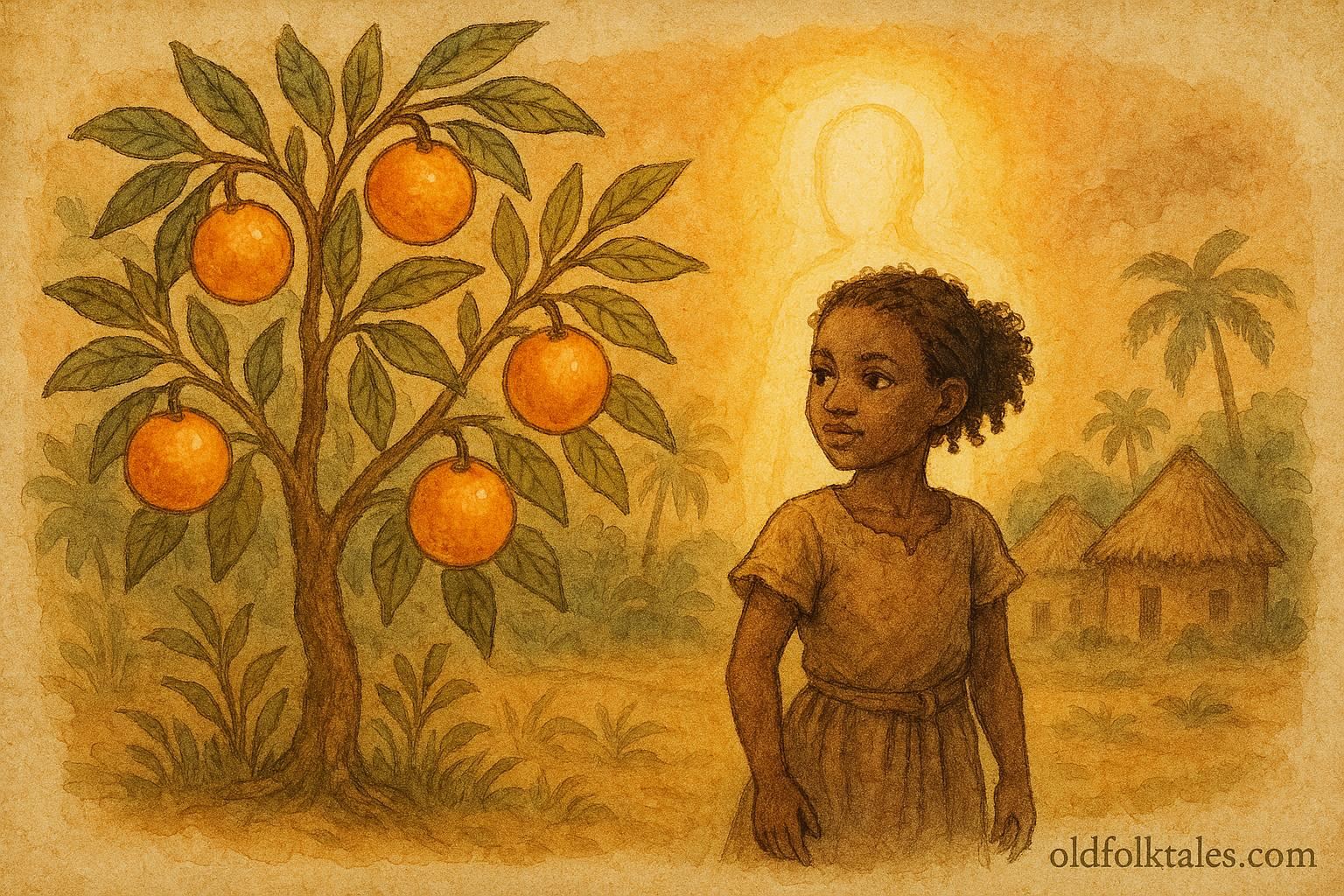
In the sun-drenched countryside near Port-au-Prince, Haiti, there once lived a little girl known for her kindness and her soft, singing voice. After her mother’s death, her father remarried a woman with two daughters of her own. This stepmother, proud and cruel, favored her own children while treating the poor girl like a servant.
Each morning, the girl fetched water from the well, swept the yard, and cooked meals she was never allowed to eat. The stepmother and her daughters dined on rice and mango, while the little girl received only scraps or nothing at all. Yet even through hunger, she never lost her gentle nature or her song.
One day, weak from starvation, the girl wandered into the dusty road leading toward the forest. Sitting beneath a tamarind tree, she began to sing softly to herself. Her melody was so pure and sorrowful that the wind carried it into the heart of the woods. There, a spirit of the forest, an old, unseen lwa who guarded nature’s gifts, listened.
The spirit appeared before her in the form of a warm, glowing light and asked, “Little one, why do you cry?”
The girl bowed her head. “Because I am hungry,” she said, “and my stepmother will not feed me.”
The spirit smiled and held out a small orange seed, bright as gold. “Plant this, child,” the spirit said. “But remember: the fruit of this tree will belong only to the one who planted it with a pure heart.”
The girl thanked the spirit and hurried home, clutching the seed to her chest. In the yard, where the soil was dry and cracked, she dug a small hole and gently buried the seed. Then she sang the same tune she had sung in the forest, her voice trembling but hopeful.
That night, as she slept under the stars, the earth stirred. By morning, a tall orange tree had sprung up in the yard, its branches heavy with glowing fruit. The air filled with the scent of citrus so sweet that neighbors came to see the miracle.
When the little girl reached out and plucked an orange, the tree swayed gently, as if bowing to her. But when the stepmother tried, the branches whipped around her, pushing her back. Furious, she ordered her daughters to climb the tree, yet the trunk became slippery as glass, and they slid to the ground. The girl, however, sang once more, and the branches lowered themselves, offering her fruit so ripe it glowed like the sun.
News of the magic tree spread quickly. People came from distant villages to taste the fruit, but the girl shared it freely, saying, “The spirit gave this blessing to fill empty stomachs, not greedy hands.” Every day, the oranges replenished themselves.
But the stepmother’s jealousy grew like a shadow. She watched as the villagers praised the girl, calling her “Ti Fi Zoranj”, the Girl of the Orange Tree. Enraged, she plotted to steal the fruit for herself.
One moonlit night, when the girl was asleep, the stepmother crept into the yard with a knife. She whispered, “If I cannot eat the fruit, I will cut down the tree!” But the moment her blade touched the bark, a great wind rose. The branches whipped out, striking her to the ground. The tree’s roots shook the earth until the stepmother fled screaming into the darkness, never to return.
The next morning, the girl wept, not out of anger, but sorrow for the wickedness that greed could bring. She continued to care for the tree, and soon the villagers helped her build a small home nearby. From then on, she shared her endless harvest with the poor, ensuring that no child in her village went hungry again.
And whenever travelers passed through Port-au-Prince and tasted the sweetest oranges they had ever known, they remembered Ti Fi Zoranj, the little girl whose kindness had fed a nation.
Moral Lesson
Kindness bears fruit that greed can never steal.
Knowledge Check
1. Who is Ti Fi Zoranj in Haitian folklore?
Ti Fi Zoranj, meaning “the Girl of the Orange Tree,” is a symbol of kindness and innocence in Haitian folktales.
2. What magical gift does the forest spirit give the girl?
The spirit blesses her with a single orange seed that grows into a tree bearing endless fruit.
3. What happens when the stepmother tries to steal the fruit?
The tree’s branches strike her down, showing that greed and cruelty cannot claim divine blessings.
4. What does the orange tree symbolize in the story?
It represents generosity, purity of heart, and the rewards of compassion.
5. How does Ti Fi Zoranj use her blessing?
She shares the fruit freely with her village, helping the hungry and poor.
6. What is the moral lesson of The Magic Orange Tree?
The tale teaches that true kindness creates abundance, while greed destroys itself.
Source: Adapted from The Magic Orange Tree and Other Haitian Folktales by Diane Wolkstein (Schocken Books, 1978).
Cultural Origin: Haiti (Port-au-Prince region – Haitian folklore).