Deep within the Amazon rainforest, where the canopy stretches like a emerald ceiling and sunlight filters through layers of leaves in scattered golden shafts, where the air hangs thick with moisture and the chorus of howler monkeys mingles with the calls of toucans and macaws, there exists a realm ruled not by men but by an ancient guardian. This is the domain of the Curupira, protector of all living things that grow, crawl, fly, and root beneath the forest’s verdant embrace.
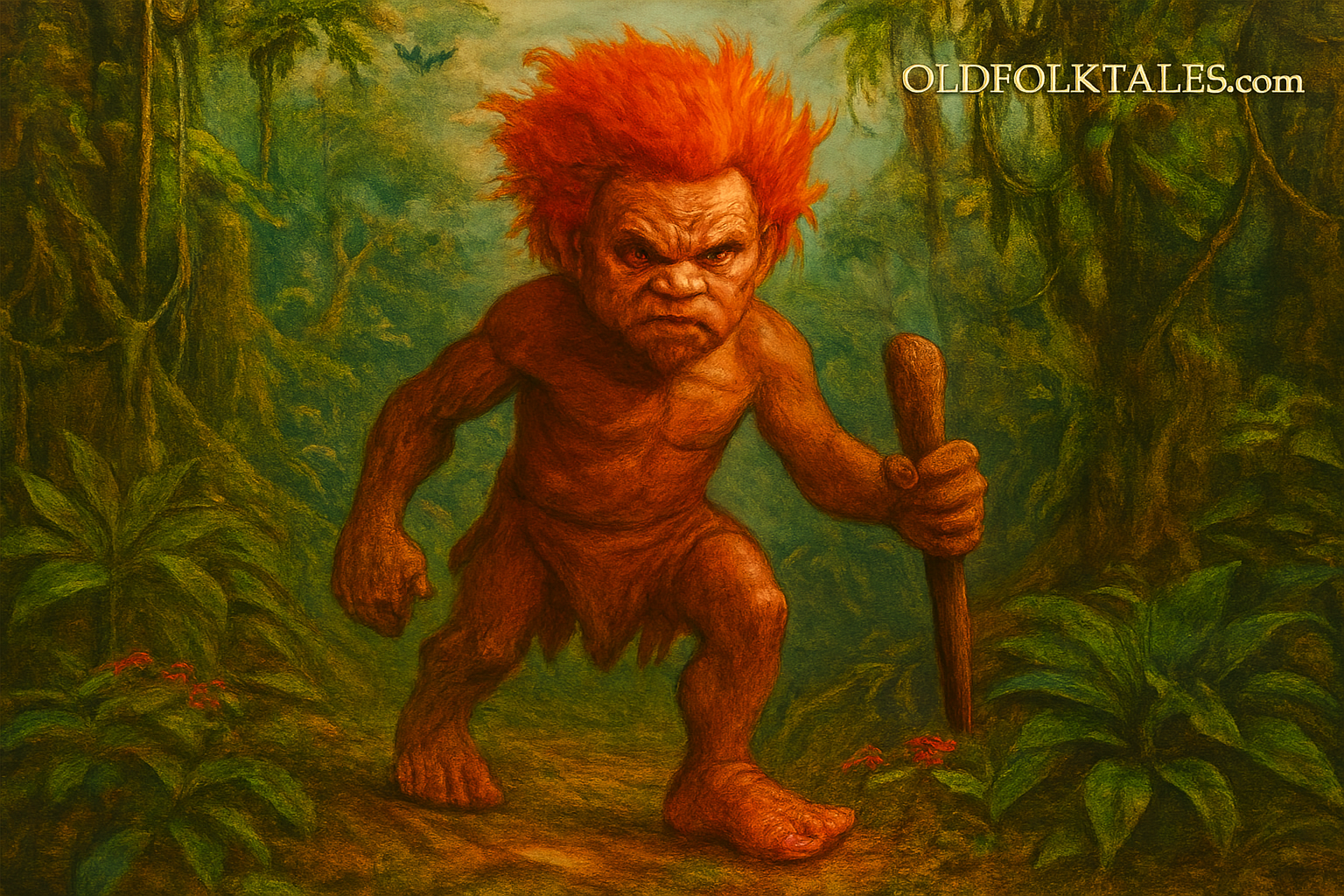
The Curupira appears as a small figure, no taller than a young boy, with skin the color of burnished copper and wild hair that blazes red as flames leaping from a fire. But what marks him as truly extraordinary, what sets him apart from any human or animal, are his feet. They are turned completely backward, with heels pointing forward and toes facing behind, as if he walks perpetually in the wrong direction. Yet this strange deformity is no accident of nature but rather a deliberate gift, a magical defense against those who would harm his forest home.
For generations, the indigenous peoples of the Amazon have known his name and respected his power. Elders teach children from their earliest years: “The forest is alive. The forest watches. And the Curupira sees all.”
Click to read all South American Folktales — timeless stories from the Andes to the Amazon.
One day, a hunter from a distant village decided to venture deep into the untouched heart of the forest. His name was João, and he was known throughout his region as a skilled tracker and fearless woodsman. But João had grown greedy. No longer content with taking only what his family needed to survive, he had begun hunting for sport and profit, killing jaguars for their pelts, capturing rare birds to sell in the cities, and felling mahogany trees to trade for gold.
“Why should I fear old stories?” João scoffed when his grandmother warned him. “The Curupira is nothing but a tale to frighten children. I go where I please, and I take what I want.”
His grandmother shook her head sadly, her weathered face creased with worry. “The forest has eyes, João. Show respect, or it will show you none in return.”
But João laughed and shouldered his rifle, his machete gleaming at his belt, his heart hardened by greed.
As he pushed deeper into the forest than he had ever ventured before, following animal trails and cutting through thick undergrowth, João noticed something peculiar. He kept seeing fresh footprints pressed into the muddy earth, small human-like tracks that seemed to be heading in the same direction he was traveling. The prints were oddly shaped, but João paid them little mind.
“Someone else must be hunting these woods,” he muttered, quickening his pace to stake his claim first.
He followed the tracks for hours, pushing through curtains of hanging vines, wading across shallow streams, climbing over massive fallen logs draped with orchids and moss. The forest grew darker and more dense, the canopy above so thick that little light penetrated. Strange birds called with voices he had never heard before. The very air seemed to vibrate with an ancient, watchful presence.
Still, he pursued those mysterious footprints, convinced they would lead him to the richest hunting grounds. But as the sun climbed high and then began its descent, João realized with growing unease that he should have reached some landmark, some clearing, some sign of the forest’s edge. Instead, he found himself going in circles, passing the same strangled fig tree, the same oddly shaped boulder, the same stream he had crossed hours before.
“This is impossible,” he said aloud, his voice swallowed by the dense vegetation. “I never lose my way.”
Then he heard it: a whistle, clear and melodious, coming from somewhere ahead. Relief flooded through him. Another person! Someone who could guide him out. He hurried toward the sound, calling out, “Hello! I’m here! Can you help me?”
But when he reached the spot where the whistle had originated, he found nothing but empty forest. The whistle came again, this time from behind him. He spun around, confused and increasingly frightened. The sound danced around him, now to his left, now to his right, now echoing from the canopy above.
And then João saw him.
Standing on a moss-covered log, no more than twenty paces away, was a small figure with blazing red hair that seemed to glow in the forest gloom. The being’s eyes sparkled with ancient mischief, and when João’s gaze dropped to its feet, his blood ran cold. The feet were on backward.
“Curupira,” João whispered, the name catching in his throat.
The forest guardian smiled, showing white teeth, and whistled again, that same haunting melody. Then he turned and ran with impossible speed through the undergrowth, his backward feet leaving tracks that pointed toward João while he fled away from him.
João tried to follow, tried to retrace his steps, tried everything he knew about navigation and survival. But every path led him deeper into confusion. The Curupira’s whistles surrounded him, sometimes mocking, sometimes angry. When João attempted to set a trap for a tapir, he returned to find the trap had been turned around, its mechanism pointing back at where he would stand. When he tried to cut down a valuable tree, his machete mysteriously disappeared from his belt, only to reappear tied high in the branches above.
Days passed. Or was it weeks? João lost all sense of time. He stumbled through the forest, exhausted, terrified, his rifle useless against an enemy he could not shoot, his skills meaningless against magic he could not comprehend. His water ran out. His food disappeared. His clothes tore on thorns that seemed to reach for him deliberately.
Finally, broken and humbled, João collapsed at the base of a massive kapok tree, its buttressed roots spreading like the walls of a cathedral. He wept, no longer the proud hunter but a frightened man far from home.
“Please,” he begged the empty forest. “Curupira, guardian of this place, forgive me. I have been arrogant and greedy. I took without asking. I killed without need. I see now that the forest is not mine to conquer but yours to protect. Please, let me go home. I swear I will honor you, respect the forest, and take only what I truly need.”
For a long moment, silence reigned. Then, the Curupira appeared before him, no longer playful but solemn. The guardian studied João with ancient eyes that had seen countless hunters come and go, some learning wisdom, others meeting darker fates.
“You speak truly?” the Curupira asked, his voice like wind through leaves.
“I do,” João replied, his head bowed. “I was a fool. My grandmother was right. The forest is alive, and you are its heart.”
The Curupira nodded slowly. “Then I will show you mercy this once. But remember, hunter: I am always watching. The forest remembers. And if you or others come here with greed and violence in your hearts, my tricks will not be so gentle.”
The guardian pointed one backward-facing foot toward a barely visible trail. “Follow that path. It will lead you home. And when you arrive, tell your people what you learned here.”
João followed the path, and within hours, he emerged at the edge of his village, to the astonishment of all who had given him up for dead. He had been gone for three weeks.
True to his word, João became a different man. Before entering the forest, he would leave small offerings at its edge: tobacco wrapped in leaves, a cup of cane liquor poured onto the roots of an old tree. He taught his children and grandchildren to take only what they needed, to thank the forest for its gifts, and always, always to respect the Curupira, whose backward feet leave forward-pointing tracks to confuse the greedy and protect the innocent creatures of his realm.
Explore myths and legends from Brazil, Peru, and Argentina rooted in spirit and survival.
The Moral of the Story
This timeless tale teaches us that nature is not a resource to exploit without consequence but a living entity deserving of reverence and respect. The Curupira’s backward feet symbolize how human greed leads us in the wrong direction, away from harmony with the natural world. The story reminds us that taking more than we need, whether from forests or any ecosystem, disrupts a sacred balance that will eventually demand accountability. It also illustrates that indigenous wisdom and traditional beliefs often contain profound ecological truths: the Curupira represents the forest’s immune system, protecting it from those who would destroy it. Finally, the tale shows that humility and genuine remorse can lead to redemption, but the lesson must be learned before it’s too late.
Knowledge Check
Q1: Who is the Curupira in Amazon folklore and what makes him unique?
A1: The Curupira is a forest guardian spirit from indigenous Amazon mythology, particularly from Tupi-Guarani traditions. He appears as a small figure with flame-red hair and distinctive backward-facing feet (heels forward, toes behind). This unique feature allows him to create misleading tracks that confuse hunters and protect the forest by leading intruders deeper into the wilderness rather than out.
Q2: What is the symbolic meaning of the Curupira’s backward feet?
A2: The Curupira’s backward feet symbolize how human greed and disrespect for nature lead people in the wrong direction, away from true wisdom and harmony. The reversed tracks represent confusion and misdirection that result from exploiting nature rather than respecting it. They also demonstrate that what appears to be the right path (following the tracks) actually leads you astray, just as destructive practices seem profitable but ultimately harm both nature and humanity.
Q3: How does the Curupira protect the Amazon rainforest according to this legend?
A3: The Curupira protects the forest through magical trickery and misdirection. He whistles from different directions to confuse hunters, creates false trails with his backward footprints leading deeper into the forest, turns hunting traps around to face the hunters themselves, and causes tools and weapons to mysteriously disappear. He terrifies those who hunt for sport or destroy trees unnecessarily, while showing mercy to those who demonstrate genuine respect and humility.
Q4: What traditional practices do indigenous peoples follow to honor the Curupira?
A4: According to Amazon folklore, local people show respect to the Curupira by leaving offerings before entering deep forest areas. These offerings typically include tobacco wrapped in leaves and drinks like cane liquor (cachaça) poured at the forest edge or at the base of old trees. These gestures ask for the Curupira’s goodwill and safe passage, acknowledging his guardianship and demonstrating respect for the forest’s sacred nature.
Q5: What lesson does João’s transformation teach about humanity’s relationship with nature?
A5: João’s transformation from greedy hunter to respectful guardian demonstrates that people can change when they recognize their mistakes and genuinely commit to different behavior. His journey shows that humility, acknowledgment of wrongdoing, and sincere promises of respect can lead to redemption. It teaches that sustainable living requires taking only what is needed, expressing gratitude for nature’s gifts, and passing this wisdom to future generations.
Q6: How does the Curupira legend reflect indigenous Amazon environmental values?
A6: The Curupira legend embodies the indigenous Tupi-Guarani worldview that sees the forest as a living, conscious entity worthy of protection rather than a resource for unlimited exploitation. The story teaches that nature has its own guardians and agency, that balance must be maintained between human needs and environmental preservation, and that spiritual respect for the natural world ensures both ecological health and human survival. This reflects the sophisticated environmental ethics of Amazonian indigenous peoples long before modern conservation movements.
Source: Adapted from indigenous Amazon oral traditions, particularly from Tupi-Guarani peoples of the Amazon basin.
Cultural Origin: South American, Amazon folktale (Indigenous Tupi-Guarani tradition)