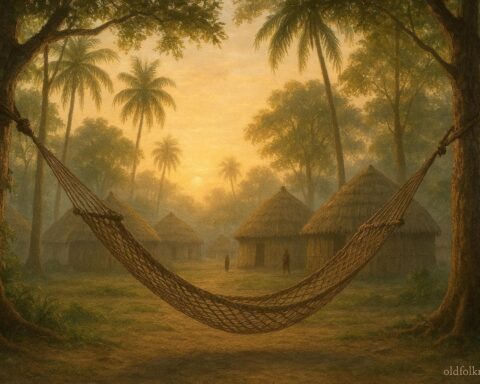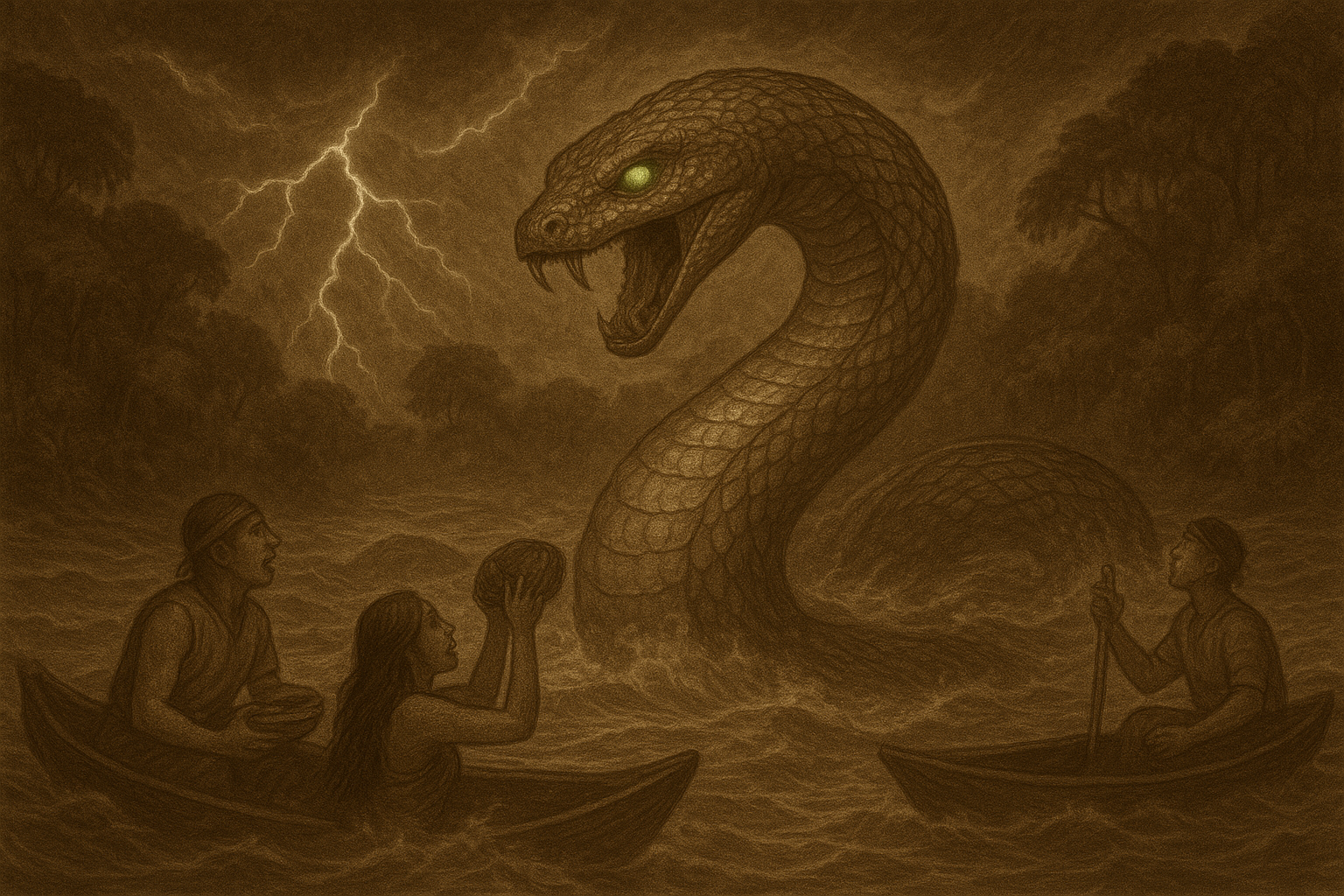
In the beginning times, when the world was younger and the rivers ran wild and untamed through the endless green expanse of the Amazon Basin, there existed a being of immense power and ancient wisdom. The indigenous peoples who made their lives along those waterways, such as the Shipibo-Conibo and the Quechua, and countless other river tribes knew her name. They spoke it with reverence and caution: Yacumama, the Mother of Waters.
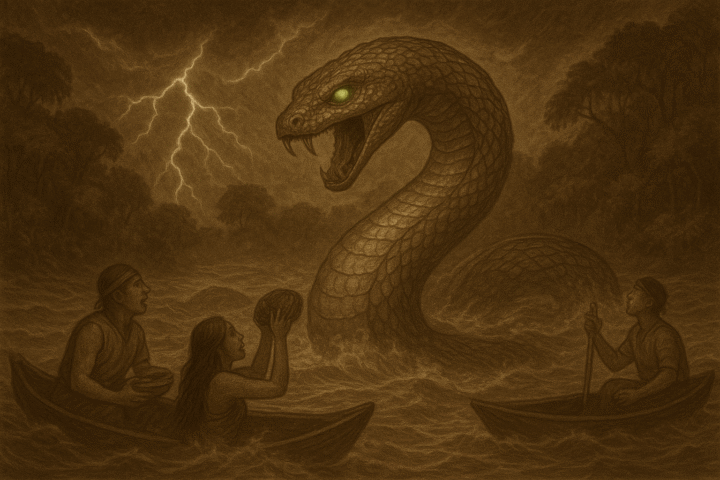
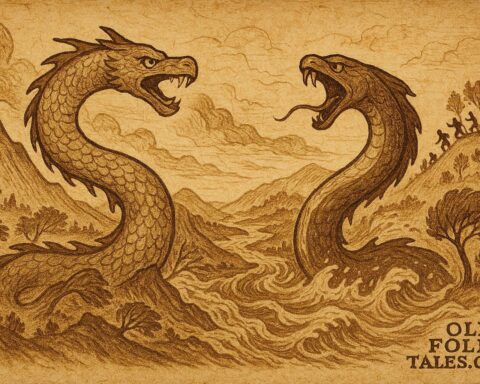
Yacumama is no ordinary serpent. She is vast beyond imagining, her body longer than the greatest canoes laid end to end, thicker than the oldest ceiba trees that tower over the forest canopy. Her scales shimmer with an otherworldly luminescence, catching the moonlight on dark waters and reflecting it like thousands of silver mirrors. Her eyes burn with the green fire of emeralds pulled from the earth’s deepest places, ancient and knowing, missing nothing that occurs within her domain.
Click to read all South American Folktales — timeless stories from the Andes to the Amazon.
But her most fearsome power lies not in her size or her mesmerizing beauty, it is in her breath. When Yacumama exhales, she can draw the very air toward her, creating whirlpools that spin and spiral with deadly force, pulling everything on the water’s surface down into the crushing depths. To the river peoples, she is far more than a creature of flesh and scale. She is a spirit, a force of nature itself, the eternal guardian of the waters and every living thing that swims, crawls, or dwells within them.
The elders tell the story of how Yacumama became the enforcer of balance, the keeper of respect between humans and the river. It happened long ago, in the days when humans first learned the art of fishing, when they discovered how to weave nets from plant fibers and fashion hooks from bone and thorn. The rivers teemed with life fish of every color and size, turtles with ancient faces, caimans basking on muddy banks. The waters provided abundantly, and at first, the people were grateful.
But gratitude, like morning mist, can evaporate when the sun of prosperity grows too hot. As the people’s skill in fishing grew, so too did their greed. They forgot the old ways of thanksgiving. They forgot to speak prayers to the river before casting their nets. They took more fish than they could eat, letting the excess rot on the banks. They took the largest fish, the breeding mothers, the young ones barely grown. The nets grew finer, the catches larger, and the songs of gratitude fell silent.
The balance of the waters broke like a taut rope pulled too far.
One night, when the moon hung full and heavy in the sky, the river began to tremble. From the deepest part of the waters, where sunlight never penetrates and the pressure could crush stone, Yacumama rose. Her massive head broke the surface, water cascading from her scales in silver torrents. Her roar split the night a sound like thunder trapped inside a canyon, like the earth itself crying out in pain and rage.
The skies responded to her fury. Clouds gathered, thick and black as smoke, blotting out the stars. Rain began to fall not the gentle, life-giving rain of the wet season, but a deluge that turned the air white and the rivers into raging brown torrents. The rain fell without ceasing for seven days and seven nights. The rivers swelled beyond their banks, consuming villages, swallowing gardens, transforming the familiar world into an endless, churning expanse of angry water.
The people huddled on the highest ground they could find, cold and terrified, watching everything they had built disappear beneath the flood. Children cried for food. Elders spoke in hushed, frightened voices about the old stories they had dismissed as mere tales. The shamans entered their trances, seeking understanding, seeking mercy.
And in their visions, they saw her: Yacumama, coiled in the depths, her emerald eyes blazing with righteous anger. They understood. The river was not a thing to be exploited without thought or thanks. The water was alive, sacred, deserving of respect. They had taken without giving back. They had forgotten that they were not masters of the river, but children of it, dependent on its generosity for their very survival.
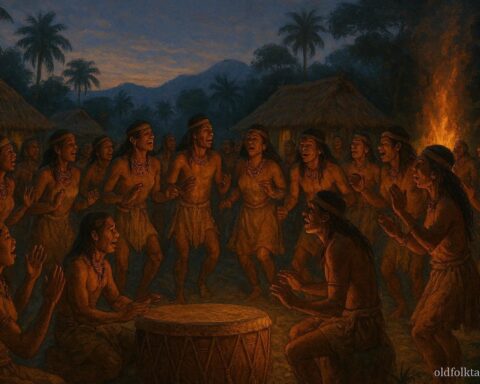
When the rains finally ceased and the floodwaters began their slow retreat, revealing the muddy scars of their transgression, the people gathered at the river’s edge. With trembling hands, they built altars from river stones and driftwood. They placed offerings upon them the best fish from their dwindling stores, ripe fruits gathered from the highest trees that had survived the flood, and most importantly, songs. Songs of apology, songs of gratitude, songs that honored the Mother of Waters and acknowledged her power and her guardianship.
They made a sacred promise that day, one that would be passed down through countless generations: at every full moon, they would bring offerings to Yacumama. They would give thanks for the river’s bounty. They would take only what they needed and never more. They would remember that the waters were alive, that they were home to a guardian who watched, who remembered, who would not tolerate disrespect.
From that day forward, the river tribes taught their children the ways of respect. They learned that before venturing into unknown parts of the river those mysterious stretches where the water runs deep and dark, where strange currents swirl one must announce one’s presence. Blow the conch shell, its deep note reverberating across the water. Strike the side of the canoe with the paddle, creating rhythmic sounds that carry through the liquid medium. Make noise to alert Yacumama, to show that you come with awareness and humility, not with arrogance or disregard.
The elders warn that Yacumama’s anger remains swift and terrible for those who forget these lessons. She can rise beneath a boat, her massive body creating waves that capsize even the sturdiest vessel. She can open her cavernous mouth and swallow an entire canoe whole, dragging it and everyone aboard down to the river bottom where bones rest in the silt and silence. Her whirlpools appear suddenly, spinning boats in dizzying circles before pulling them under, the water closing over them as though they never existed.
But for those who remember, for those who approach the river with respect and gratitude, who make their offerings and sing their songs, who take only what they need and give thanks for even that for these people, Yacumama is a benefactor. The waters remain calm beneath their paddles. The fish swim willingly into their nets. The river guides them safely home through fog and darkness. The Mother of Waters protects those who honor her, just as she punishes those who do not.
Even now, in the present day, the descendants of those ancient river peoples maintain the old ways. They know that Yacumama still dwells in the depths, her emerald eyes watching, her ancient wisdom remembering. They know that the river is not dead water flowing mindlessly to the sea, but a living force with its own spirit, its own power, its own guardian who will not let balance be broken again.
Explore myths and legends from Brazil, Peru, and Argentina rooted in spirit and survival.
The Moral Lesson
The legend of Yacumama teaches the fundamental importance of respecting nature and maintaining balance with the environment. It reminds us that taking from nature without gratitude or restraint leads to devastating consequences, while approaching the natural world with humility and reciprocity brings harmony and abundance. The story emphasizes that nature is not a resource to exploit but a living force deserving of reverence, and that humans must recognize their role not as masters but as dependent participants in the web of life. Most profoundly, it shows that remembering and honoring ancient wisdom about our relationship with the earth is essential for survival and prosperity.
Knowledge Check
Q1: Who is Yacumama in Amazonian mythology and what does her name mean? A: Yacumama, whose name means “Mother of Waters,” is a massive serpent spirit from the folklore of indigenous Amazonian peoples including the Shipibo-Conibo and Quechua tribes. She serves as the guardian and protector of rivers and all aquatic life, possessing the power to create deadly whirlpools with her breath and embodying the living force of water itself.
Q2: What caused Yacumama to flood the land for seven days? A: Yacumama sent the devastating seven-day flood because humans had broken the balance of the waters through greed and disrespect. After learning to fish, people forgot to offer thanks to the river, took more than they needed, and stopped following the old ways of gratitude, which angered the Mother of Waters and prompted her fierce response.
Q3: How do the river tribes show respect to Yacumama before fishing or traveling? A: The river peoples make regular offerings at full moon including fish, fruit, and songs at altars built by riverbanks. Before entering unknown parts of the river, they blow conch shells or make noise by striking their canoes to announce their presence, showing awareness and humility rather than arrogance toward the Mother of Waters.
Q4: What happens to those who anger Yacumama versus those who respect her? A: Those who disrespect Yacumama face her terrible wrath she can capsize boats with waves from her massive body, create whirlpools that pull vessels underwater, or swallow entire canoes whole. However, fishermen and travelers who honor her with respect, offerings, and gratitude find calm waters, plentiful catches, and safe passage through even the most dangerous river sections.
Q5: What physical characteristics make Yacumama a fearsome creature? A: Yacumama is described as an immense serpent longer than the largest canoes and thicker than ancient ceiba trees. Her scales shimmer like moonlight on water with otherworldly luminescence, her eyes burn with green emerald fire, and most fearsome of all, her breath can pull the air itself toward her, creating deadly whirlpools that drag everything down into the depths.
Q6: What broader lesson does the Yacumama legend teach about humanity’s relationship with nature? A: The legend teaches that nature is a living force deserving reverence, not a resource for unlimited exploitation. It emphasizes that humans must maintain balance through gratitude, humility, and reciprocity taking only what is needed while giving thanks in return. The story shows that disrespecting natural forces leads to catastrophic consequences, while honoring them brings harmony, protection, and abundance.
Source: Adapted from oral traditions of the Shipibo-Conibo people documented by the Smithsonian Folklife Festival; “Yacumama”
Cultural Origin: Shipibo-Conibo, Quechua, and other indigenous river tribes of the Western Amazon Basin, primarily Peru, Ecuador, and Brazil