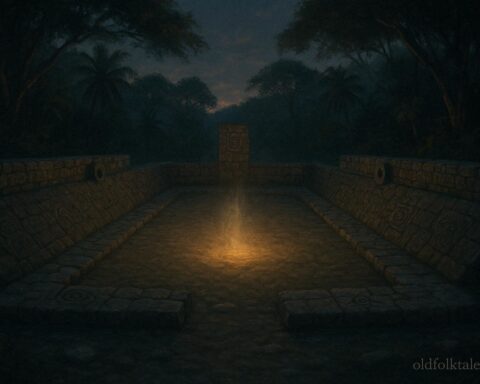
Long ago, in the mountains of Oaxaca, when the rivers were low and the earth cracked under the sun, the people prayed for rain. Crops withered, and streams ran dry. The elders spoke of a woman chosen by the spirits to hold the power of rain itself, a jar that contained both the life-giving waters and the potential for destruction. Her name was Xilonen, and she bore the weight of the village’s survival in her hands.
Xilonen was no ordinary woman. She had been raised with wisdom, patience, and a deep respect for the forces of nature. From a young age, she was taught the songs that called forth the clouds, the dances that summoned gentle showers, and the rituals that could prevent floods. But the spirits warned her that the jar must never be opened carelessly, for rain was not only a gift—it was a force that demanded balance.
For many seasons, Xilonen carried the rain jar with reverence. She would climb the hills at dawn and sing to the mountains, letting the mist rise from the valleys and knowing when to open the jar just enough to water the fields. Farmers would rejoice as their maize and beans grew tall, and children would splash in puddles formed from the careful rain. But even as the people thrived, some grew impatient.
Immerse yourself in Latin America’s stories of passion, transformation, and spirit.
“Why must she wait?” they asked. “The clouds are here. Let her pour the rain all at once and end our hardships!”
Xilonen heard their voices, but she remembered the teachings of the elders: to open the jar too quickly was to invite floods; to hoard it too long was to bring drought. She practiced restraint, listening to the land, feeling the soil, and observing the behavior of the animals who also sensed changes in the sky.
One season, when the hills were especially dry, a young man named Tecuani approached her. He was bold and strong but did not yet understand the subtle rhythms of nature.
“Open the jar now!” he urged. “Our crops are dying, and we cannot wait any longer. The spirits will forgive you if you release the rain.”
Xilonen looked at him and shook her head. “The spirits do not forgive recklessness,” she said. “Rain is not mine to give freely. It must be measured, in harmony with the land and the lives that depend on it.”
Tecuani grew angry. He tried to seize the jar from her hands, thinking that strength alone could bend the power of nature. But the jar was heavy, imbued with the spirits’ protection. No human strength could lift it without the proper song, the right timing, and the wisdom to act with balance.
The villagers watched in awe as Xilonen performed the ancient dances, whispering chants to the spirits. Slowly, the clouds thickened above, and a gentle mist began to fall, nourishing the soil without harming it. Tecuani realized that patience and knowledge were more powerful than brute force. Humility washed over him as he bowed to Xilonen, recognizing her skill and respect for the sacred balance.
Years passed, and Xilonen continued to serve her people. The jar never overflowed, the rivers never ran dry, and the villagers learned to honor the rhythms of the earth. They saw that responsibility was not just a matter of holding power but of using it wisely, in harmony with all living things.
The story of Xilonen spread far beyond the mountains of Oaxaca. Parents told it to children to teach the value of patience and restraint. Farmers would chant her name before planting seeds, and elders would remind everyone that the balance of nature could be preserved only through care, attention, and respect.
Even today, some say that during the first rains of the season, Xilonen’s spirit can be felt in the gentle showers, a reminder that wisdom and responsibility guide the waters that feed the land. The jar itself, though invisible to human eyes, continues to teach that those who seek to control nature without understanding risk the wrath of imbalance, while those who act with humility and awareness are blessed with life-giving rain.
Explore the ancestral legends of Canada, Mesoamerica, and South America’s Indigenous tribes.
Moral Lesson
True power lies in responsibility, patience, and balance. Wisdom is shown not by haste or force but by understanding the rhythms of nature and acting with care.
Knowledge Check
1. Who was Xilonen, and why was she important?
Xilonen was a woman chosen to hold the rain jar, ensuring the land received rain in a balanced way to prevent drought or flood.
2. What could happen if the rain jar was opened carelessly?
Opening the jar carelessly could result in floods that destroy crops and homes, or withholding it could cause drought.
3. How did Xilonen release the rain safely?
She released the rain slowly, using songs, dances, and careful observation of the land and animals to guide timing.
4. What lesson did Tecuani learn?
He learned that patience, humility, and respect for natural forces are more powerful than physical strength or impatience.
5. How did the villagers benefit from Xilonen’s careful use of the jar?
Their crops thrived, rivers stayed full, and they learned to respect the balance of nature and the power of responsible action.
6. Why is Xilonen’s story still told today?
To teach future generations the importance of restraint, wisdom, and harmonious interaction with the environment.
Source
Adapted from Mixtec oral tradition collections; INAH archives.
Cultural Origin
Mixtec peoples, Oaxaca, Mexico.