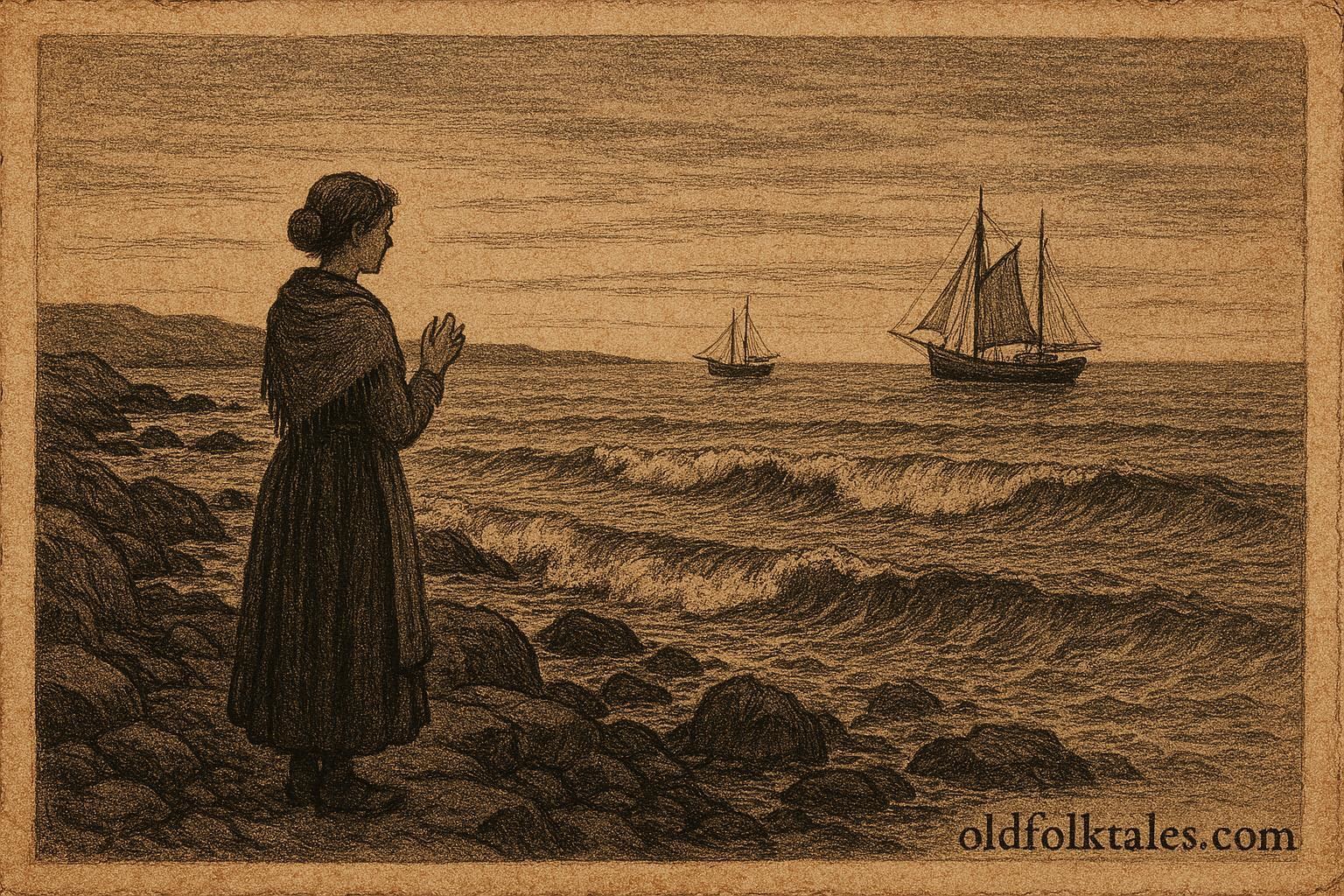
Along the Atlantic shore of Nova Scotia, where the coastline curves gently before breaking into rock and foam, there once lived a woman named Mairead. She was not a sailor, nor did she own a boat, yet fishermen often paused to ask her opinion before heading out to sea. She had no charts, no compass, and no instruments of brass or glass. What she had was knowledge passed quietly from one woman to another, like a tide that never fully receded.
Mairead learned to count waves from her grandmother.
As a child, she spent long afternoons sitting beside the old woman on a weathered bench overlooking the shore. While others watched gulls or gathered shells, her grandmother watched the water itself. She did not stare at the horizon or the clouds. She counted.
“One,” she would murmur as a wave broke cleanly.
“Two,” when the next followed.
“Three,” when the third rose slightly higher.
Sometimes she would stop at seven. Sometimes at twelve. Occasionally she would begin again, shaking her head.
Mairead once asked why.
“Because the sea speaks in patterns,” her grandmother said. “And storms break patterns before they break ships.”
Discover ancient tales passed down by the Indigenous peoples of the Americas.
She explained that calm seas often followed a steady rhythm, waves rising and falling with gentle regularity. But before a storm, the rhythm faltered. Waves arrived too quickly or hesitated too long. Sets overlapped. The water forgot how to behave.
“Men read the sky,” her grandmother said. “Women read the water beneath it.”
Years passed, and Mairead grew into a quiet, observant woman. Her grandmother died, but the counting remained. Mairead counted while walking the beach, while mending nets for neighbors, and while waiting for boats to return at dusk.
One autumn evening, a trading vessel arrived unexpectedly. Its captain announced plans to leave again before dawn, eager to beat an incoming tide. Many villagers were uneasy. The air felt heavy. The sea was smooth, almost too smooth.
Mairead walked down to the shore as the sun lowered. She stood still and began to count.
The first waves came evenly. She reached six without concern. But then the seventh arrived too soon. The eighth hesitated. The ninth rose sharply, breaking out of sequence. Mairead started again.
The pattern broke twice more.
She went straight to the captain.
“There will be a storm before morning,” she said plainly.
The captain frowned. The sky was clear. His barometer showed nothing unusual. “You cannot know that,” he replied.
“I do,” Mairead said. “The waves are already forgetting themselves.”
Some of the crew argued to wait. Others mocked the idea of trusting a woman with no seafaring rank. The captain hesitated only briefly before ordering departure.
That night, the wind arrived without warning. Fog followed, thick and blinding. The sea rose suddenly, confused and violent. The ship barely cleared the harbor before being forced to turn back, sails torn and hull damaged. By morning, it limped ashore, battered but intact.
No one laughed at Mairead after that.
Word spread quickly along the coast. Fishermen began stopping by her home before voyages, asking her to watch the water. She never charged them. She simply walked to the shore, counted, and spoke honestly.
Some days, she smiled and told them the rhythm was steady. Other days, she shook her head and told them to wait.
Not everyone listened.
One winter morning, a small fishing boat left despite her warning. The waves had broken pattern early, colliding and reforming too quickly. The crew believed urgency mattered more than caution. By evening, the boat had not returned.
When it finally washed ashore days later, broken and empty, grief settled heavily over the village. Mairead did not say, “I told you so.” She simply returned to the shore and counted again.
As years passed, Mairead taught her daughter the same way her grandmother had taught her. They sat together in silence, letting the numbers form naturally. No writing. No measuring. Just attention.
“Why women?” her daughter once asked.
“Because this knowledge survives in patience,” Mairead replied. “And patience is often taught to us first.”
Long after Mairead’s time, people still say that some storms along the Nova Scotia coast arrive quietly, announced only by confused waves. And that those who know how to count them are rarely surprised by what follows.
Moral Lesson
Wisdom does not always come from tools or authority. It often lives in observation, patience, and inherited knowledge. The story teaches that traditions preserved through quiet practice can be as reliable as modern instruments, and that dismissing such wisdom can lead to unnecessary loss.
Knowledge Check
- What skill did Mairead inherit from her grandmother?
The ability to predict storms by counting wave patterns. - What do broken wave patterns indicate in the story?
An approaching storm or dangerous sea conditions. - Why did some sailors ignore Mairead’s warning?
They trusted instruments and appearances over traditional knowledge. - How did the village’s attitude change over time?
They came to respect Mairead’s observations and seek her guidance. - Why is this knowledge passed through women in the story?
Because it relies on patience, observation, and oral teaching. - What does wave counting symbolize?
The importance of paying attention to subtle natural signs.
Source:
Adapted from Nova Scotia Folklore Society publications and Dalhousie folklore studies.
Cultural Origin:
Maritime folklore, Nova Scotia.