In the northern lands where the Innu people lived, winter was not merely a season. It was a force that breathed, listened, and remembered. Snow did not fall without reason, and cold did not linger without purpose. The elders taught that winter had once wandered freely, untethered and unpredictable, until the world nearly broke beneath its weight.
To prevent that chaos from returning, winter’s power was entrusted to a single caretaker in each generation. This keeper did not command the cold. She carried it.
Long ago, during a time when the seasons still struggled to find balance, there lived a woman named Ashini. She was not chosen for her strength or her voice, but for her steadiness. Ashini spoke little and observed much. She noticed when the caribou moved early, when the rivers hesitated before freezing, and when the sky carried a certain sharpness in its color. The elders watched her carefully.
One autumn, when frost arrived too soon and the wind carried an unfamiliar bitterness, the elders summoned Ashini. They brought forth a bundle wrapped in sealskin, tied with sinew, and marked with symbols older than memory. Even before it was opened, the air around it cooled.
“This is winter,” the eldest woman said. “Not the season you know, but its heart.”
Ashini did not step back. She knelt.
The elder explained that winter’s power must be carried away from the land during the warm months and released slowly when the time was right. Too much too soon would kill the animals and starve the people. Too little would leave the land weak and unprepared. The bundle could not be opened carelessly, nor carried with anger or pride.
Ashini accepted the bundle without question.
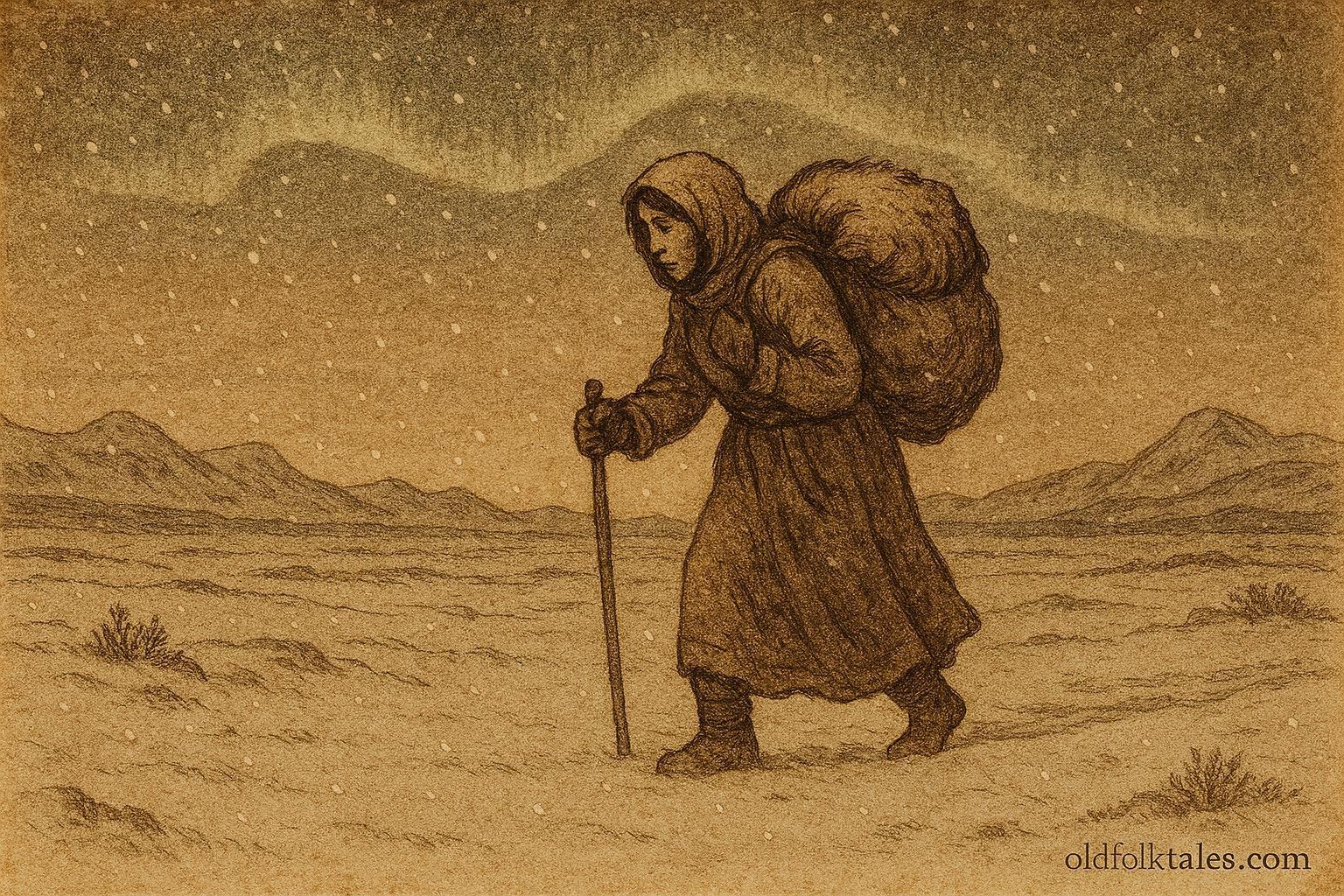
From that moment, her life changed. She carried winter on her back as she walked between camps, through forests and along frozen rivers. The bundle was never light. Some days it felt like stone. Other days it pulsed with cold so sharp it burned through her clothing. When Ashini grew impatient or restless, the weight increased. When her thoughts slowed and her breathing steadied, it eased.
People noticed that wherever Ashini stayed, the weather behaved differently. Frost lingered but did not destroy. Snow fell cleanly, not in suffocating drifts. Hunters found tracks where they should be. Children did not fall ill from sudden cold. Yet Ashini herself grew thinner, quieter.
As the months passed, whispers began.
Some said Ashini held too much power. Others claimed winter should be released fully so the land could prove its strength. A few demanded she open the bundle and end the waiting. Hunger makes people impatient, and impatience sharpens tongues.
Ashini listened, but she did not respond.
One night, as the northern lights trembled low across the sky, a young man followed her beyond the camp. He accused her of hoarding winter, of fearing the season rather than trusting it. He demanded she open the bundle so the land could return to its natural order.
Ashini met his gaze calmly.
“Winter is not angry,” she said. “But it is heavy.”
Before he could answer, a wind rose suddenly, biting and wild. Snow lashed the ground, and the cold cut through fur and flesh alike. The young man staggered, frightened. Ashini tightened the bundle’s ties, and the storm weakened as quickly as it had come.
The people began to understand.
When the time came for winter’s true arrival, Ashini climbed a high ridge overlooking the valley. She did not rush. She loosened the sinew slowly, releasing the cold in careful measure. Snow fell gently at first, then more steadily. Rivers froze strong enough to cross but not so fast that fish were trapped and wasted. The animals adapted. The people endured.
But balance demands sacrifice.
Each season, Ashini released part of herself along with the winter. Her hair silvered early. Her steps slowed. By the final year of her duty, she could barely lift the bundle.
One spring, as the snow melted and the land breathed again, Ashini walked alone into the forest. She set the empty bundle beneath a tree and did not return.
The elders later found her tracks ending at the river’s edge, where ice broke cleanly into water. They said winter no longer needed to be carried. It had learned restraint.
From then on, the Innu taught that seasons survive not through force, but through care. Winter still comes, but it listens.
Explore the ancestral legends of Canada, Mesoamerica, and South America’s Indigenous tribes.
Moral Lesson
This story teaches that power must be handled with patience and responsibility. True guardianship is not about control or display, but about knowing when to hold back and when to release. Balance is preserved through restraint, not dominance.
Knowledge Check
1. What does the winter bundle represent in the story?
It represents the concentrated power of winter that must be carefully managed.
2. Why was Ashini chosen as the carrier of winter?
Because of her patience, observation, and emotional restraint.
3. What happens when people demand winter be released early?
The land becomes threatened by imbalance and sudden cold.
4. How does Ashini maintain balance during winter’s arrival?
By releasing winter slowly and intentionally.
5. What sacrifice does Ashini make?
Her strength and eventually her life force.
6. What lesson does the community learn?
That seasons require respect, not force, to remain in harmony.
Source
Adapted from Indigenous seasonal cycle narratives; Native-Languages.org.
Cultural Origin
Innu First Peoples, Labrador and Quebec.