In the heart of old Cuba, when the world still whispered with spirits and animals spoke in voices all their own, there lived a toad who saw more than anyone ever guessed. He was small and round, his skin rough as the bark of an old ceiba tree, and his eyes shone like twin beads of polished amber. To most, he was ugly and slow, a creature of mud and shadow. But to those who listened with their hearts, he was something else entirely, the keeper of quiet wisdom, the watcher in the dark.
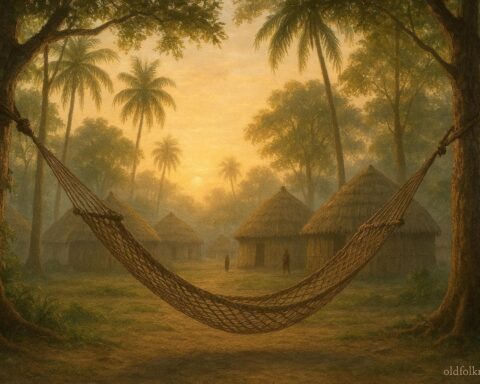
The Toad lived beside a well at the edge of a sugarcane field. The air there was thick with the scent of molasses and the hum of life, cicadas, frogs, wind, and water blending into a song older than the island itself. Every day, the Toad sat at the lip of the well and watched the world unfold. He never hurried, never shouted, and never boasted. He simply watched.
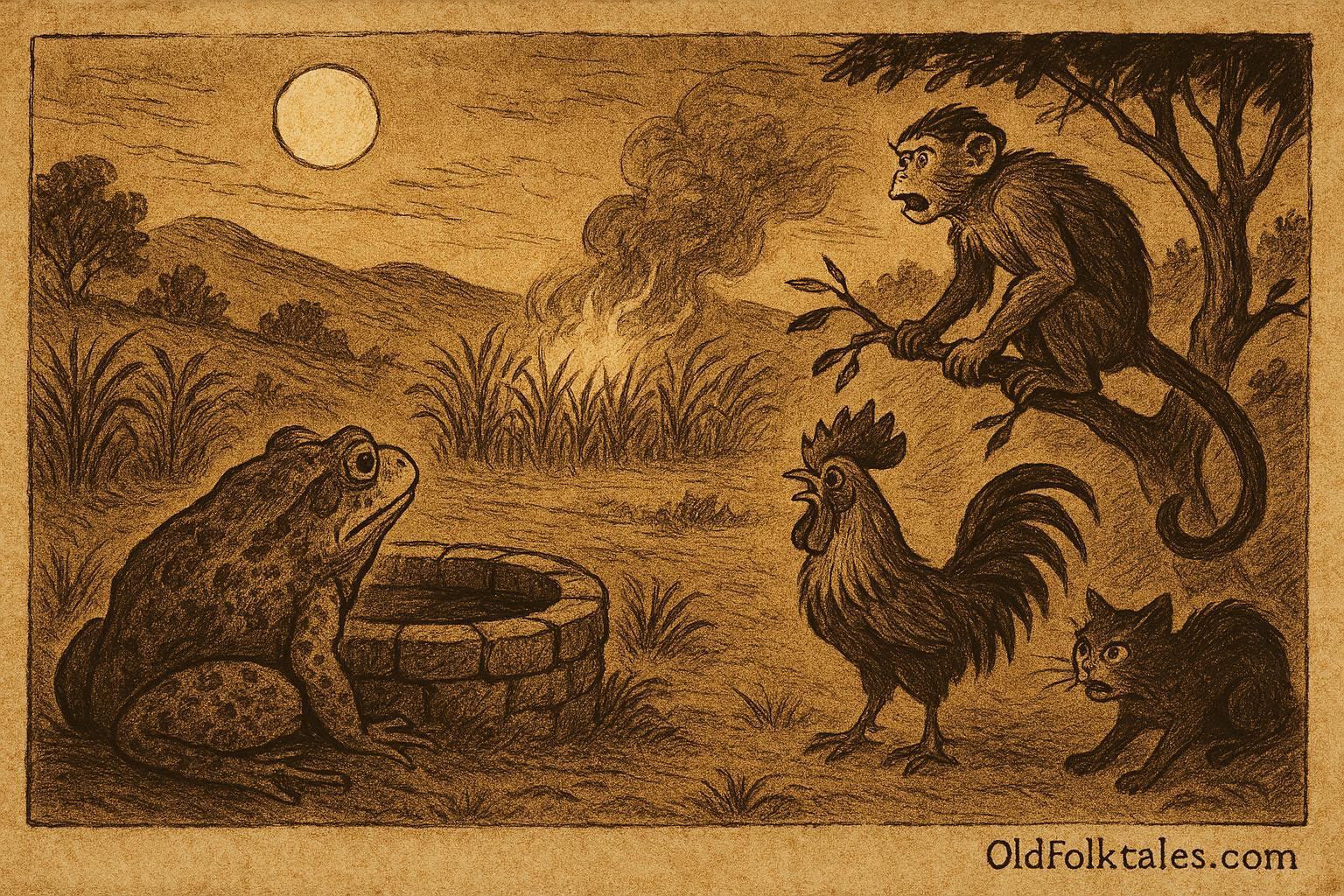
One hot afternoon, several animals gathered near the well to drink. Among them were the proud Rooster, the restless Monkey, and the sly Cat. They were laughing, boasting, and teasing one another as friends sometimes do when the day is long and sweet.
“Look at the Toad!” cried Monkey, swinging from a low branch. “Always sitting, always staring! Does he ever do anything?”
Rooster puffed his red chest. “He’s too lazy to move. His eyes are big, but I doubt he sees beyond his nose. What use is a creature who only watches?”
Cat flicked her tail and purred slyly. “Perhaps he dreams of being something grand, but a toad is just a toad.”
Their laughter echoed across the field, and the Toad heard every word. But he said nothing. He only blinked slowly and kept his gaze fixed on the horizon, where a faint shimmer stirred in the air.
As night fell, the animals went to rest. But the Toad, true to his nature, stayed awake. The moon hung low and heavy, and a strange scent rode on the wind, smoke, faint but growing stronger. The Toad’s throat throbbed as he croaked once, twice, then again, trying to rouse the sleepers.
“Croak… croak…”
Monkey turned over in his tree. “Quiet, old stone-face,” he muttered.
“Croak… croak!”
Now Rooster stirred. “Can’t you see it’s night, fool? Even the moon is tired!”
Still the Toad croaked, his alarm swelling into the darkness. Then, with a sudden gust, a spark of flame leapt from the direction of the cane field. The dry stalks caught fire like paper in the wind, and in moments the night blazed orange and gold.
Monkey shrieked and leapt for higher ground. Rooster flapped wildly, feathers singed. Cat dashed for the open yard, howling as sparks rained down. The fire spread fast, faster than any of them could think or move.
The only creature that did not panic was the Toad. While the others ran, he splashed into the well and croaked with all his strength. His voice carried through the night, and soon the farmer awoke. Seeing the red glow through his window, he rushed out with buckets of water, calling for help. His family followed, beating at the flames with wet cloths.
By dawn, the fire was out. The field was blackened, but the farmhouse still stood. The animals, trembling and soot-streaked, gathered near the well where the Toad sat dripping with dew.
Monkey bowed his head first. “Toad,” he said softly, “you saw what we did not.”
Rooster, his feathers now dull with ash, added, “We mocked you for watching, but your watchfulness saved us all.”
Cat, her fur singed and eyes lowered, whispered, “Forgive us, wise one. We were blind to your gift.”
The Toad blinked, his amber eyes calm. “I am no wise one,” he said slowly. “I only see what others overlook. The world speaks, and I listen. That is all.”
And from that day on, no one mocked the Toad again. They came to see him not as ugly or idle, but as a guardian, the quiet witness who saw danger before it came, the humble soul who kept watch when all others slept.
Moral Lesson
The tale of The Watchful Toad teaches that true wisdom often hides in the most modest forms. Patience and vigilance, not pride or noise, guard us from unseen dangers. Those who look down on others for their stillness may find, too late, that it was the still ones who saw the truth all along.
Knowledge Check
- Where does the Toad live in the story?
Beside a well near a sugarcane field in rural Cuba. - Why do the other animals mock the Toad?
They believe he is lazy and useless because he only sits and watches. - What danger does the Toad sense before anyone else?
A fire starting in the sugarcane field. - How does the Toad save the others?
He croaks loudly to alert them and wakes the farmer, who extinguishes the fire. - What lesson do the animals learn from the Toad?
They learn to respect watchfulness and humility, recognizing that wisdom often appears in quiet forms. - What does this Afro-Cuban folktale symbolize?
It symbolizes the value of vigilance, humility, and the deep spiritual awareness found in nature’s overlooked creatures.
Source: Adapted faithfully from “The Watchful Toad” in Afro-Cuban Tales (Cuentos Negros de Cuba) by Lydia Cabrera, translated by Alberto Hernández-Chiroldes & Lauren Yoder, University of Nebraska Press, 2004.
Cultural Origin: Cuba (Afro-Cuban oral tradition)