In a quiet corner of a small New Mexican village long ago, two little old people lived in a humble adobe house at the edge of town. Their home was made of sun-baked clay, its walls warm and cracked with age, and its roof sagged beneath the dry desert wind. Life had not been easy for them. The man was thin and bent with years of work in the fields; the woman’s hands were rough from grinding corn and tending their tiny garden.
They had little more than one another, and the faith that somehow, every day, the Lord would provide.
The Winter of Hunger
One winter, as Christmas drew near, the snow fell heavier than anyone in the village could remember. The fields lay empty, the well had frozen over, and their cupboard held only a few kernels of corn and a small piece of bread. The fire burned low because they had no more wood to spare.
The old man sighed. “Wife,” he said softly, “it seems we will have no feast for Christmas this year.”
The old woman looked down at her worn shawl and tried to smile. “God will see us through,” she said, though her voice trembled.
That night, as the cold pressed against their adobe walls, neither could sleep. Finally, before dawn, the old man rose from his straw bed and whispered, “I will go out and see if the mountains will give us something to eat.” He took his walking stick, wrapped himself in a tattered serape, and set out into the freezing air.
The Stranger by the Mesquite Tree
The old man wandered along the edge of the arroyo, where snow glittered like crushed glass under the pale sun. He prayed quietly as he walked: “Lord, I ask not for riches, only for a little food so that my wife and I may celebrate Your day.”
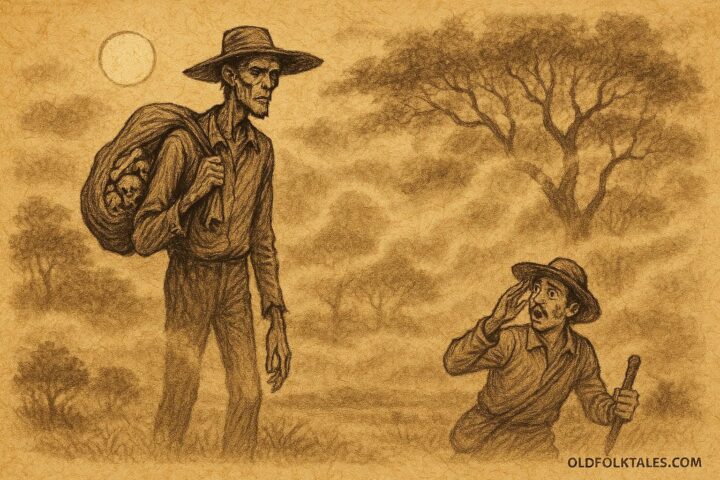
As he neared a gnarled mesquite tree, he noticed someone standing there, a figure dressed in white robes that seemed to shimmer like morning light. The old man stopped in awe.
“Good morning, abuelo,” said the stranger, smiling kindly. “Why do you walk alone on this cold day?”
The old man bowed respectfully. “I go to seek something for my wife and me to eat, kind sir. We are very poor and have nothing for Christmas.”
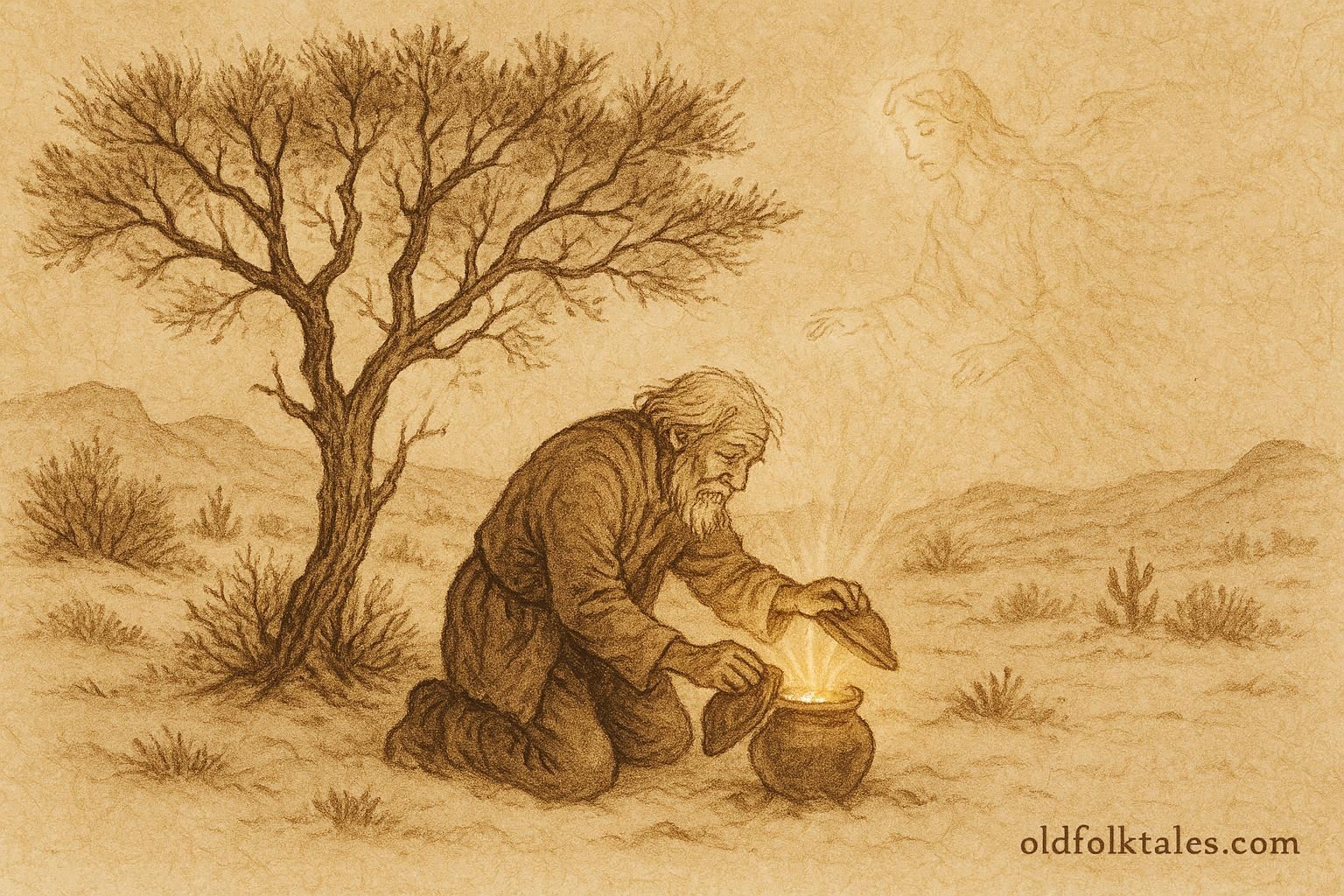
The stranger nodded thoughtfully and pointed to the roots of the mesquite tree. “Dig there, old one. Under these roots you will find what you seek. But remember, take only what you need, and give thanks for it.”
Before the old man could reply, the stranger vanished as suddenly as he had appeared.
The Hidden Treasure
With trembling hands, the old man knelt in the snow and began to dig. His fingers brushed against something hard, a small clay jar, sealed with wax. When he broke it open, a golden light spilled out. Inside were bright silver coins and gold pieces that gleamed like sunlight.
Tears filled the old man’s eyes. He whispered a prayer of thanks, took only a handful of the coins, and carefully buried the rest. Then he hurried home, his heart warm with gratitude.
The Wife’s Desire
When he entered their little house, the old woman’s eyes grew wide. “Husband! Where did you find such treasure?”
He told her everything, about the stranger, the mesquite tree, and his promise to take only what they needed. The old woman listened, her heart pounding.
“So there is more gold left?” she asked, her voice sharp with excitement.
“Yes,” said the old man, “but we must not be greedy. The stranger’s words were clear, take only enough to live.”
But that night, as the wind howled outside, the woman lay awake thinking of the gold buried beneath the tree. She thought of warm clothes, fine food, and a new house. Before dawn, while her husband still slept, she rose quietly and set out toward the arroyo.
The Punishment of Greed
The snow had stopped, and the sky was streaked with gray clouds. When the old woman reached the mesquite tree, she dropped to her knees and began to dig furiously. Soon she found the clay jar, still half full of gold. Her eyes shone.
“This will make us rich!” she cried and reached in with both hands. But as she did, the ground beneath her began to tremble. A gust of icy wind swept through the arroyo, and a deep voice echoed in her ears:
“Greed brings no blessing.”
Before she could cry out, the earth closed around her wrists, and she was turned to stone, her figure frozen beside the tree forever.
The Old Man’s Sorrow
When the old man awoke and found his wife gone, he followed her tracks through the snow. When he reached the mesquite tree, his heart broke. There, where his wife should have been, stood a stone shaped like a kneeling woman.
He wept and prayed for forgiveness, not for himself, but for her. He covered the treasure again and never spoke of it to anyone. Yet he was never hungry again. The villagers said that when he needed food, it somehow appeared in his basket, and when he grew cold, his fire never died.
And though he lived the rest of his days alone, he lived with peace in his heart, for he had learned that gratitude, not greed, brings true blessing.
Moral Lesson
This folktale teaches that humility and gratitude lead to peace, while greed destroys what we most desire. True richness lies in contentment and faith, not in gold.
Knowledge Check
-
What is the main moral of “The Two Little Old People”?
It teaches humility, gratitude, and the dangers of greed. -
Where does this folktale originate?
From the Spanish Colonial tradition in New Mexico, USA. -
What did the old man find under the mesquite tree?
A buried jar filled with gold and silver coins. -
Why was the old woman punished?
Because she disobeyed the warning and let greed guide her actions. -
What symbolizes divine reward in the story?
The hidden treasure, revealed through faith and humility. -
How does the story reflect Spanish colonial culture?
Through Christian faith, moral humility, and the blending of European and New Mexican traditions.
Source: Adapted faithfully from “Three Spanish Folk Tales,” collected by D. Huning (1936), University of New Mexico Digital Repository.
Cultural Origin: Spanish Colonial New Mexico (Hispanic–American folklore).