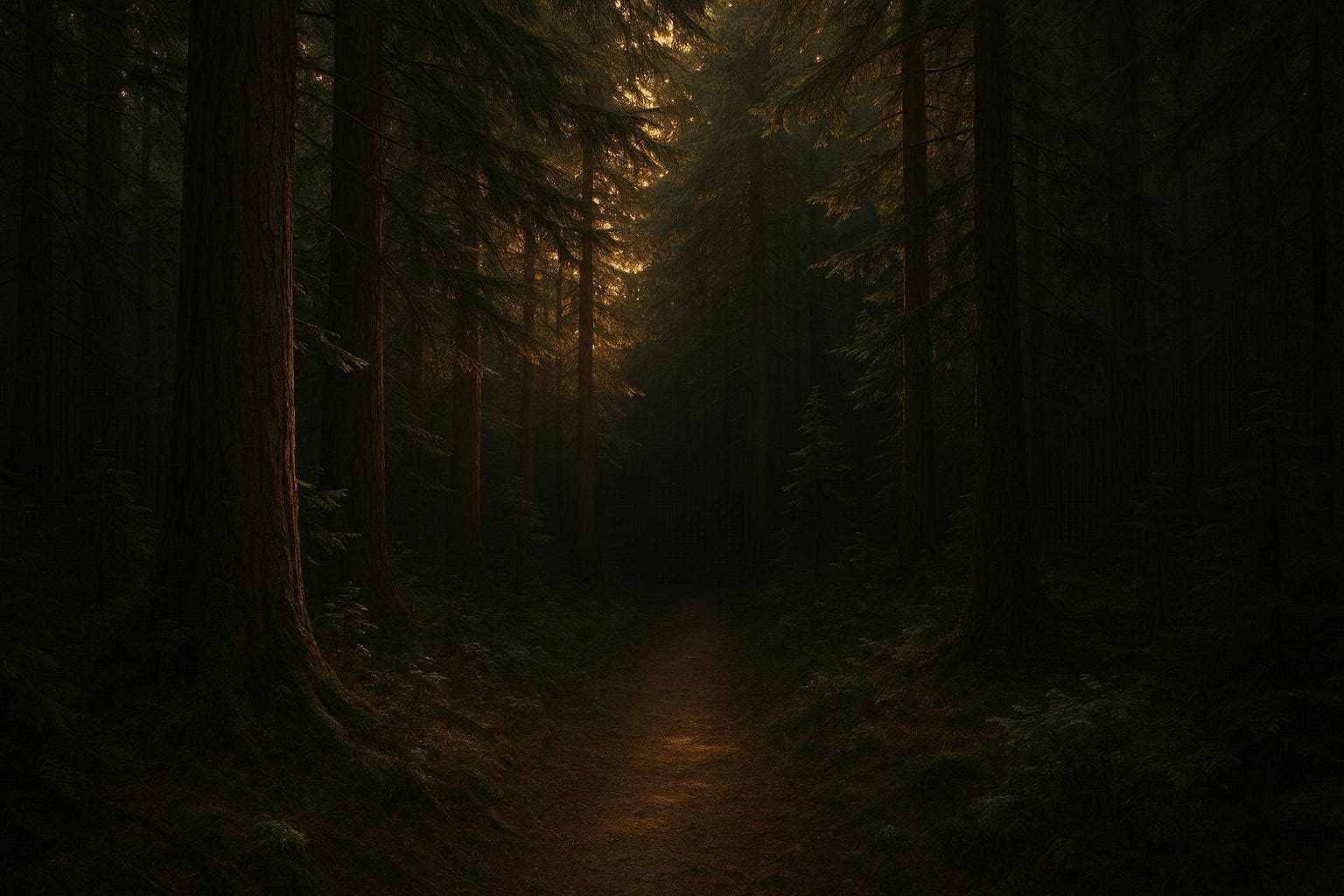
Long before boundaries were marked on paper and time was measured by clocks instead of shadows, a narrow forest trail wound through the lands of the Gitxsan people. It followed the curves of rivers, passed through stands of cedar and spruce, and crossed feeding grounds used by deer, elk, and smaller animals whose lives were closely watched by the community. The trail was not owned by anyone, yet it belonged to everyone. More importantly, it belonged to the land itself.
From the earliest teachings, people were told that the trail was meant for daylight travel only. At sunset, when birds settled and animals emerged to feed, the forest required quiet and space. Elders explained this rule simply. The night belonged to those who could not speak for themselves. To walk the trail after sunset was not forbidden out of fear, but out of responsibility.
For many generations, the teaching was followed without question. Travelers planned carefully. Hunters returned before dusk. Messengers rested when the light faded. Children learned early to watch the angle of the sun against the trees. The trail remained clear, firm beneath the feet, and easy to follow.
But as time passed, memory loosened its grip.
A period came when the people grew confident in their knowledge and strength. Torches replaced patience. Younger travelers laughed at the old warnings, saying that animals could move aside and the forest would endure anything. A few hunters began returning late, claiming the night offered better chances. Others followed, then more. Each crossing after sunset was small, almost invisible, but the forest noticed.
At first, the trail responded gently.
Those who walked it at night found their journeys slowed. Branches seemed to tangle more tightly. The ground softened unexpectedly. Sounds carried strangely, footsteps echoing where silence should have been. Some travelers returned uneasy but did not speak of it. Others joked and pressed on.
Then the wildlife began to change its behavior. Deer abandoned familiar feeding grounds. Birds nested farther away. Elders saw the signs and spoke at gatherings, reminding the people of the old agreement. They said the trail was not simply soil and stone but a shared promise. Still, the warnings were dismissed. No single person felt responsible, and so no one stopped.
One evening, a group of traders decided to test the forest openly. They set out well after sunset, lanterns swinging, voices loud. They boasted that nothing would stop them. According to those who later listened, the forest did not react immediately. The path remained visible for a while, as though waiting.
Then, without sound or warning, the trail thinned.
The ground beneath their feet grew uneven. Familiar landmarks vanished. The traders tried to turn back, but the way behind them no longer matched the way they had come. Trees stood where open ground had been. Stones appeared where the path once curved. Panic rose, and their voices echoed sharply, disturbing the night even further.
When dawn came, the traders found themselves standing in a place none of them recognized, though it lay not far from their own village. Exhausted and shaken, they returned by daylight, silent and humbled. When asked what had happened, they could only say that the trail had let them go.
That night marked the beginning.
From then on, anyone who attempted to walk the trail after sunset experienced the same thing. The path did not collapse or threaten. It simply withdrew. Some travelers found themselves gently turned back toward their homes. Others wandered until morning, learning patience the hard way. No one was harmed, but no one doubted the message.
The elders gathered the people and spoke plainly. They said the trail had always been alive in the way all meaningful places are alive. It had listened when people listened. It had yielded when people respected it. Now, it had taken responsibility where humans had failed.
New rules were spoken aloud, not as commands but as reminders. The trail would be used only by day. Children were taught not just where to walk, but why. Hunters adjusted their practices. Travelers learned to stop and rest rather than rush. Over time, the animals returned. The forest settled.
Yet the trail never fully returned to its old form.
Those who walked it during daylight noticed that it felt narrower, more attentive. It seemed to watch who passed and how. Those who hurried carelessly found the walk tiring. Those who moved with awareness found it smooth. Elders said this was not punishment but memory. The trail remembered what it had been forced to do.
To this day, among the Gitxsan, it is said that when dusk approaches and the forest grows quiet, the trail begins to loosen its shape. Not out of anger, but out of care. It closes because it must. It closes because the land, like a good guardian, steps in when restraint is forgotten.
The teaching is simple, but not easy. Some paths exist only within limits. When those limits are ignored, the path does not argue. It simply leaves.
Discover ancient tales passed down by the Indigenous peoples of the Americas.
Moral Lesson
Restraint is not loss but protection. When humans refuse to limit themselves, the land will restore balance in its own way. Respect for time, place, and life ensures that paths remain open.
Knowledge Check
- What rule governed the use of the forest trail?
Answer: The trail was meant to be used only during daylight hours. - Why did the elders discourage night travel on the trail?
Answer: To protect wildlife and respect the forest’s natural cycles. - How did the trail first respond to being used at night?
Answer: It made travel slower and more difficult without immediate danger. - What happened when travelers continued to ignore the warnings?
Answer: The trail disappeared or reshaped itself at night. - Did the trail’s closure harm travelers?
Answer: No, it disoriented them but allowed them to return safely by daylight. - What lasting change occurred even after people respected the rule again?
Answer: The trail remained narrower and more responsive, showing memory.
Source
Adapted from Royal BC Museum Indigenous land-use narratives.
Cultural Origin
Gitxsan First Peoples, British Columbia.