In the time when the world was younger and the gods still intervened directly in the affairs of mortals, the Guaraní people lived in harmony with the forest and its countless spirits. Among them walked individuals blessed with special powers, men and women who could speak to plants, command the weather, and heal the sick with knowledge passed down through sacred lineages. These were the pajés, the shamans and sorcerers who served as intermediaries between the human world and the realm of spirits.
Most pajés used their gifts wisely, understanding that power was meant to serve the community rather than elevate the individual. They healed the wounded, blessed the crops, communed with ancestors, and maintained the delicate balance between the visible and invisible worlds. The people respected them, and the gods smiled upon their work.
Click to read all South American Folktales — timeless stories from the Andes to the Amazon.
But as with all gifts given to mortals, there were those who chose to corrupt what was meant to be sacred.
In a particular village nestled deep within the Paraguayan forest, there lived three sorcerers who had grown drunk on their own abilities. Their names were Yaguarú, Taperé, and Kuarahy-pytã, and they had once been respected members of the community. But over time, pride had taken root in their hearts like a poisonous vine, choking out the wisdom and humility that should have guided their use of power.
Yaguarú began charging exorbitant fees for healing, refusing to help those who could not pay with valuable goods. When a poor widow came to him begging for medicine for her dying child, he turned her away with cruel laughter, saying that poverty was a sign the gods had already judged her unworthy.
Taperé used his powers to manipulate others for personal gain. He cast spells that made men desire women who did not want them, created charms that caused neighbors to quarrel over boundaries, and whispered curses that brought misfortune to anyone who questioned his authority. He delighted in the chaos he created, viewing people as pieces in a game only he understood.
Kuarahy-pytã was perhaps the worst of the three. He had discovered how to draw power not from the proper spiritual sources but from causing suffering to others. He performed dark rituals that required pain and fear as fuel, caring nothing for the victims who provided it. Animals disappeared from the forest, and sometimes children vanished in the night, though no one dared speak openly about where they might have gone.
The three corrupt sorcerers formed an alliance, protecting each other from criticism and using their combined powers to intimidate the village. The good pajés who remained tried to oppose them but found themselves outmatched. The common people suffered in silence, too afraid to resist, hoping the gods would eventually notice and intervene.
And the gods did notice.
Tupã, the supreme deity, looked down from his celestial realm and saw the corruption festering in that village. He saw how sacred gifts had been twisted into instruments of oppression and cruelty. He saw innocent people suffering while those who should have protected them instead preyed upon them like jaguars among deer.
The god’s anger was terrible to behold. Storm clouds gathered over the forest with unnatural speed, and lightning illuminated the sky in patterns that spelled judgment. The three corrupt sorcerers, feeling the divine attention upon them, tried to flee into the deepest parts of the forest, but there was nowhere they could hide from the eyes of heaven.
Tupã’s voice shook the earth like thunder. “You who were given the sacred gift of power to heal and protect have instead chosen to harm and exploit. You have betrayed the trust of your people and violated the covenant between mortals and the divine. You have transformed blessing into curse. Therefore, you yourselves shall be transformed, your nature remade to reflect the poison you have spread.”
As the god spoke, the three sorcerers felt their bodies begin to change. Their skin hardened and segmented, turning black and yellow. Their limbs multiplied and thinned into jointed legs. Wings sprouted from their backs, translucent and veined like leaves. Their mouths extended into mandibles, and their eyes became compound, seeing the world fractured into a thousand fragments.
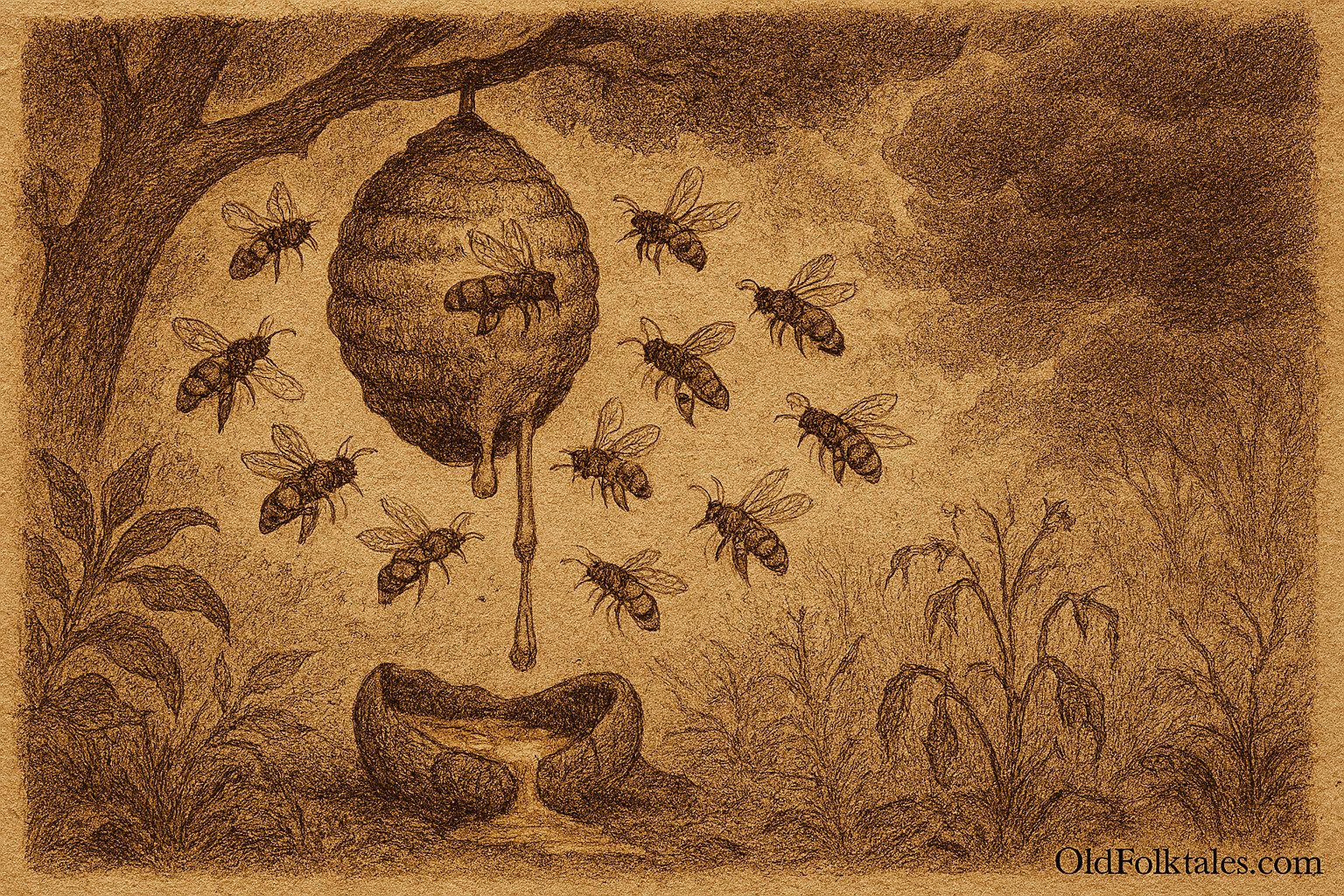
They had become bees, but not the ordinary bees that pollinated flowers and produced sweet honey. These were mbahe-cuaá, creatures that appeared similar to helpful bees but whose honey carried poison. Just as the sorcerers had appeared to be healers while actually spreading harm, so too would these transformed beings appear productive while creating toxicity.
The transformation did not end with the three original sorcerers. Tupã decreed that their descendants would also be born as mbahe-cuaá, generation after generation, a living reminder of what happens when sacred power is corrupted. The toxic bees would build their hives in the forest, producing honey that looked golden and sweet but brought sickness and pain to any who consumed it.
The Guaraní people learned to identify these dangerous bees, noting the subtle differences in their appearance and behavior that distinguished them from beneficial insects. They taught their children to be cautious, to examine before consuming, to understand that not everything that appears nourishing actually is.
But the legend served a deeper purpose than simple practical warning. When young people showed signs of developing spiritual gifts, the elders would tell them the story of mbahe-cuaá. They would explain how power, no matter how great, is meaningless without moral foundation. They would emphasize that abilities that could heal could just as easily harm, and that the choice of how to use one’s gifts defined not just individual character but could echo through generations.
“Look at the toxic bees,” the elders would say, pointing to a distant hive. “They were once human, once trusted members of our community. Their transformation was not just punishment but teaching. They remind us that those who corrupt sacred trust become sources of poison themselves, no matter how they might appear on the surface.”
The story spread throughout Guaraní territory, carried from village to village by travelers and traders. It became one of the foundational cautionary tales of the culture, invoked whenever someone with power or influence showed signs of prioritizing self interest over community welfare.
To this day, in the forests of Paraguay, there are bees whose honey must not be eaten. The Guaraní people still call them mbahe-cuaá and still tell the story of their origin. When children ask why some bees make poison instead of sweetness, their elders answer with the ancient tale, ensuring that each new generation understands the profound truth at its heart: power without morality becomes poison, and those who abuse the trust placed in them by their community ultimately poison themselves as well.
The toxic bees continue their existence, forever transformed, forever producing honey that harms rather than nourishes, living symbols of a lesson the gods deemed so important that they wrote it into the very fabric of nature itself.
Discover the sacred tales of llamas, condors, and gods who guard the Andes
The Moral of the Story
The legend of mbahe-cuaá teaches us that power and knowledge are sacred trusts that must be used for the benefit of the community, not personal gain. Those who abuse positions of trust and authority, especially when those positions involve caring for others’ wellbeing, corrupt not only themselves but potentially future generations. The story emphasizes that appearances can be deceiving and that we must examine the true nature and effects of actions rather than accepting surface presentations. Most importantly, it warns that the abuse of sacred gifts brings consequences that extend far beyond the individual wrongdoer.
Knowledge Check
Q1: Who were Yaguarú, Taperé, and Kuarahy-pytã before their transformation?
A: They were three pajés or shamans who originally possessed sacred spiritual powers meant to heal and protect their Guaraní community. However, they corrupted their gifts through greed, manipulation, and dark rituals that caused suffering, prioritizing personal power over their responsibility to serve others.
Q2: What specific abuses did each sorcerer commit?
A: Yaguarú refused to heal the poor and charged excessive fees, even turning away a dying child. Taperé manipulated people with spells that caused desire, conflict, and misfortune for his own amusement and power. Kuarahy-pytã performed dark rituals requiring pain and suffering, causing disappearances of animals and possibly children.
Q3: Why did Tupã transform the corrupt sorcerers into toxic bees?
A: Tupã transformed them into mbahe-cuaá as punishment that reflected their crimes. Just as they appeared to be healers while actually spreading harm, the toxic bees appear similar to beneficial bees but produce poisonous honey. The transformation served as both punishment and an eternal teaching tool for future generations.
Q4: What does the honey of mbahe-cuaá represent symbolically?
A: The toxic honey symbolizes how corruption can hide behind an attractive appearance. It represents actions or offerings that seem beneficial on the surface but actually cause harm, teaching the importance of examining the true nature and consequences of what we accept from those in positions of power or trust.
Q5: How do the Guaraní people use this legend in their culture?
A: The Guaraní use the mbahe-cuaá story as a cautionary tale when teaching young people with developing spiritual gifts about the responsible use of power. Elders invoke the legend to emphasize that abilities must be grounded in morality and used for community benefit, warning that corruption of sacred trust has consequences lasting through generations.
Q6: What broader lesson does this legend teach about authority and responsibility?
A: The legend teaches that those given positions of power, knowledge, or authority hold sacred trusts that must serve the community’s wellbeing. It emphasizes that abusing these positions for personal gain or causing harm to those one should protect results in corruption that transforms the abuser into a source of poison, affecting not just themselves but potentially their descendants.
Source: Adapted from traditional Guaraní oral mythology and folklore documented in Paraguayan indigenous cultural preservation records and anthropological studies of Guaraní spiritual beliefs and natural world interpretations.
Cultural Origin: Guaraní indigenous communities of Paraguay and surrounding regions, South America