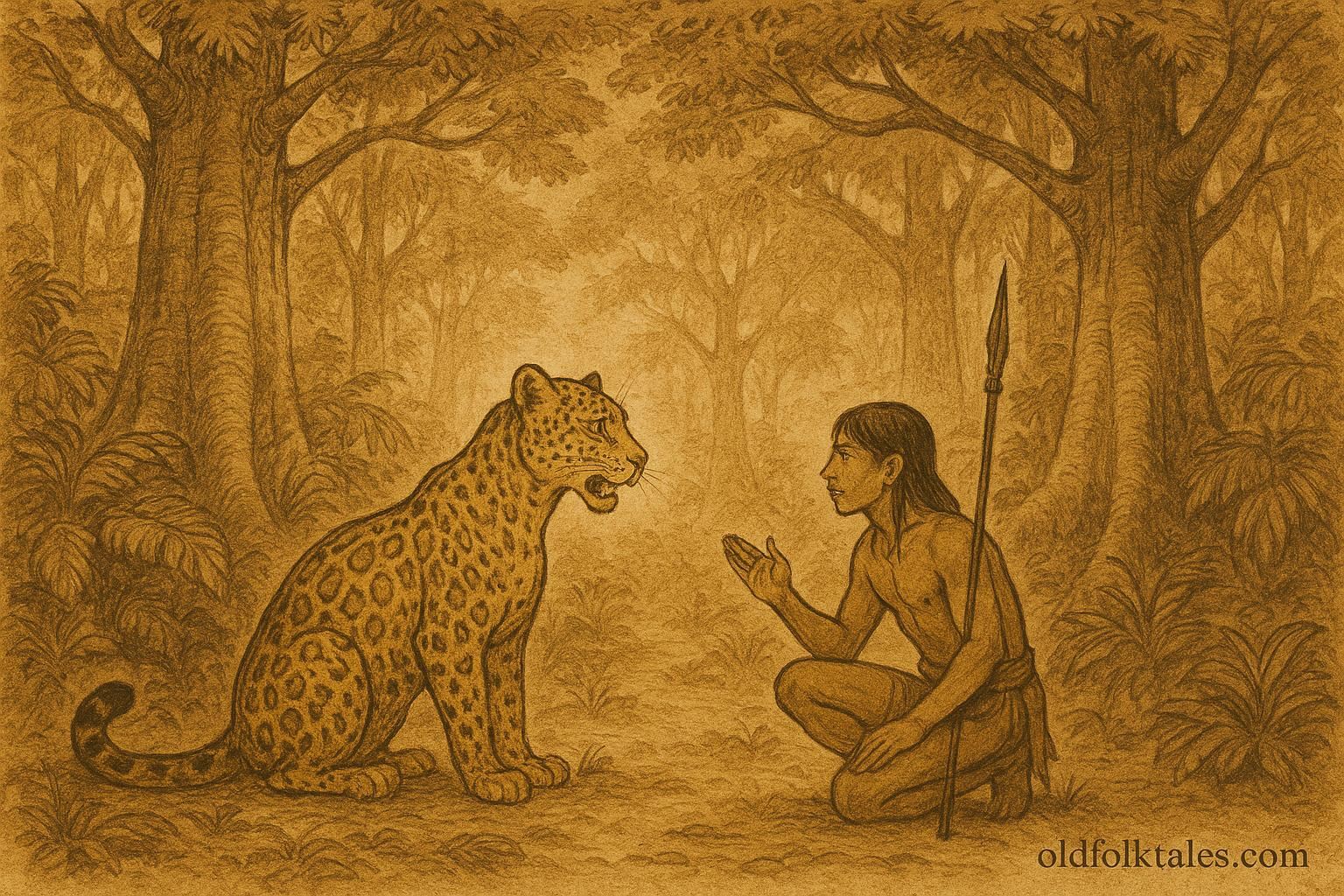
In the deep jungles of Mexico and Central America, where towering ceiba trees stitched the sky to the earth and the air hummed with unseen life, there lived a young Indigenous hunter known throughout his village for his quiet discipline. He hunted only what was needed, never wasting meat or spirit, and before each journey he offered a prayer, not just to God, as the missionaries taught, but also to the forest itself, whose presence felt older than stone.
One morning, as colonial bells rang faintly from a distant settlement, the hunter followed a narrow path into the jungle’s heart. The forest thickened, light breaking through the leaves like scattered gold. Birds fell silent. Even the insects seemed to wait.
That was when he heard a voice.
“Do you walk with respect, or only with hunger?”
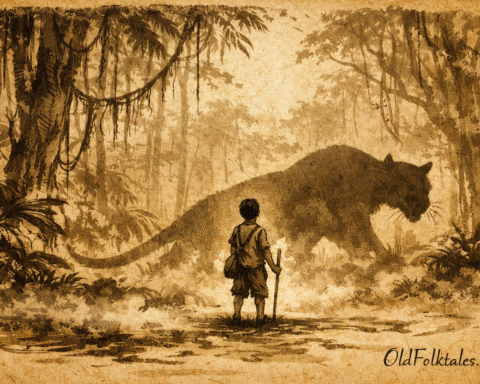
Startled, the hunter turned to find a great jaguar standing upon a fallen log. Its coat gleamed like burnished fire, eyes steady and knowing. Fear tightened the hunter’s chest, yet he did not run. Instead, he lowered his gaze and bowed his head.
“I walk with care,” he replied. “I take only what I need, and I honor what I take.”
The jaguar studied him in silence. In stories whispered by elders, the jaguar was more than flesh—it was guardian, judge, and spirit. Few ever saw it. Fewer still lived to speak of it.
“You speak truth,” the jaguar said at last. “But words are easy. Walk with me, and let your deeds answer.”
The jaguar led the hunter deeper into the jungle, where the land grew tangled and wild. Along the way, they encountered a wounded deer caught in a snare, left by careless hands. The jaguar watched closely.
“What do you do?” it asked.
The hunter freed the animal, easing its pain, though it meant returning home empty-handed. The jaguar nodded, its tail swaying slowly.
Further on, they reached a river where gold flecks shimmered beneath the water. The jaguar spoke again. “Take what you wish. No one will know.”
The hunter knelt but did not reach for the gold. “Riches taken without need poison the spirit,” he said. “The forest gives enough without greed.”
As dusk fell, they came upon a clearing where colonial officials had ordered trees cut for timber. The stumps bled sap, and the ground lay bare. The jaguar’s voice grew heavy.
“The forest weakens when balance is broken. Will you speak when others refuse to listen?”
The hunter hesitated. To challenge authority invited punishment. Yet he remembered his people, the river, the animals. He lifted his head.
“I will speak,” he said quietly. “Even if my voice shakes.”
At the jungle’s edge, the jaguar stopped. “You have chosen well,” it said. “Remember, strength is not dominance, but responsibility.”
With that, the jaguar vanished into shadow.
The hunter returned to his village changed. He spoke against wasteful hunting and careless cutting. Some laughed. Others listened. Slowly, habits shifted. The forest endured.
Though colonial rulers dismissed such tales as superstition, the story survived, spoken softly around fires, reminding each new generation that wisdom listens, courage speaks, and nature remembers.
Moral Lesson
This folktale teaches that true strength lies in integrity, humility, and respect for the natural world. Wisdom comes to those who act ethically even when unseen, and harmony endures when humans treat nature as a partner rather than a possession.
Knowledge Check
1. Who is the main character in The Talking Jaguar?
A young Indigenous hunter known for respect, restraint, and moral discipline.
2. What does the jaguar symbolize in the story?
The jaguar represents spiritual authority, natural law, and moral judgment.
3. What lessons does the jaguar test the hunter on?
Integrity, courage, honesty, restraint, and respect for nature.
4. How does the story reflect Spanish Colonial influence?
It blends Indigenous spiritual beliefs with moral instruction valued in colonial storytelling.
5. Why is greed rejected in the tale?
Because it disrupts balance, harms the community, and weakens spiritual integrity.
6. What cultural purpose did this folktale serve?
It taught ethical behavior, environmental respect, and moral courage through oral tradition.
Source: Colonial Latin American oral folklore; Indigenous-Christian syncretic traditions
Cultural Origin: Mexico and Central America (Spanish Colonial period)