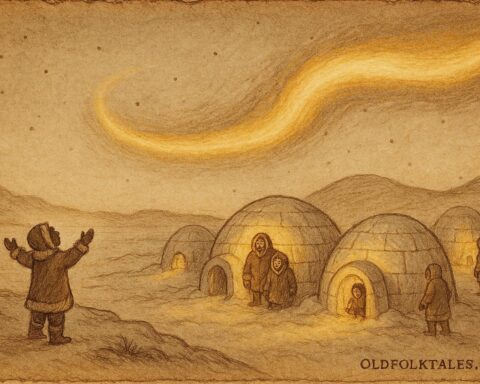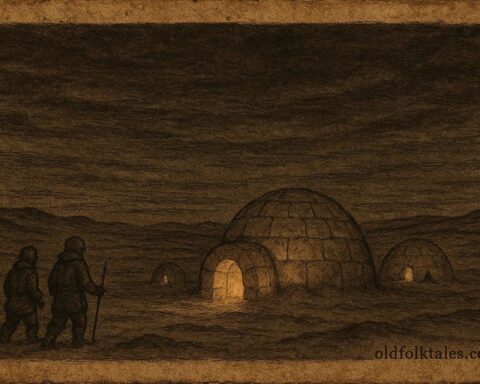
Long ago, when the earth was still young and the northern wind spoke in the language of spirits, the tundra stretched endless and silent. There were no towns, no ships, no fences only snow, stone, and sky. The people who lived there were few, moving with the caribou and seals, their hearts bound to the land that gave and took in equal measure.
Among them lived a woman named Anana. She was known for her strength and her kindness, for she could sew the thickest hides, calm wild dogs, and share her last meal with anyone who passed her fire. Her laughter warmed even the coldest nights. Yet she lived alone, for her husband had been lost years before while hunting on the frozen sea. Still, Anana never turned bitter. “The land is my family,” she would say, “and the wind carries their voices.”
One winter, colder than any before, the sky turned pale and the winds roared without rest. The seals vanished from the ice, the snow fell too deep for travel, and hunger crept through the people’s tents. Children cried through the nights. The hunters returned empty-handed.
Anana saw her neighbors growing weak and desperate. She gave away her last dried fish, her last scraps of seal fat, and even the boots from her feet. “The earth will remember kindness,” she told them. “The ice always listens.” But when her stores were gone, she had nothing left for herself.
Explore the ancestral legends of Canada, Mesoamerica, and South America’s Indigenous tribes
That night, she went out into the storm. The snow swirled like ghosts, and the cold bit deep into her skin. She fell to her knees on the open tundra and called out, “Great Mother of the Land, hear me! If my body can bring warmth or safety to my people, then take it. Let my life feed theirs.”
The wind quieted. The snowflakes stopped midair, hanging like stars. From the darkness came a deep, gentle voice—the voice of the Earth itself.
“Your heart is full of giving,” said the voice. “Your spirit shines like the moon upon new snow. But if I grant your wish, you will no longer walk among them.”
Anana bowed her head. “Then so be it.”
The land trembled. The ground beneath her turned soft and glowing. The snow melted around her knees. Light rose from her skin, spreading across the horizon. Slowly, her legs hardened into stone, her arms became the shape of cliffs, and her hair streamed behind her like frozen rivers.
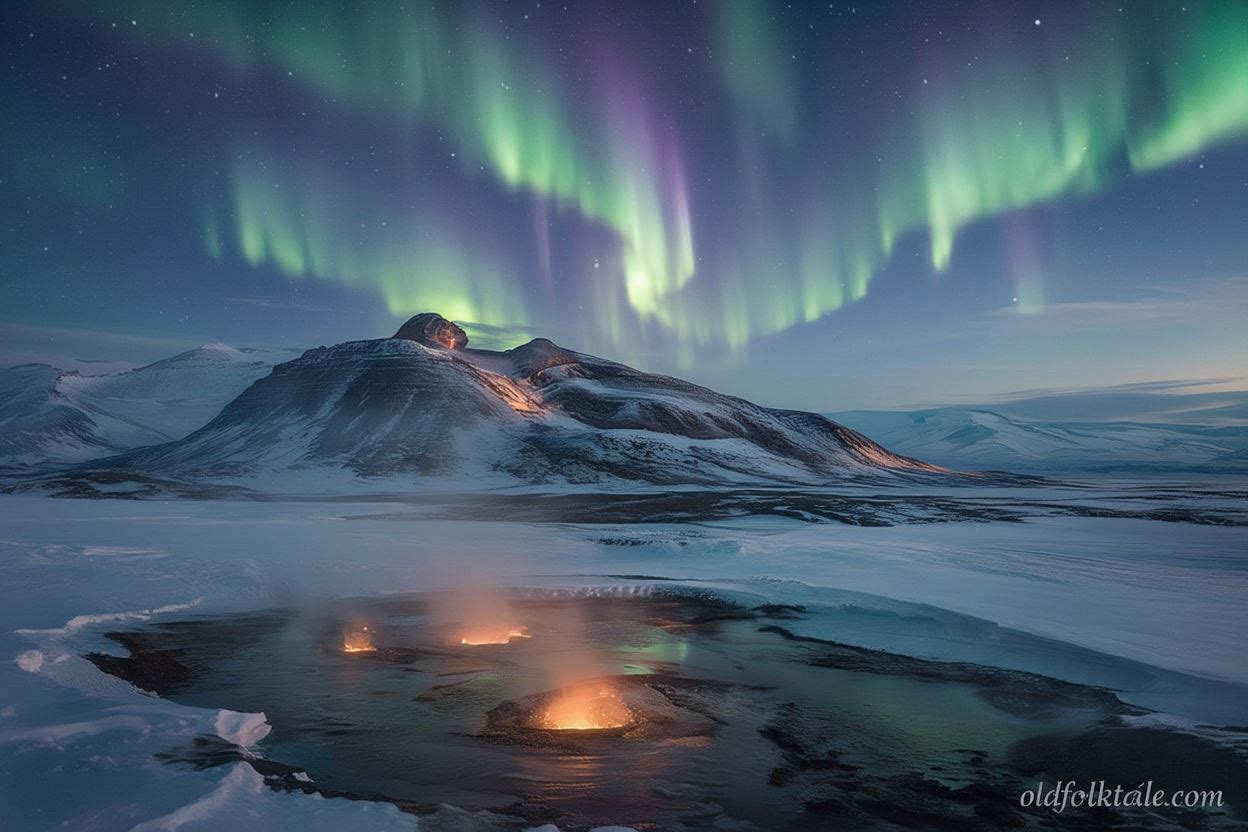
When the storm passed and the hunters awoke, they saw a new mountain on the edge of the tundra, a woman’s shape carved of rock and ice, her face forever turned toward the village. At her feet, warm springs bubbled up from the earth, bringing life to the frozen ground. The people gathered around and wept, for they knew it was Anana.
They built their tents near the springs, and for the first time in many moons, the land grew kind again. Fish returned to the rivers, the caribou crossed the plains once more, and moss began to grow where her stone fingers touched the soil. The people survived the great winter, and when they looked at the mountain glowing in the pale sun, they felt her warmth watching over them.
Years passed. Children grew and learned the story of Anana, the woman whose love became the land itself. They placed small offerings of flowers and food at the base of the stone figure each spring, whispering, “Thank you, Mother of the Tundra.”
But one year, a group of strangers came from far across the sea. They wore thick coats of fur and metal, carrying tools that bit into the rock. They did not know the land’s spirit. They looked at the mountain and said, “There is iron here. There is treasure beneath her feet.”
The villagers begged them not to touch the sacred stone. “She is not a mountain,” they cried. “She is our protector. She gave her life for us.”
The strangers laughed. “You tell children’s tales,” they said, and struck their hammers into the rock.
That night, the wind howled across the plains like a wounded animal. The springs turned cold, the moss withered, and snow began to fall harder than ever before. The strangers tried to flee, but the ground cracked beneath them, swallowing their fires whole.
When morning came, their tools were gone, buried in a drift of ice. The people found a single new ridge of rock where the hammers had fallen, shaped like a broken hand reaching toward the sky. The villagers bowed their heads. They knew Anana had protected them once again, sealing the greed of men beneath her frozen skin.
From then on, no one dared to harm her stone form. Hunters passed by her mountain and left small carvings or drops of oil as thanks. Mothers sang lullabies about her sacrifice, and elders said that when the northern lights shimmer, Anana’s spirit is walking the tundra, watching her people with love.
To this day, travelers in the Canadian Arctic tell of a mountain shaped like a woman kneeling toward the horizon. They say that if you touch the rock when the aurora glows above, it feels warm like a heartbeat deep within the stone.
Moral Lesson
True love is measured not in words, but in the sacrifices we make for others. Selflessness endures beyond death, and the spirit of generosity gives life to the land itself.
Knowledge Check
-
Who was Anana?
A kind and generous woman who cared for her people during a harsh winter. -
What happened when she prayed to the spirit of the land?
The earth transformed her into a mountain to protect and sustain her people. -
What miracle appeared after her transformation?
Warm springs emerged at the base of her stone form, bringing life to the frozen tundra. -
What happened when strangers tried to harm the sacred mountain?
A storm destroyed their tools and buried them, showing the land’s protection. -
What do the Inuit people believe about the mountain today?
They believe Anana’s spirit still guards them, her warmth alive in the northern lights. -
What is the central message of the story?
That love and sacrifice create lasting harmony between people and nature.
Source: Adapted from Inuit oral traditions in Voices of the North Wind by Margaret Blackstone (1963), Ottawa: Northern Heritage Press.
Cultural Origin: Inuit (Canadian Arctic)