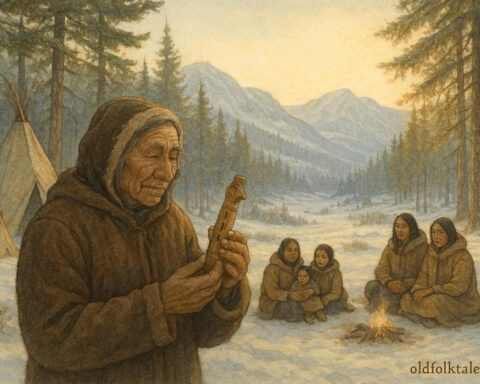
In the rolling hills and dense cedar forests of Interior British Columbia, the Secwépemc people had long lived in harmony with the land. Amid the towering evergreens and winding streams, there was a small clearing, bathed in sunlight during the day and silvery moonlight at night. At the center of this clearing sat a remarkable stone seat, smooth and polished by generations of use and careful upkeep. Its surface was cool to the touch, yet imbued with a warmth that seemed to respond to the intentions of those who approached it.
The elders said that the seat was a gift from the ancestors, carved from sacred stone to honor the principles of leadership and community. “This stone will accept only those whose hearts are pure and whose intentions serve the people,” they said. “Arrogance will be rejected, pride will be denied, and those who seek power for themselves will find the seat cold and unyielding.”
For decades, young men and women had tried to claim the seat. Some saw it as a symbol of prestige, a way to gain recognition among their peers. Others thought that sitting on it would grant them strength or authority beyond their years. Each time, the stone proved wise beyond their desire. It refused their weight, offering no support. Some stumbled as they tried to sit, feeling a chill run through their limbs. Others sat but found no warmth, no comfort, no sense of connection. The stone offered a silent lesson: leadership is not for the self, but for the good of all.
Discover ancient tales passed down by the Indigenous peoples of the Americas.
One summer, a young woman named Tsenet approached the stone seat. She had watched others attempt to claim it with pride or trickery and had heard of the chill and rejection that followed. Unlike the others, she approached the seat without ambition or desire for recognition. She came seeking guidance, wisdom, and the chance to serve her community. She knelt before the stone, laying her hands gently upon it, feeling the coolness seep into her fingers. She closed her eyes and listened, not just to the voices of the elders around her, but to the whispers of the wind in the cedars, the song of the nearby stream, and the faint hum that seemed to rise from the stone itself.
The elders watched silently, knowing that Tsenet’s intentions were sincere. They could see the care in her movements, the humility in her posture, and the quiet determination in her eyes. When she finally settled onto the stone, it accepted her. Warmth spread through her body, a gentle radiance that seemed to echo from the stone into the surrounding clearing. She felt connected to the ancestors, to those who had guided the people for generations, and to the entire Secwépemc community. The elders nodded in approval, for they knew that the stone had recognized a heart aligned with service, not self-interest.
Tsenet’s acceptance of the stone seat was not just a personal achievement; it became a lesson for all who witnessed it. The stone seat did not give power—it revealed who was worthy of it. True leadership, she understood, was not about commanding others or seeking praise. It was about listening, observing, guiding, and acting in the interest of the people. It required humility, patience, and the willingness to place the needs of the community above personal desire.
After that day, Tsenet spent time learning from the elders, tending the cedar groves, and assisting in communal decisions. Each time she approached the stone seat, it welcomed her, reinforcing the connection between intention and responsibility. She learned that those who came with pride or ambition would still find the stone cold and unyielding. Those who came to listen, to serve, and to act with integrity would find warmth and guidance.
The story of the stone seat spread among the youth of the village. Children and adolescents were told about the stone not as a tale of magic alone, but as a living reminder of the values that sustained their people. It became a rite of passage to approach the seat with mindfulness, to test one’s intentions and learn the weight of responsibility. Even those who never sat upon it carried the lesson in their hearts: leadership is earned, not taken.
Seasons passed, and Tsenet grew into a respected leader. She never sought power for its own sake. Her decisions reflected patience, empathy, and understanding. The stone seat continued to stand at the clearing, its presence a constant reminder of ancestral wisdom. It was not merely a seat; it was a teacher, a guardian of communal values, and a mirror of the hearts of those who approached.
Through the stone seat, the Secwépemc people learned that leadership is inseparable from service, that authority is inseparable from responsibility, and that the balance of community depends on humility and integrity. Even today, elders remind the young: the stone seat does not belong to those who seek glory, but to those who listen, observe, and act for the good of all.
Moral lesson
True leadership is earned through humility, patience, and service. Authority taken for personal gain is rejected, while responsibility undertaken for the community is honored.
Knowledge check
- Why did the stone seat reject some people?
It rejected anyone seeking personal gain, recognition, or authority without humility. - Who successfully sat on the stone seat?
Tsenet, a young woman who approached with humility and a desire to serve. - What does the stone seat symbolize?
The living measure of true leadership and moral character. - Why is leadership not given freely according to this story?
Because authority must reflect service and responsibility to the community, not ambition or pride. - How did the elders use the stone seat to teach values?
They allowed it to reveal the intentions of those who approached, reinforcing lessons of humility and communal duty. - Which First Peoples cultural group does this story originate from?
Secwépemc First Peoples, Interior British Columbia, Canada.
Source: Adapted from Indigenous leadership teachings; Native-Languages.org
Cultural origin: Secwépemc First Peoples, Interior British Columbia, Canada