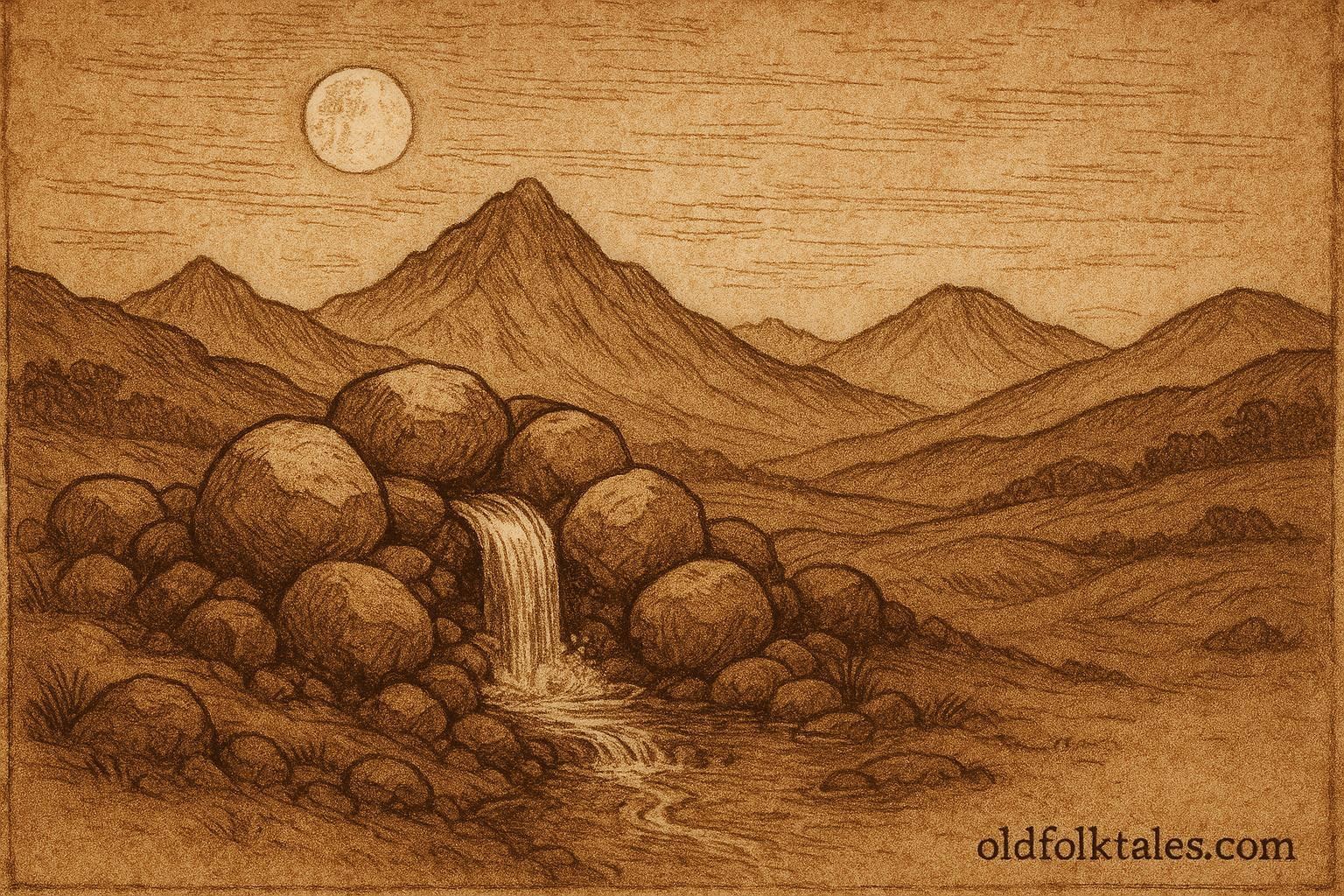
High on the Andean plateau of what is now Bolivia, where the air thinned and the land stretched wide beneath the sky, there was a village that depended on a single spring. It rose quietly from between two stones at the base of a low ridge, clear and cold even during the driest seasons. The people called it Jach’a Uma, the Great Water, though it was no wider than a child’s arm.
The spring never dried. When rivers shrank and lakes receded, it continued to flow, steady and patient. The elders said it was not fed by snow or rain alone but by agreement. Long ago, they taught, the water had listened to the people and decided to remain.
From the beginning, rules governed its use. Water was drawn only during daylight. No one washed tools or animals at the source. No vessel was filled beyond need. At dusk, when shadows lengthened and the mountain peaks darkened, the spring was left alone.
Children were warned never to approach it at night.
“The water sleeps,” the elders said. “And sleeping things must not be disturbed.”
For generations, the rules were followed. The spring provided enough for drinking, cooking, and small gardens. No one claimed it as property. No fence marked it. Respect was its only protection.
Then the village grew.
New families settled nearby, drawn by the reliability of the water. With more people came more need, and with need came impatience. Some began drawing water late in the evening, arguing that thirst did not obey the sun. Others filled extra jars “just in case.” A few washed their hands directly in the spring, letting soapless but careless fingers cloud the surface.
The elders noticed the change.
At council meetings, they spoke gently but firmly. They reminded the people that water was not endless simply because it had always been there. They repeated the old teaching: what gives life can also withdraw it.
Some listened. Others smiled politely and continued as before.
The first night the spring closed, no one saw it happen.
A young herder named Kusi had stayed late repairing a broken strap. When he went to the spring after sunset, carrying an empty gourd, he found only stone. The gap where water usually emerged was dry, smooth, and cool to the touch.
Confused, he waited. He pressed his ear to the ground. There was no sound of flow.
At dawn, the spring returned as if nothing had happened.
Kusi told no one, thinking it a mistake or his own exhaustion. But the next night, another villager found the same absence. Then another. Soon, it was clear that after sunset, the spring vanished completely.
Panic spread.
People began guarding the spring at night, lighting torches and keeping watch. Each evening, as the sun dipped below the ridge, the water thinned, slowed, and finally disappeared. By morning, it returned, cold and full.
Arguments erupted. Some accused others of hiding water. Some blamed spirits. A few demanded that the elders “fix” the problem.
Elder Nayra, whose hair had turned the color of ash, listened without interruption. When the shouting stopped, she spoke quietly.
“The spring has not failed us,” she said. “It has corrected us.”
She explained what the elders had long known but rarely spoken aloud. The spring was believed to be guarded by an achachila, an ancestral presence bound to the land. It did not punish. It adjusted. When use became careless, it reduced access. When respect weakened, it restored balance.
“The water closes its eyes at night,” Nayra said. “Because we forgot how to stop ourselves.”
Not everyone accepted this explanation. Some villagers attempted to dig around the stones, hoping to find the hidden source. Each pit filled briefly with dampness and then dried completely. Others tried to camp beside the spring to claim priority access at dawn, but the water always returned slowly, ignoring their urgency.
Weeks passed. Gardens suffered. Tempers frayed.
Finally, the council imposed a change.
Water collection was limited by household, measured not by containers but by purpose. Evening gatherings were held near the spring, not to draw water, but to acknowledge it. Elders retold the old stories. Children were brought to listen. No one approached the source after sunset.
Slowly, the urgency eased.
One night, during a festival, the spring behaved differently. Though the sun had set, the water remained visible, shimmering faintly under the moon. No one dared touch it. At dawn, it flowed stronger than before.
From that time on, the spring still closed at night but only when restraint weakened. The people learned to read its rhythm. It became a teacher rather than a mystery.
Travelers passing through heard the rule and laughed quietly, until they saw the stones themselves. Those who ignored the custom left thirsty. Those who listened understood.
To this day, the people say the spring does not belong to the village. The village belongs to the spring.
Click to read all South American Folktales — timeless stories from the Andes to the Amazon.
Moral Lesson
This folktale teaches that conservation begins with restraint. Resources endure not because they are abundant, but because communities choose limits. Respect for water ensures its continuity, while misuse invites withdrawal.
Knowledge Check
- What made the spring unique in the village?
Answer: It never dried and reliably provided water even during droughts. - When did the spring disappear?
Answer: After sunset. - Why did the spring begin closing at night?
Answer: Because people misused and wasted water. - Who explained the meaning of the spring’s behavior?
Answer: Elder Nayra. - What belief explained the spring’s actions?
Answer: It was guarded by an ancestral presence that enforced balance. - What lesson did the villagers ultimately learn?
Answer: That restraint and respect are necessary for conservation.
Source: Adapted from Andean Water Spirits and Community Law, Instituto de Estudios Andinos (2002)
Cultural Origin: Aymara peoples, Bolivia