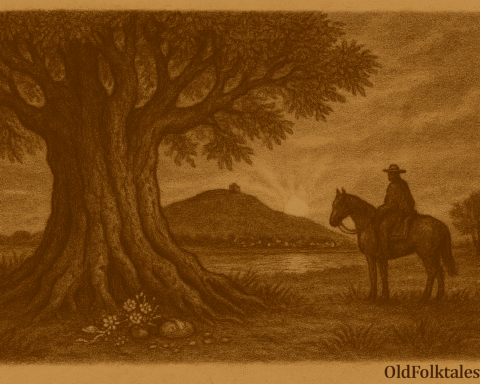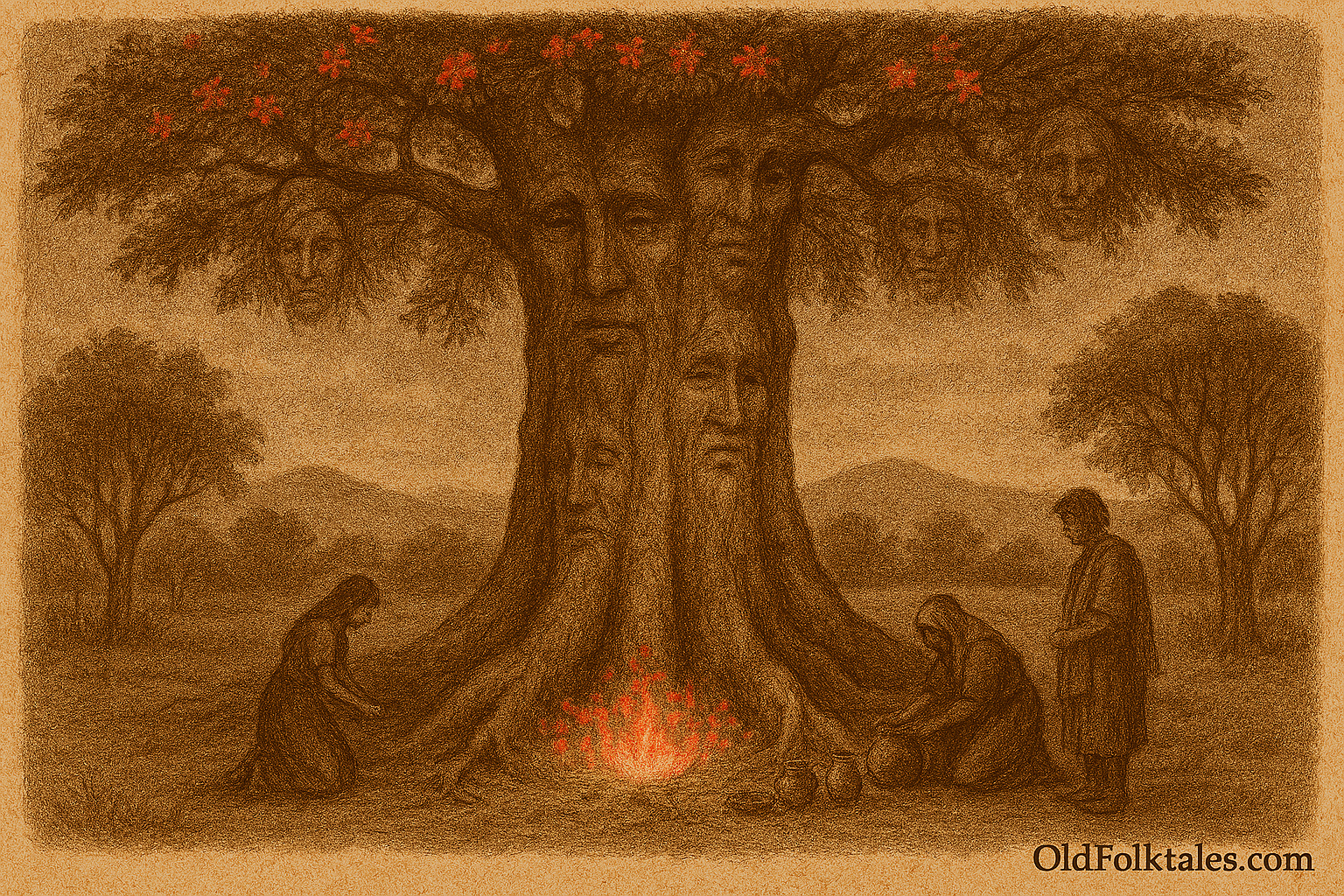
In the heart of Paraguay’s lush countryside, where rivers snake through emerald forests and the red earth yields abundant life, there once stood a ceibo tree unlike any other. Its massive trunk rose from the ground like a pillar supporting the sky itself, its gnarled bark telling stories written across centuries. The tree’s branches spread wide and generous, creating a canopy so dense that even the fiercest summer sun could barely penetrate its shade. During the flowering season, the ceibo burst into magnificent crimson blooms, each petal like a flame dancing against the green backdrop of the forest.
But this was no ordinary tree. The indigenous Guaraní people who lived in its shadow knew the ceibo as something far more sacred a dwelling place for the spirits of their ancestors, a bridge between the world of the living and the realm of those who had passed beyond. The elders spoke of it in hushed, reverent tones, teaching each new generation that the tree was protected, blessed, and alive with a power that demanded respect.
Click to read all South American Folktales — timeless stories from the Andes to the Amazon.
The village that grew near the sacred ceibo thrived under its watchful presence. Families built their homes within sight of its towering form, drawing comfort from its permanence. Children played in its shade during the hottest hours of the day, listening to their grandmothers tell tales of how the tree had stood there long before any of them were born, and how it would remain long after they joined the ancestors within its trunk.
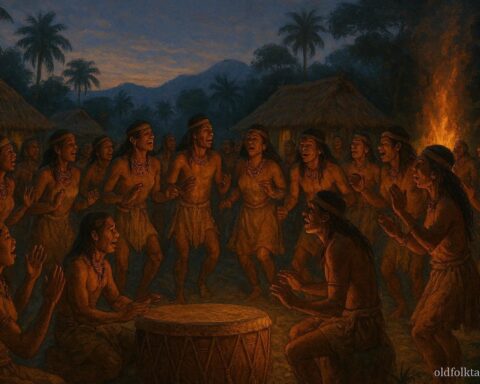
The people honored the ceibo with offerings flowers woven into garlands, bowls of chicha placed at its roots, prayers whispered into the wind that rustled through its leaves. Before any important decision, the village elders would gather beneath its branches to seek guidance, believing that the ancestral spirits could hear their concerns and send signs through the movement of leaves or the songs of birds that nested in the tree’s arms.
In return for this devotion, the sacred ceibo blessed the community abundantly. Women who struggled to conceive would visit the tree, pressing their hands against its ancient bark and asking the ancestors for the gift of children. More often than not, within the turning of seasons, their prayers were answered. Fields planted near the ceibo produced crops that grew tall and strong, their yields surpassing those of more distant plots. When illness threatened the village, healers would gather bark from fallen branches never cutting from the living tree to brew medicines that restored health with remarkable speed.
The tree’s protection extended beyond physical blessings. Families who made their offerings faithfully found their homes spared from floods when the rivers swelled, their livestock healthy when disease struck neighboring herds, their paths safe when jaguars prowled the forest at night. The ceibo stood as both guardian and benefactor, asking only for respect and reverence in exchange for its gifts.
But not everyone understood the sacred bond between the people and the tree. One year, a man came to the village from distant lands a merchant seeking timber for his trade. His eyes, accustomed to seeing only profit, looked upon the magnificent ceibo and saw not a sacred dwelling of spirits but a fortune waiting to be harvested. The wood of such an ancient tree would be dense and valuable, worth more than anything else in the forest.
The villagers warned him. The elders explained the tree’s sacred nature, told him of the ancestral spirits who called it home, cautioned him that cutting the ceibo without permission would bring terrible misfortune. But the merchant laughed at their superstitions, dismissing their beliefs as the foolish fears of simple people who didn’t understand the modern world of commerce and progress.
One morning, before the sun had fully risen, the merchant took his axe to the sacred ceibo. The first strike of metal against bark echoed through the forest like a scream. Birds exploded from the branches in a panicked cloud. The air itself seemed to grow heavy and thick, as if the forest were holding its breath.
The merchant ignored every sign. He swung his axe again and again, cutting deep into the ancient trunk. Sap flowed like blood from the wounds, pooling dark and thick at the tree’s base. With each strike, the merchant felt a strange chill creeping through his bones, but greed drove him forward. He was determined to fell the tree and claim his prize.
But the ancestral spirits would not allow such sacrilege to go unpunished. Before the merchant could complete his terrible work, misfortune descended upon him like a curse. His axe blade shattered, a shard of metal catching his hand and opening a wound that bled profusely. As he stumbled backward, his foot caught in the tree’s roots roots that seemed to reach up and grasp him and he fell hard against the ground.
In the days that followed, the merchant’s condition worsened. The wound on his hand refused to heal, becoming infected despite all treatments. Fever gripped him, and in his delirium, he claimed to see faces in the darkness ancient, stern faces that spoke in languages he couldn’t understand but whose anger he felt in every fiber of his being. His mind began to slip away, haunted by nightmares of roots growing through his body, of bark covering his skin, of being absorbed into the very tree he had tried to destroy.
The villagers, despite their anger at his transgression, took pity on the suffering man. Their healers tended to him while the elders performed ceremonies beneath the wounded ceibo, asking the ancestral spirits for mercy. They made offerings of their finest goods, sang songs of apology, and promised to guard the tree even more carefully.
Slowly, grudgingly, the spirits’ anger subsided. The merchant recovered enough to leave the village, though he was forever changed his body weakened, his mind marked by what he had witnessed, his hands trembling whenever he held any tool. He departed with nothing but the clothes on his back, leaving behind his ambitions of wealth and carrying instead a hard-learned lesson about the cost of disrespecting the sacred.
The ceibo tree, though wounded, survived. The villagers treated its injuries with reverence, sealing the cuts with sacred mud and offering prayers of healing. Within time, the tree’s remarkable vitality showed through as new growth covered the scars. It continued to stand as it always had a monument to the power of ancestral spirits, a reminder that some things in this world are too sacred for mortal hands to claim, and a symbol of the blessings that flow to those who honor what is holy.
Explore Andean folklore — stories born from highland valleys and Incan legends
The Moral Lesson
This legend teaches the fundamental importance of respecting sacred spaces and honoring the spiritual beliefs of communities connected to the land. The ceibo tree represents the bond between humanity and nature, between the living and their ancestors, and between material desires and spiritual values. When we approach the sacred with reverence and humility, we receive protection and abundance. But when greed blinds us to the spiritual dimension of life and we take without permission what should never be taken, we invite suffering and loss. True prosperity comes not from exploitation but from living in harmony with the sacred forces that sustain us.
Knowledge Check
Q1: Why was the ceibo tree considered sacred by the Guaraní people of Paraguay?
A: The ceibo tree was believed to house the spirits of ancestors, serving as a bridge between the living and the dead. It was a dwelling place for ancestral spirits who protected and blessed the community.
Q2: What blessings did the sacred ceibo tree provide to those who honored it?
A: The tree granted fertility to women struggling to conceive, ensured abundant crop yields, provided healing through its bark for medicines, and protected families from floods, disease, and predators when they made proper offerings.
Q3: What happened to the merchant who tried to cut down the sacred ceibo tree?
A: The merchant suffered immediate misfortune his axe shattered and wounded him, he fell and became trapped by the roots, then developed an infection and fever with delirium. He was haunted by visions of angry ancestral spirits and left the village broken in body and mind.
Q4: How did the villagers show their respect for the ancestral spirits in the ceibo tree?
A: They made offerings of flowers, food (chicha), and prayers at the tree’s roots. They gathered beneath it for important decisions, used only fallen branches for medicine, and performed ceremonies asking for guidance and blessings.
Q5: What does the ceibo tree symbolize in Paraguayan Guaraní culture?
A: The ceibo symbolizes the connection between past and present generations, the importance of respecting nature’s sacred spaces, ancestral wisdom and protection, and the reciprocal relationship between humans and the spiritual world.
Q6: What is the significance of seeking permission before interacting with sacred natural sites?
A: The legend emphasizes that sacred sites are not commodities to be exploited but spiritual entities deserving reverence. Seeking permission through prayer and offerings acknowledges the spirits’ presence and authority, maintaining the balance between human needs and spiritual respect.
Source: Adapted from Paraguayan plant-origin legends documented by Carlos Villagra Marsal and the Portal Guaraní folklore archives.
Cultural Origin: Guaraní Indigenous People, Paraguay