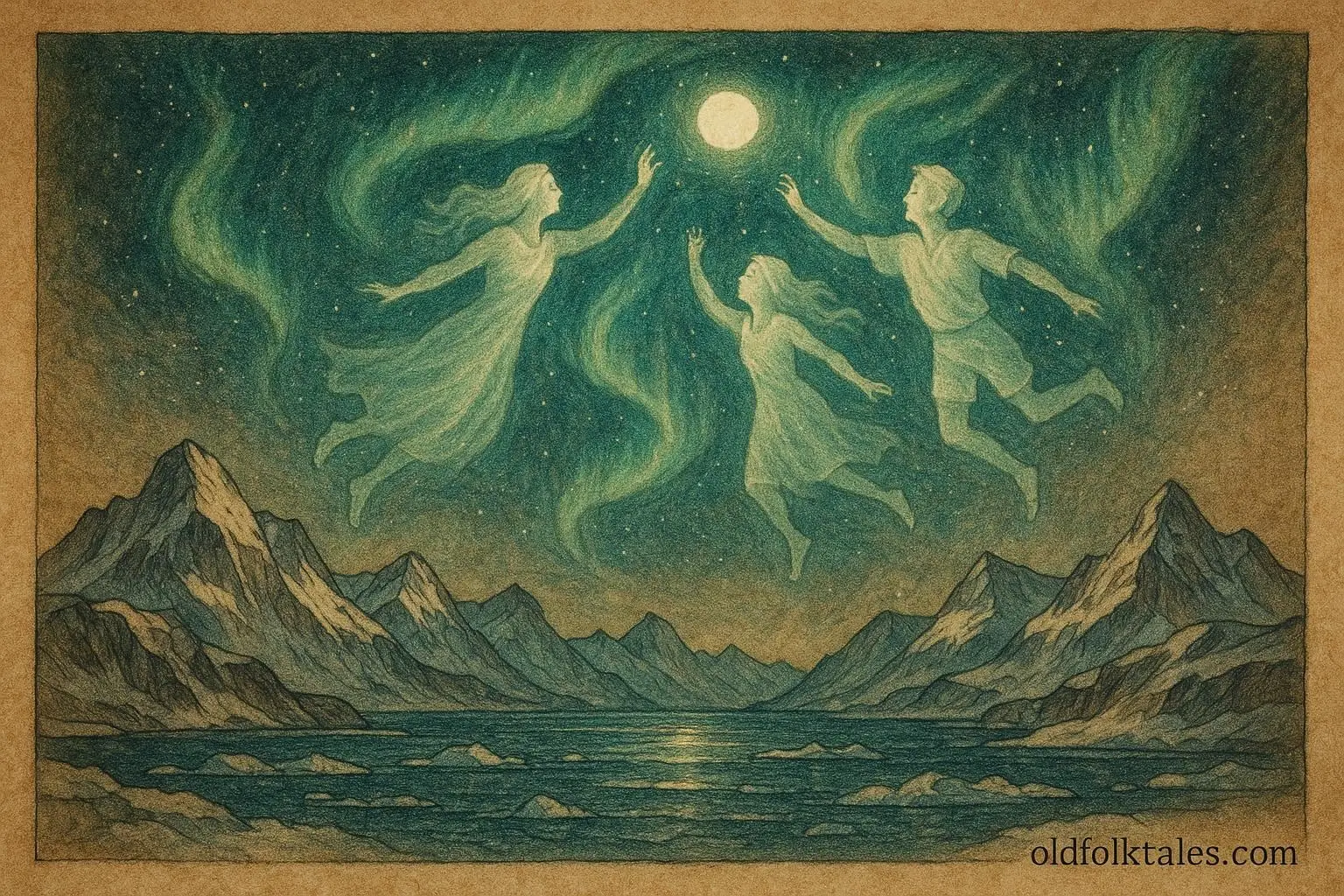
On long winter nights in the Arctic, when the air is still and the stars shine like diamonds, the sky sometimes comes alive with colors that move and shimmer like living fire. Curtains of green, pink, and violet light ripple above the frozen land, twisting and turning as if unseen hands were drawing across the heavens. The Inuit call this breathtaking sight the dance of the spirits, and for countless generations, they have told stories about the Northern Lights that fill the darkness with meaning and wonder.
In the time before stories were written down, when knowledge passed through song and memory, the elders would gather the children inside snow houses or under sealskin tents. As the wind howled outside and the lamps burned low, the youngest would look up through the smoke hole and ask why the sky was glowing. The elders would smile, their faces glowing in the flickering light, and say, “Do not be afraid. Those are the spirits of our ancestors playing in the sky.”
According to the old belief, the Northern Lights are not just a beautiful sight but a living message from those who came before. When the lights appear, it means that the souls of the departed are happy. They have reached the land of the afterlife, a place beyond the cold and hunger of the earthly world. There, they dance and laugh, playing a game that reminds them of their days on earth. Some say they use a walrus skull as their ball, tossing it back and forth with joy, their laughter carried down to earth in the whispering of the wind.
Discover Mexico’s timeless tales blending Indigenous roots and Spanish tradition
Sometimes, when the lights move swiftly and brightly, people say the spirits are dancing with excitement. When they move slowly and softly, the spirits are peaceful and content. To the Inuit, this shimmering dance is a reminder that life and death are part of the same great circle, and that the love of family continues even after the body is gone.
But not all stories of the Northern Lights are gentle. Some elders warn that the lights must be treated with respect. Children are told never to mock the lights or whistle at them, for doing so might draw the spirits down from the sky. They could reach out with their glowing hands and take the person up to join their game forever. When the aurora brightens suddenly, it is said to be the spirits responding to someone’s voice. To show respect, people lower their heads, whisper prayers, or clap their hands softly to greet the ancestors watching from above.
Other versions of the legend tell that the Northern Lights are the torches carried by spirits who watch over the living. When travelers cross the ice or hunters return late from the sea, the ancestors light the sky to guide them safely home. The glowing arcs and ribbons of color are their lamps, shining across the heavens so that no one is lost in the vast Arctic darkness.
In some villages, the people say that when the aurora appears, it is a time to be quiet and thankful. Families gather outside their homes, watching the lights move, speaking softly so the spirits can hear their gratitude. They thank their ancestors for keeping the land alive, for sending good weather, and for guiding the hunters and fishers through the dangers of the north.
There are even songs passed down through generations that call to the Northern Lights. The melodies are slow and haunting, sung in low tones that mimic the rhythm of the lights themselves. Some say that if you listen closely, you can hear the spirits singing back, their voices echoing faintly across the frozen tundra. The people who live close to the land understand that the aurora is not just light but memory. It is the bridge between the living and the dead, a reminder that love does not fade, even in the coldest of winters.
Elders teach that when a person dies, their spirit joins the great dance in the sky. The colors of the aurora represent their joy in being free from pain and their happiness in watching over their descendants. When a family loses someone dear, and the lights appear soon after, they take comfort in believing that the departed soul is safe and smiling above them.
To see the aurora is to feel the heartbeat of the world itself. The flickering colors reflect the constant rhythm of life, death, and renewal that defines the Arctic. In a land where darkness lasts for months and the cold can steal breath away, the Northern Lights remind the Inuit people that beauty and spirit endure even in the hardest times. They are the promise that no one is ever truly gone, that the ancestors remain close, lighting the sky with love.
Today, the story of the Aurora Spirits continues to be told, even as scientists explain the phenomenon as charged particles colliding with the atmosphere. For the Inuit, science does not erase the meaning. Instead, it deepens it, showing how creation itself participates in the sacred. The lights remain a mystery that connects heaven and earth, body and soul, past and present. They continue to inspire awe, respect, and unity among all who witness them.
Discover the diverse storytelling traditions of Canada — from the icy North to the Maritimes
Moral Lesson
The legend of the Northern Lights teaches reverence for the dead and gratitude for life. It reminds us that beauty in nature is never meaningless, for every color in the sky carries the memory of those who came before. Through the lights, the Inuit see a reflection of spiritual balance joy in the afterlife and love that endures beyond death. The story encourages people to treat nature with respect, to remember their ancestors, and to see the sacred in every wonder of the world.
Knowledge Check
1. What do the Inuit believe the Northern Lights represent?
They believe the lights are the spirits of the departed playing joyfully in the sky.
2. What game are the spirits said to play in the sky?
They are said to play a game using a walrus skull as a ball.
3. What warning do elders give about the Northern Lights?
They warn not to whistle or mock the lights, or the spirits might come down and take the person away.
4. How do the Northern Lights help travelers and hunters?
They are believed to be torches carried by ancestors to guide travelers safely through the Arctic night.
5. What emotion do the lights express when they move quickly and brightly?
They show the joy and excitement of the spirits.
6. What moral lesson does this legend teach?
It teaches reverence for the dead, respect for nature, and the enduring connection between the living and the spirit world.
Source: Northern Lights: The Stories Behind the Aurora Borealis by Joanna J. Wilson, 2013.
Cultural Origin: Inuit First Nations, Arctic Canada