Deep within the vast forests of the Brazilian Amazon, where towering trees knit together a green ceiling and the air hums with unseen life, there lives a powerful guardian known as the Curupira. To the people who have long called the forest home, the Curupira is not a tale of fear alone, but a warning, one meant to protect both the land and those who depend upon it.
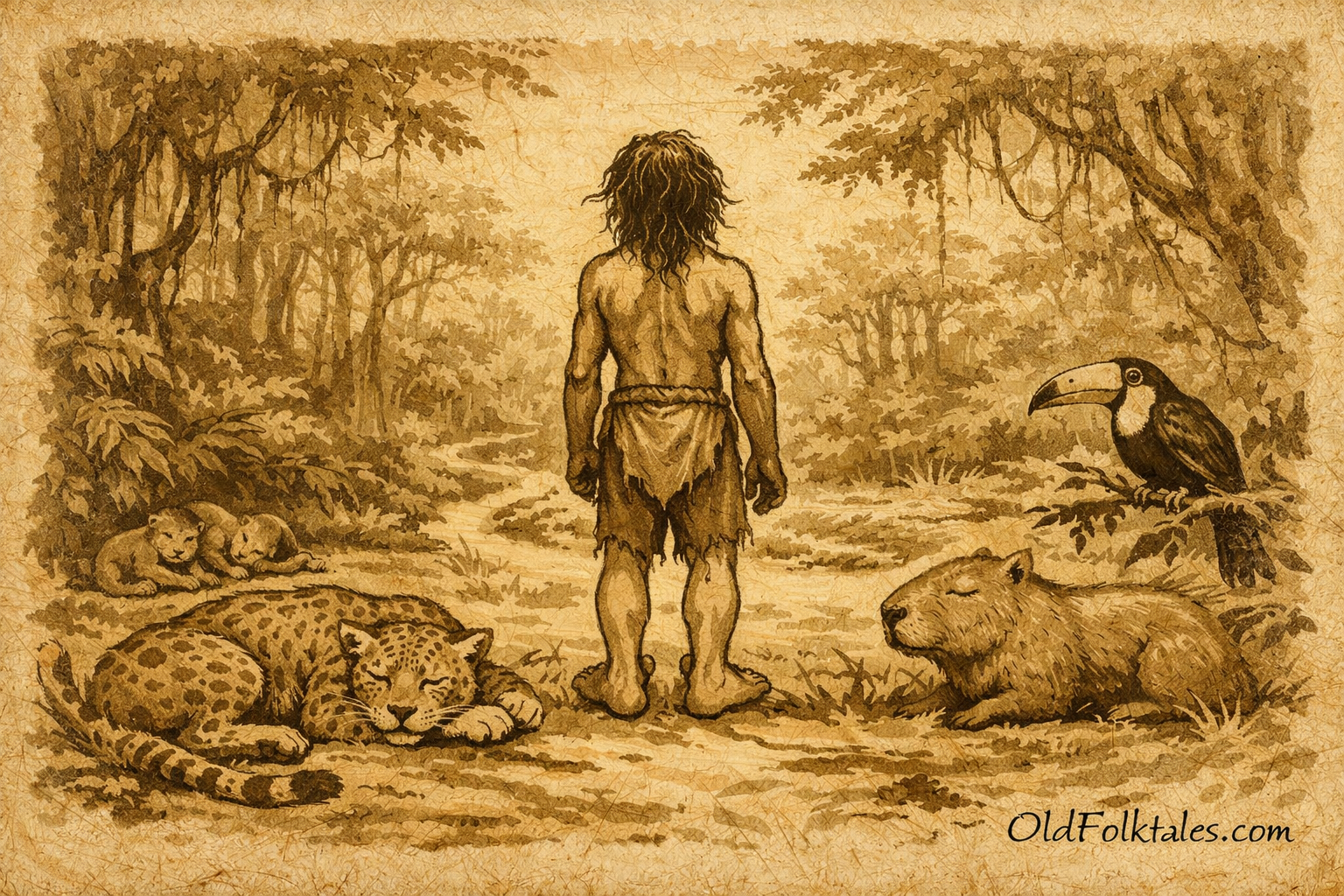
The Curupira is a forest spirit, small in stature but immense in power. His most striking feature is his feet, which face backward, heels pointing forward and toes behind. These strange feet are not a deformity, but a deliberate mark of his role. They confuse footprints and mislead those who would enter the forest with greed in their hearts.
Journey through Central America’s heartlands and hear its stories of creation, courage, and nature.
Hunters often spoke of hearing whistles echoing between the trees or laughter carried on the wind, just beyond sight. Those sounds were said to belong to the Curupira, watching silently as humans moved through his domain. The forest, after all, was not empty or lifeless. It breathed, listened, and remembered.
For generations, hunting provided food and tools for Amazonian communities. When done with care, it sustained life without harming the balance of the forest. The elders taught that animals must be taken only when needed and never wasted. But not all hunters listened.
Some entered the forest driven by greed rather than necessity. They hunted more animals than they could carry, killed for sport, or ignored the rhythms of the land. It was these hunters who most often encountered the Curupira.
At first, the forest seemed to shift around them. Paths twisted where none had before. Familiar trees appeared strange. Footprints led nowhere. The hunter would walk for hours, then days, only to find himself circling back to the same place. Panic set in as food ran out and daylight faded.
The Curupira had led them astray.
His backward feet left tracks that pointed in the wrong direction, confusing even the most experienced woodsmen. The deeper the greedy hunter wandered, the more hopeless his situation became. Some returned home exhausted and humbled. Others were never seen again, their fate absorbed into the forest’s endless silence.
Yet the Curupira was not cruel without reason. Hunters who entered the forest with respect, who took only what they needed and offered gratitude to the land, were treated differently. These hunters might glimpse the Curupira briefly, standing between the trees, watching with sharp, knowing eyes. Instead of fear, they felt guidance.
Such hunters found clear paths. They returned home safely, carrying just enough to feed their families. The forest remained whole, its animals protected, its balance preserved.
Children grew up hearing these stories beside cooking fires and beneath starlit skies. They learned early that the forest was alive and aware, that every action carried consequence. The Curupira became a symbol of the forest’s spirit itself, protective, demanding respect, and intolerant of greed.
Long before words like “conservation” existed, the Curupira taught a simple truth: survival depends on harmony with nature. Those who honor the forest are sheltered by it. Those who exploit it invite confusion, loss, and punishment.
Explore myths and legends from Brazil, Peru, and Argentina rooted in spirit and survival.
Moral Lesson
This folktale teaches that respect for nature ensures survival, while greed and excess disrupt balance and lead to punishment. The forest gives life only to those who treat it with care and restraint.
Knowledge Check
1. Who is the Curupira in Amazonian folklore?
The Curupira is a forest spirit who protects animals and guards the balance of nature.
2. What is unique about the Curupira’s appearance?
His feet face backward, confusing hunters who follow his tracks.
3. Why does the Curupira punish some hunters?
He punishes those who hunt greedily or take more than they need.
4. How does the Curupira treat respectful hunters?
He guides them safely through the forest and allows them to return home.
5. What does the forest represent in this story?
A living, aware force that responds to human behavior.
6. What lesson does the Curupira legend teach children?
That harmony with nature is essential for survival and balance.
Source: Indigenous oral tradition; Brazilian folklore records
Cultural Origin: Amazon Basin, Brazil (Tupi-Guarani traditions)