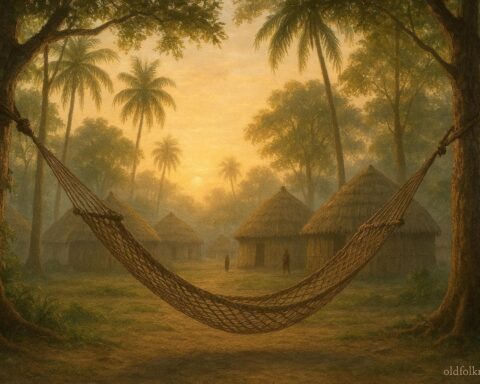
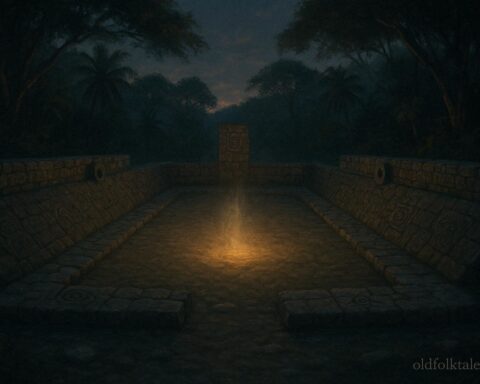
Long before the coastline of the Greater Antilles was divided by boundaries and names, there stood a wide coconut grove near the sea. The trees rose tall and graceful, their long leaves whispering whenever the wind passed through them. For generations, the people gathered coconuts from this grove, using them for food, drink, oil, rope, and shelter. The grove provided steadily, never failing, even in seasons when other crops struggled.
The elders taught that the grove endured because it was alive in more ways than one. They said a spirit dwelled among the trees, unseen but watchful, bound to the land itself. The spirit did not speak with words, but with balance. When the people took only what they needed and gave thanks, the grove flourished. When greed entered their hearts, the spirit responded.
For many years, harmony held.
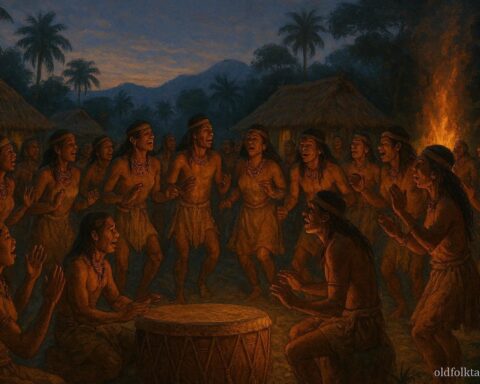
Before harvesting, villagers placed shells or woven fibers at the base of the trees. They spoke softly, thanking the grove for its gifts. Children were taught never to strike a tree in anger or waste what they gathered. Even fallen coconuts were treated with care.
Then times changed.
A man named Aru grew restless. He watched traders from distant shores pass by with heavy canoes filled with goods. He began to see the coconut grove not as a shared gift, but as untapped wealth. “The trees grow endlessly,” he told others. “Why should we limit ourselves when there is so much?”
Immerse yourself in Latin America’s stories of passion, transformation, and spirit.
At first, Aru harvested only a little more than usual. He collected coconuts before they had fully ripened. He stripped trees bare, leaving none for animals or neighbors. He stopped giving thanks, believing such gestures unnecessary.
Nothing happened immediately.
Encouraged, Aru grew bolder. He returned day after day, cutting young palms to make room for faster-growing trees. He sold coconuts in excess, storing them poorly, allowing many to spoil. When others warned him, he laughed.
“The grove exists for us,” he said. “If there is a spirit, it has done nothing to stop me.”
The first sign came quietly.
One morning, Aru found his baskets lighter than expected. Coconuts he had gathered the night before had split open and dried. The milk inside had turned bitter. He blamed the sun and continued harvesting.
Then the trees began to change.
Leaves yellowed too quickly. Coconuts fell before ripening. Crabs abandoned the grove. Birds no longer nested among the branches. Still, Aru refused to stop.
One night, as the wind moved through the palms, the sound changed. It was no longer a gentle rustle, but a low, hollow sigh. Those who listened felt unease settle in their chests.
Aru returned to the grove before dawn, eager to gather what remained. As he reached for a coconut, the ground beneath his feet softened, causing him to stumble. The tree he leaned against cracked, its trunk splitting down the middle. Startled, he backed away.
From between the trees, a presence emerged.
It was neither fully human nor fully formed. Its shape shifted like wind through leaves. Its voice did not come from a mouth, but from the grove itself.
“You have taken without listening,” the spirit said. “You have gathered without gratitude.”
Aru fell to his knees, fear gripping him. “I only used what was here,” he replied weakly.
“You used without care,” the spirit answered. “This grove survives on balance, not ownership.”
The spirit did not strike him. Instead, it showed him.
Aru saw visions of his past ancestors harvesting slowly, sharing freely, returning what they could not use. He saw the future as well: barren soil, broken palms, empty canoes.
When the vision faded, the spirit spoke once more. “You may stay, or you may leave. But if you take again without thanks, the grove will no longer know you.”
Aru left the grove shaken. For days, he avoided it. Hunger followed. The coconuts he had stored spoiled entirely. No trader would barter with him. He watched others return to the old ways—harvesting together, speaking gratitude, restoring fallen trees.
At last, Aru returned.
He brought no baskets, no blades. He knelt at the edge of the grove and offered what he had neglected for so long: acknowledgment. He worked with others to repair damage, planting young palms and sharing labor.
Slowly, the grove healed.
Leaves returned to green. Birds nested again. The wind softened.
From that time on, the people remembered. They taught their children that abundance without respect leads to loss, and that gratitude sustains what strength alone cannot.
The spirit remained, unseen but present, not as a punisher, but as a guardian of balance.
Explore the ancestral legends of Canada, Mesoamerica, and South America’s Indigenous tribes.
Moral Lesson
Nature gives generously, but it responds to how it is treated. Gratitude, restraint, and responsibility preserve abundance, while greed turns even plentiful gifts into loss.
Knowledge Check
1. What role does the coconut grove play in the community?
It provides food, materials, and sustenance while serving as a shared and respected resource.
2. Why does the spirit protect the grove?
To maintain balance between human use and respect for the land.
3. What mistake does Aru make?
He harvests excessively without gratitude or responsibility.
4. How does the spirit punish wrongdoing?
By withdrawing balance rather than causing direct harm.
5. What restores harmony to the grove?
Acknowledgment, shared responsibility, and respectful harvesting.
6. What lesson do future generations learn?
That abundance depends on care, not control.
Source
Adapted from Smithsonian Caribbean Indigenous Oral Traditions and University of the West Indies archival folklore studies.
Cultural Origin
Taíno peoples, Greater Antilles.