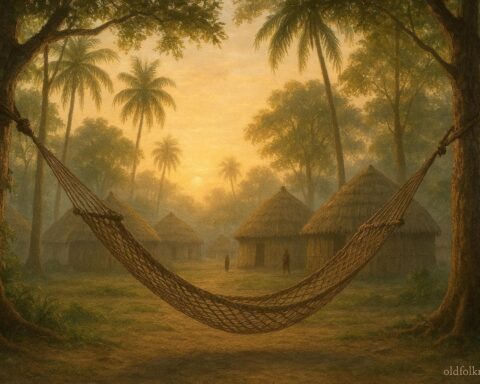
Long before the islands of the Caribbean bore their modern names, when the Taíno people still spoke directly to the spirits of nature, there ruled a powerful goddess known as Guabancex, the Lady of Storms. She was the spirit of the hurricane, the whirlwind that shook the seas and tore across the lush mountains of Borikén (Puerto Rico) and Hispaniola.
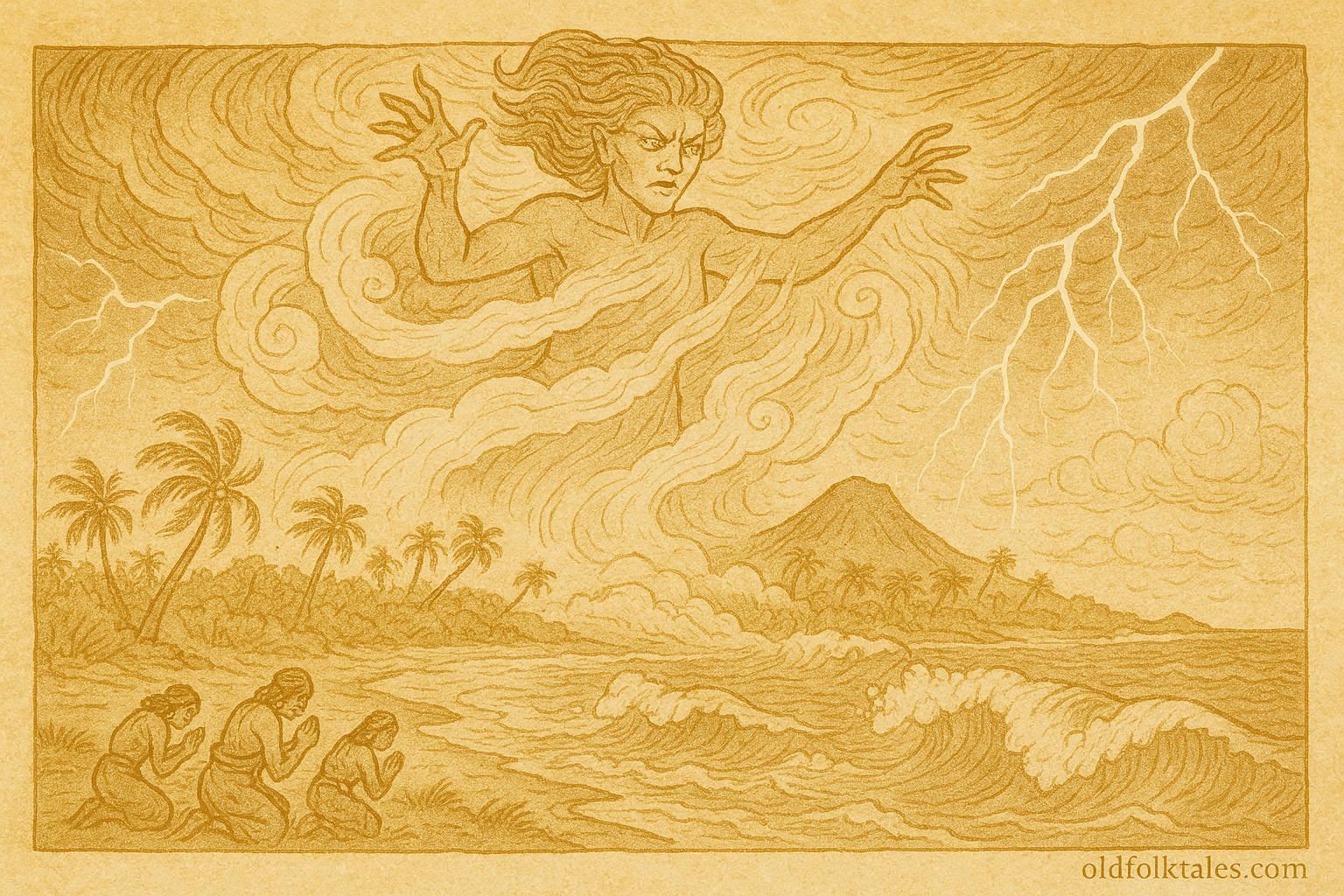
To the Taíno, Guabancex was not evil, though her rage could level villages and uproot trees. She was one of the oldest and most revered beings, the embodiment of the sky’s fury and the sea’s breath. She danced among the clouds, her arms swirling like spirals of wind, her hair a streaming tempest. Her voice was the thunder that rolled over the mountains, and her tears became the endless rain.
Explore French-Canadian legends and First Nations myths in our Canadian Folktales collection
In the time of peace, Guabancex slept within the eye of the storm, watching from the high heavens as the people planted cassava, fished in calm waters, and gave thanks to the zemí spirits, the divine forces of earth, sky, and water. But when the people grew careless and forgot their rituals of gratitude, the balance began to shift.
One season, the Taíno grew prosperous and proud. Their crops flourished, their canoes overflowed with fish, and their dances grew more frequent than their offerings. They thanked Yúcahu, the spirit of agriculture, but neglected Guabancex, the one who could undo all things.
She felt their silence like a wound. The winds began to stir around her as she rose from her slumber. “They have forgotten me,” she thundered. “They live upon my breath and build upon my waters, yet offer me no word of honor!”
In her wrath, she summoned her fierce attendants, Guataubá, the herald of the hurricane’s winds, and Coatrisquie, the keeper of the torrential rains. Together they gathered their power at the edge of the sky. Guataubá’s wings beat furiously, sending howling gusts across the sea, while Coatrisquie overturned her gourd, spilling floods upon the land.
The people looked up in terror as the sky turned black. The ocean swelled like a living beast, and the trees bent low, whispering warnings. “Guabancex is awake!” the elders cried. “Prepare the sacred stones! Offer the cassava! Plead for her mercy!”
But it was too late.
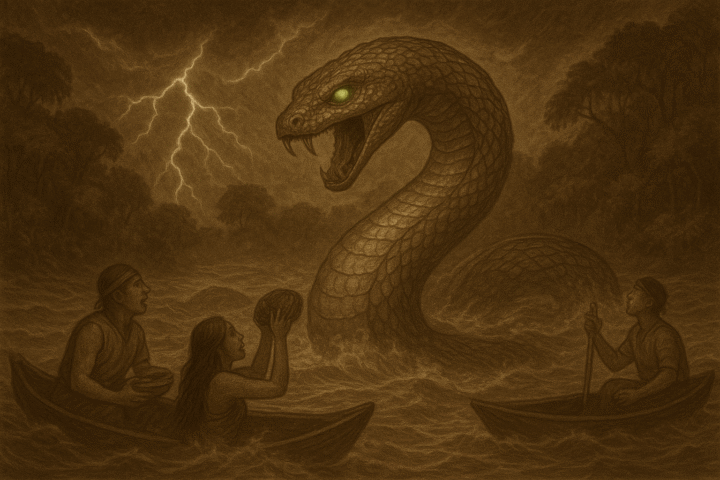
Guabancex descended in her full might, a great spiraling force that spun across the Caribbean. Her winds tore the roofs from huts, her rains flooded the fields, and her lightning split the tallest ceiba trees. The people fled to caves and mountaintops, clutching the zemís that symbolized the spirits of protection.
Yet even as she destroyed, Guabancex was not blind to the suffering she caused. Within the heart of her storm, she saw the people kneeling, weeping, and remembering her name. The sound of their prayers reached her, mingling with the roar of the hurricane. Slowly, her rage began to quiet.
The next morning, the people emerged to a changed world. The old crops were gone, but the soil was rich and dark again. The rivers had carved new paths, and the air smelled of new beginnings. The storm had cleared what was weak and left space for renewal.
The elders gathered the people and spoke:
“Guabancex is not only the destroyer; she is also the giver of life. Her storms test us, remind us of humility, and prepare the world for rebirth. We must never forget to honor her, for she is the breath of the sky and the rhythm of the earth.”
From that time onward, the Taíno made offerings to Guabancex each season, not to stop her storms, but to respect her purpose. When the hurricanes came, they built shelters in her name and told stories of her sacred dance, knowing that her fury was part of the cycle that sustains the islands.
They taught their children to listen to the wind’s voice before the rains, for sometimes it carried her whisper:
“I destroy only to make room for life.”
And so the Taíno remembered that creation and destruction are not enemies but partners in the endless song of the world, the song sung by Guabancex, the Lady of Storms.
Explore the ancestral legends of Canada, Mesoamerica, and South America’s Indigenous tribes.
Moral Lesson
The legend of Guabancex teaches that nature’s fury is not mere punishment but part of life’s renewal. It reminds us that respect for natural balance is sacred, and that destruction often clears the way for growth, just as storms make way for calm skies and fertile lands.
Knowledge Check
- Who is Guabancex in Taíno mythology?
Guabancex is the Taíno goddess of the hurricane, representing the power of wind, rain, and transformation. - Why did Guabancex unleash her storms on the people?
She grew angry when the people stopped honoring her with offerings and forgot her role in the balance of nature. - Who are Guabancex’s attendants?
Her attendants are Guataubá, the spirit of wind, and Coatrisquie, the spirit of rain. - What happened after Guabancex’s storm passed?
The land was renewed,old crops destroyed, but the soil enriched and ready for new life to grow. - What does Guabancex symbolize in Taíno culture?
She symbolizes the dual nature of creation and destruction,the sacred balance between chaos and renewal in the natural world. - What is the moral of Guabancex’s story?
That humans must honor and respect nature’s power, for even destruction can be a path to rebirth and harmony.
Source: Adapted from Relación acerca de las antigüedades de los indios by Ramón Pané (1498); interpreted in Sebastián Robiou Lamarche’s Mitología Taína.
Cultural Origin: Taíno (Puerto Rico and Hispaniola)