Long ago, in the high country where the Andes touch the sky and the wind carries the voices of ancestors, there lived a young herder named Tupaq. He was known throughout his village for his skill with llamas and alpacas, guiding them to the sweetest grasses that grew between the rocks and along the edges of crystalline streams that tumbled down from the snow-covered peaks.
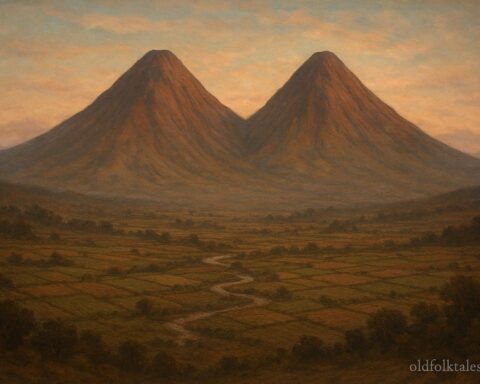
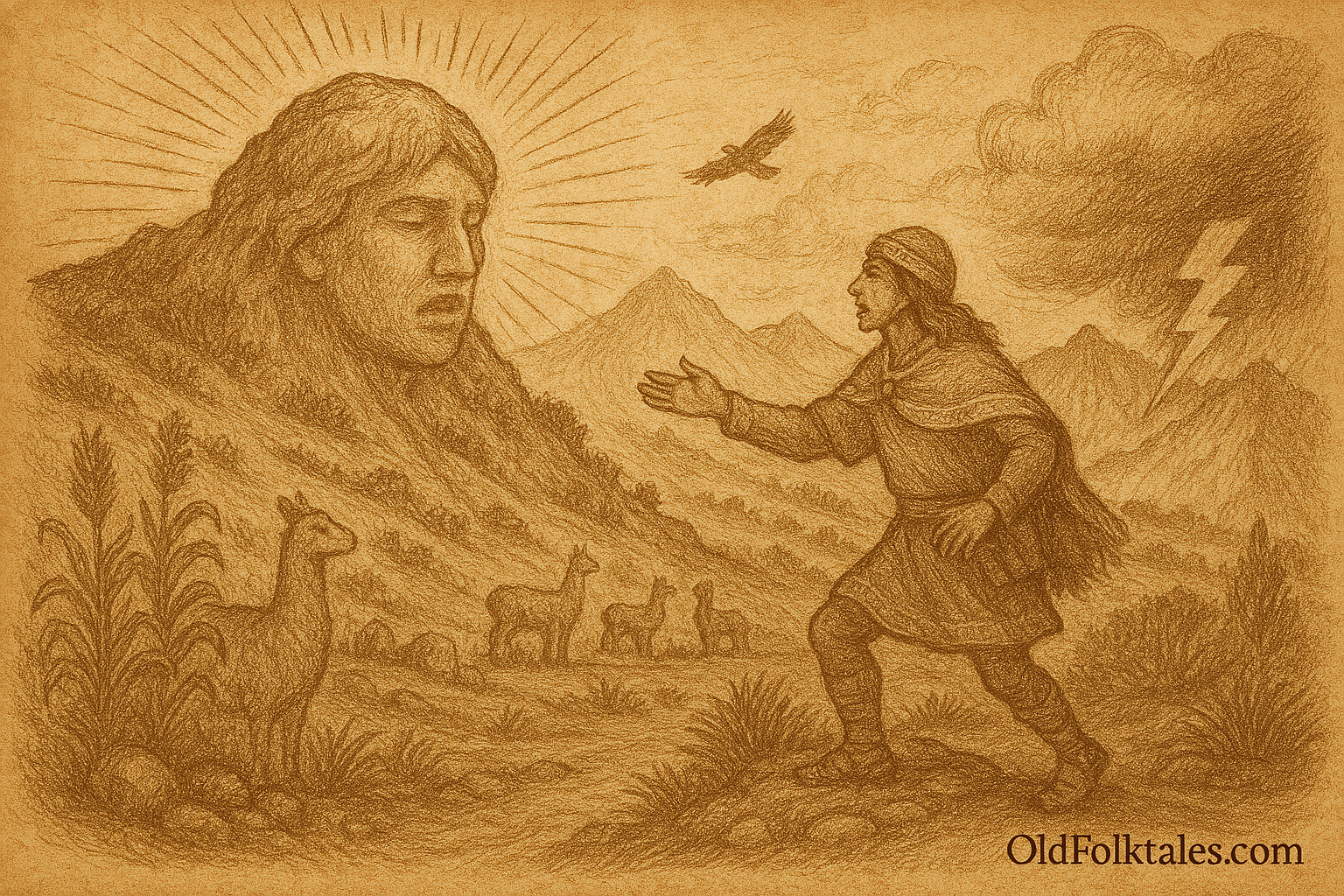
Tupaq had been born in the shadow of a particular hill that rose like a guardian over the valley, a place the elders called Apu Qaqa, the sacred wak’a. The hill was not the tallest in the region, nor did it bear the eternal snows that crowned the greatest mountains, but it possessed something the others did not: a presence that could be felt like breath on the back of one’s neck, a consciousness that seemed to watch over all who lived within sight of its slopes.
Click to read all Andean Highland Folktales — echoing from the mountain peaks of Peru, Bolivia, and Ecuador.
The elders spoke of Apu Qaqa with reverence and a touch of fear. They left offerings of coca leaves at small stone altars built into its flank’s neat arrangements of three perfect leaves, accompanied by prayers whispered in the old language. They warned children never to speak disrespectfully near the wak’a, for the spirits within were ancient and powerful, connected to the very bones of the earth and the memories of all who had walked these paths before.
Tupaq had heard these stories since childhood, yet he had never truly understood them. To him, Apu Qaqa was simply a hill, albeit a beautiful one, covered in golden ichu grass that swayed like waves when the wind swept down from the heights. He respected it as his elders did, leaving the traditional offerings, but in his heart, he thought of the wak’a as nothing more than stone and soil.
One particular morning, when Tupaq was seventeen summers old, he led his family’s herd up the slopes of Apu Qaqa to graze. The sky was that impossible blue that exists only at high altitude, and condors wheeled in lazy circles overhead, their massive wings catching the updrafts. The llamas moved peacefully among the rocks, their soft humming creating a gentle music that blended with the whisper of wind through grass.
Tupaq settled himself on a sun-warmed boulder, watching his animals and thinking about his life. Lately, he had felt restless, confined by the boundaries of the valley that had held his family for generations. He dreamed of distant places the great markets of Cusco that travelers described, the coastal lowlands where the ocean stretched beyond sight, lands where different peoples spoke different tongues and followed different ways.
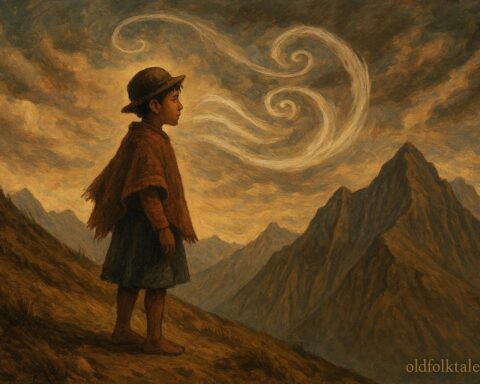
As he sat lost in these thoughts, something extraordinary happened. The wind shifted, and in that shift, Tupaq heard something that made his blood run cold and hot at once. It was a voice deep and resonant, seeming to come from everywhere and nowhere, from the earth itself and from the air around him.
“Tupaq, son of this soil,” the voice said, each word vibrating through his chest like distant thunder. “You who were born under my watch and grew strong on my slopes.”
The young herder leaped to his feet, his heart hammering. His llamas had gone completely still, their large eyes alert, their ears forward. Even they sensed what was happening.
“Who speaks?” Tupaq managed to whisper, though he already knew. The elders’ stories flooded back to him the wak’a was alive, conscious, aware.
“I am Apu Qaqa,” the voice replied, patient and ancient. “I am the spirit of this hill, the keeper of memories, the witness of generations. I have watched you grow from a child stumbling after his first llama to the young man you are today. And I have seen something else, I have seen your restlessness, your dreams of distant places.”
Tupaq’s throat was dry. “You can see my thoughts?”
“I can feel the pull of your spirit, as I feel the pull of wind and water, sun and stars,” Apu Qaqa answered. “And I tell you this, Tupaq: you will leave. The path calls you, and you must walk it. You will travel far from this valley, far from the sight of my slopes. You will see the great cities and the endless waters. You will learn the ways of other peoples and speak words in other tongues.”
The young herder felt a mixture of exhilaration and terror. The wak’a was giving him permission no, more than that, it was prophesying his departure. But there was something in the voice, a quality he couldn’t quite name, that suggested the prophecy was not yet complete.
“But know this,” the wak’a continued, its voice now carrying a tone of absolute certainty. “You will return. Though your feet carry you to the farthest horizons, though years pass and your face becomes weathered by foreign suns and winds, you will come back to this valley. The cord that binds you to this earth, to this hill, to the bones of your ancestors sleeping in this soil that cord cannot be broken. It may stretch thin as spider silk, but it will never snap. And one day, it will draw you home.”
Tupaq stood trembling, tears streaming down his face though he couldn’t say whether they were tears of joy or sorrow, anticipation or fear. “When?” he asked. “When will I return?”
“When your heart finally understands what I tell you now,” Apu Qaqa replied, its voice growing softer, beginning to fade back into the wind. “That to know the world, you must leave home. But to know yourself, you must return. Go with my blessing, young shepherd. Walk your path. And when you come back and you will come back you will see me not as mere stone, but as I truly am: the living heart of your homeland, the keeper of all you are and all you will become.”
The voice faded entirely, leaving only the whisper of wind and the gentle humming of llamas. Tupaq sank back onto his boulder, his mind reeling with wonder and the weight of prophecy.
In the months that followed, Tupaq did indeed leave his valley. He traveled to cities where stone buildings rose higher than any hill he had known. He walked beside the ocean and tasted its salt. He learned new languages and new ways of living. Years became decades, and his face grew lined with the marks of time and experience.
But always, in his dreams, he saw Apu Qaqa rising against the blue Andean sky. Always, he felt the pull the wak’a had spoken of, gentle but insistent, drawing him back toward home.
And when Tupaq was an old man, wealthy with experience if not with gold, he finally returned to his valley. He climbed the familiar slopes of Apu Qaqa, his steps slower than they had been in youth but no less certain. When he reached the sun-warmed boulder where he had once sat as a restless young shepherd, he placed his weathered hand upon the earth and whispered, “I have returned, as you said I would. And now I understand. I am bound to this land not by chains, but by love. Not by ignorance of the world, but by knowledge of where I truly belong.”
The wind rose around him, warm and welcoming, carrying a whisper that might have been words or might have been only the voice of home itself: “Welcome back, son of this soil. Welcome home.”
Click to read all South American Folktales — timeless stories from the Andes to the Amazon.
The Moral Lesson
This Quechua tale teaches us about the sacred connection between people and place, and the wisdom that comes from honoring both journey and homecoming. It reminds us that the land itself holds consciousness and memory, deserving our respect and reverence. The story also speaks to a universal human truth: that we must sometimes leave home to discover the wider world, but in doing so, we often discover that our deepest identity is rooted in the places and traditions that shaped us. The prophecy fulfilled demonstrates that respecting the spirits of land and ancestors isn’t superstition, but recognition of the profound bonds that connect us to our origins.
Knowledge Check
Q1: What is a wak’a in Quechua culture and belief?
A: A wak’a is a sacred site or object inhabited by spirits often hills, mountains, springs, or stones that are considered alive and conscious. Wak’as are revered as guardians and keepers of memory, deeply connected to the ancestors and the spiritual essence of the land.
Q2: What prophecy did Apu Qaqa speak to the young shepherd Tupaq?
A: Apu Qaqa prophesied that Tupaq would leave the valley and travel far, experiencing distant places and different ways of life, but that he would inevitably return home. The wak’a told him that the spiritual connection to his homeland could stretch but never break.
Q3: Why did Tupaq initially not understand the significance of the wak’a?
A: Despite growing up with traditional teachings, Tupaq saw Apu Qaqa as merely a physical hill rather than a living spiritual presence. His youth and restlessness prevented him from fully appreciating the deep connection between the land, ancestors, and his own identity.
Q4: What do the coca leaf offerings represent in the story?
A: The coca leaf offerings represent traditional Quechua spiritual practice a way of showing respect and reverence to the wak’a spirits. These offerings maintain the relationship between humans and the sacred landscape, honoring the consciousness within natural features.
Q5: What is the symbolic meaning of Tupaq’s journey and return?
A: Tupaq’s journey symbolizes the universal human need to explore and expand one’s horizons, while his return represents the equally important recognition of one’s roots and identity. The journey teaches that true wisdom comes from both experiencing the world and understanding one’s place within it.
Q6: How does this tale reflect Quechua worldview about land and ancestors?
A: The story embodies the Quechua belief that landscape is not passive or inanimate, but alive with ancestral spirits and consciousness. It reflects the understanding that people and place are spiritually interconnected, and that respecting these sacred connections is essential to maintaining cultural identity and harmony.
Source: Adapted from traditional Quechua oral narratives about wak’a spirits and sacred hills, as documented in Andean ethnographic research and folklore collections regarding animistic beliefs in the Andes region.
Cultural Origin: Quechua peoples, Andean Highlands of Peru and surrounding regions