In the Charlevoix region of Quebec, where hills roll gently toward the St. Lawrence River and forests stretch unbroken for miles, there is a river that locals have always treated with special care. By day, it appears ordinary enough. Its waters move steadily over smooth stones, reflecting the sky and surrounding trees. But by night, when the world grows still and human voices fade, the river reveals its secret.
It is said that the stones begin to sing.
Not loudly, and not all at once. The sound rises softly, like a hum carried on the wind, weaving through the darkness. Those who hear it for the first time often think it is the breeze or a distant voice. Only later do they realize the sound comes from the river itself.
Elders have long warned travelers to listen if they are ever lost near the river after sunset. The singing stones, they say, do not sing for everyone, and they do not sing without reason.
Long ago, before roads were clearly marked and lanterns were few, a young woodcutter named Mathieu lived near the edge of the Charlevoix forest. He was skilled with his hands but impatient by nature, often working until darkness forced him to stop. One evening, determined to finish his task, Mathieu ignored the fading light and pressed deeper into the forest.
Explore the ancestral legends of Canada, Mesoamerica, and South America’s Indigenous tribes.
By the time he turned back, night had fallen fully. Clouds covered the moon, and familiar landmarks disappeared into shadow. He walked quickly at first, then faster, panic rising as every path began to look the same. His lantern flickered and went out, leaving him in complete darkness.
Mathieu stopped, breathing hard. He remembered stories of travelers who wandered all night and were never found. Just as fear threatened to overtake him, he heard a faint sound.
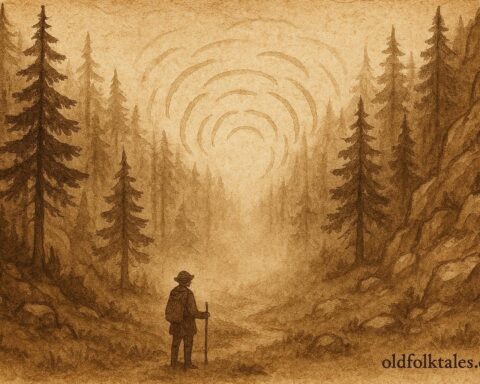
At first, it seemed like distant singing. Low and steady, it rose and fell gently, neither joyful nor sad. Mathieu strained to listen. The sound came from ahead, near the river.
Unsure but desperate, he followed it.
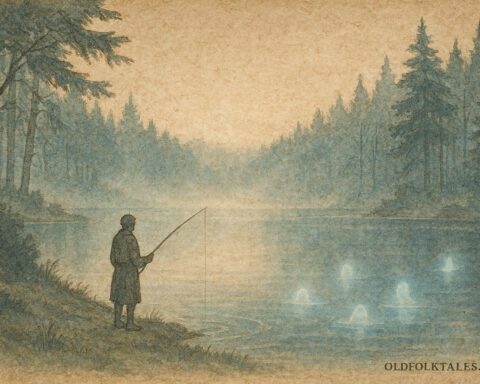
As he drew closer, the sound became clearer. It was not a voice, but many tones woven together, as though the stones themselves were humming. When Mathieu reached the riverbank, he saw smooth rocks glistening in the faint starlight. The water flowed calmly, and the stones beneath its surface shimmered softly.
The singing grew stronger when Mathieu stepped too close to the edge, shifting into a sharper tone that made him pause. When he moved along the bank instead, the sound softened again, guiding him downstream.
Mathieu walked slowly, listening carefully. Whenever he strayed from the safest path, the stones’ song changed, becoming uneven or distant. When he followed the right direction, the melody steadied, warm and reassuring.
Hours later, Mathieu emerged near his village, unharmed. As the first light of dawn touched the sky, the singing faded, leaving only the quiet rush of water.
Mathieu told everyone what he had heard. Some believed him immediately. Others laughed, saying exhaustion had confused his senses. But not long after, others began to listen.
A group of traders traveling late one autumn evening lost their way in thick fog. They heard the same singing and followed it, reaching shelter just before a storm broke. A woman searching for a missing child found her path guided by gentle tones that grew louder when she hesitated and clearer when she moved correctly.
Over time, people noticed something else. The stones sang only at night, and only when someone nearby needed guidance. Those who wandered carelessly, laughing and shouting, heard nothing. Those who moved quietly and paid attention were led safely.
An elder explained that the stones were not alive in the way humans are, but they remembered. The river had witnessed generations of footsteps, fears, prayers, and gratitude. The stones absorbed these moments and returned them as sound when the forest needed balance.
There were warnings as well. One man, confident in his strength, ignored the singing and crossed the river at a dangerous point. The song turned sharp and urgent, but he dismissed it. He slipped on wet stones and was injured, rescued only because others heard his cries.
From then on, people respected the river even more. Travelers paused before crossing, listening first. Children were taught that silence was sometimes more important than questions. The stones were said to sing not to command, but to guide.
Mathieu grew older and became known for helping travelers. When asked about the stones, he said they taught him patience. He explained that the song could only be heard by those who slowed down enough to notice it.
Even now, when night settles over Charlevoix and the river runs dark and deep, some claim they hear a low, steady melody. It does not call attention to itself. It waits. And for those who listen with care, the singing stones still guide the lost safely home.
Explore the ancestral legends of Canada, Mesoamerica, and South America’s Indigenous tribes.
Moral Lesson
Guidance often comes quietly and must be met with patience and attention. Those who rush or dismiss subtle signs may miss protection offered freely, while those who listen carefully and move with respect find their way even in darkness. True safety lies not in force or confidence alone, but in awareness and trust in the natural world.
Knowledge Check
- What makes the stones of the Charlevoix river unusual?
They emit singing sounds at night. - When do the stones sing most clearly?
When travelers are lost and listening carefully. - How do the stones guide people?
By changing their tones to indicate safe or dangerous paths. - Why do some people never hear the singing?
Because they move carelessly or do not pay attention. - What does the river represent in the story?
A protective natural force shaped by memory. - What lesson does Mathieu learn?
That patience and listening lead to safety.
Source: BanQ; Quebec Folklore Research Collections.
Cultural Origin: French-Canadian folklore, Charlevoix region, Quebec.