In the Ethiopian Highlands, where the land rises in dramatic plateaus and the air carries the scent of wild sage and juniper, there lived two shepherds who tended their flocks on neighboring hillsides. The valleys between the mountains were carpeted with grass that turned golden in the dry season and emerald during the rains, providing ample grazing for the sheep and goats that were the lifeblood of the Amhara communities scattered across these ancient lands.
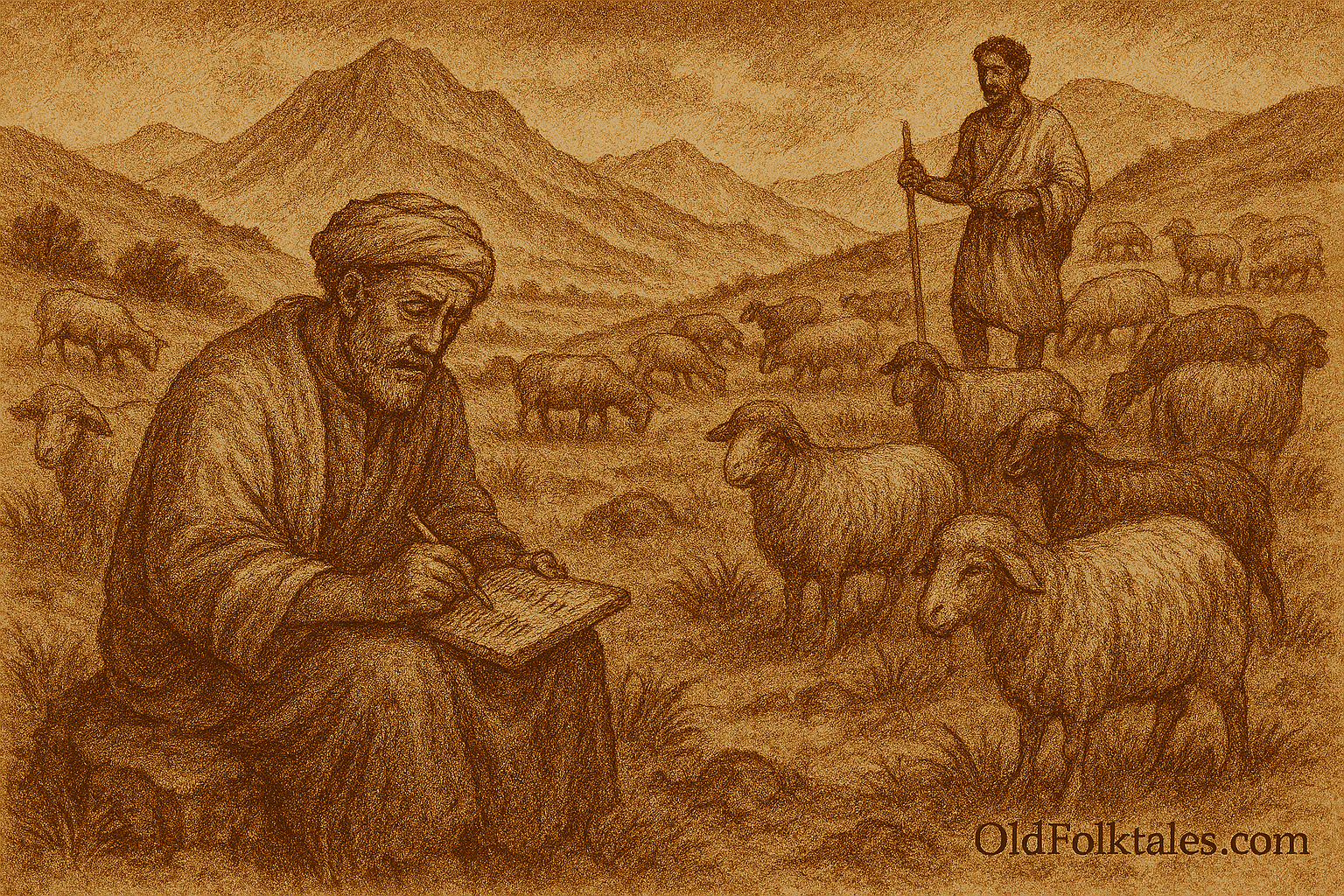
The first shepherd was named Desta, a man known throughout the region for his meticulous nature and his pride in the size of his flock. Every morning, without fail, he would count his sheep as they emerged from their stone-walled enclosure. He would stand at the narrow gate, a stick in his hand to keep track, marking each animal that passed: one, two, three, four, continuing until he reached the end. At midday, when the sun stood high and the shadows disappeared beneath the animals’ feet, he would count them again. And in the evening, as the light turned honey-gold and the mountains cast long purple shadows across the valleys, he would count them once more before securing them for the night.
Click to read all South American Folktales — timeless stories from the Andes to the Amazon.
“Eighty-seven,” he would announce with satisfaction, or “Ninety-two,” depending on the season and whether lambs had been born or animals sold at market. The numbers gave him a sense of control, a feeling that he understood exactly the state of his wealth and prosperity. He kept careful records scratched onto pieces of bark, noting each day’s count, comparing this month to last month, this year to previous years. When he met other shepherds at the market in the highland town, he would boast about the precision of his knowledge. “I know my flock exactly,” he would say. “Not one sheep can go missing without my knowing immediately. I am not like other shepherds who are careless and vague.”
The second shepherd was named Tekle, an older man whose face was weathered by decades of sun and wind, whose eyes held a quietness that came from long observation. Tekle kept far fewer sheep than Desta perhaps half the number, but he knew each one as intimately as he knew his own children. He had names for many of them, or at least private names he used in his own mind. He knew which ewe was the leader, which ram was aggressive, which lambs were strong, and which needed extra attention. When his flock grazed, Tekle would sit on a rock and watch them, not counting but observing noticing which animals ate well and which hung back, which moved with vigor, and which seemed listless or slow.
The other shepherds sometimes teased Tekle gently. “Old man,” they would say, “how many sheep do you have today? Do you even know?” Tekle would smile, his weathered face crinkling like ancient parchment, and shrug. “Enough,” he would say simply. “I know my flock.” But he could not give the precise number that Desta could recite so proudly, and some thought him careless or perhaps too old to keep proper track.
One year, during the season of short rains, a sickness began to move through the highlands. It came quietly at first, affecting animals here and there a sheep that seemed sluggish, a goat that stopped eating, livestock that separated themselves from the herd with a strange lethargy. The disease was insidious, not killing quickly but weakening slowly, spreading from animal to animal through contact and shared grazing grounds.
Desta continued his daily routine with unwavering dedication. Each morning, noon, and evening, he counted. “Eighty-seven,” he would note with satisfaction. “The same as yesterday. All is well.” The ritual of counting reassured him. The numbers remained stable, so surely his flock remained healthy. He was too focused on the mathematics of his wealth to notice the subtle signs that something had changed.
But the numbers, Desta discovered too late, told only part of the story. The disease did not kill sheep immediately it weakened them gradually. An animal could be alive and mobile enough to be counted but already sick, already spreading illness to others. Desta’s obsession with the number prevented him from seeing what was happening within that number. He didn’t notice that several of his sheep had begun to lag behind the others. He didn’t observe that some had stopped eating well or that their wool looked dull and lifeless. He didn’t see that their eyes, which should have been bright and alert, had grown dim and clouded.
By the time Desta finally noticed that his sheep were sick when the disease had progressed so far that animals began to collapse and die, it was too late to contain it. The illness had spread through his entire flock. He ran frantically between the animals, trying to separate the sick from the healthy, but they had been mingling for weeks. He sought help from the village, but the responses were limited. Traditional remedies were tried, but the disease had taken too strong a hold. Within a month, Desta had lost more than half his flock. The numbers he had counted so carefully dwindled with heartbreaking speed: eighty-seven became seventy, then fifty, then forty. His wealth, his pride, his carefully tracked prosperity, all reduced to a fraction of what it had been.
Meanwhile, on the neighboring hillside, Tekle’s smaller flock remained largely untouched. When the same disease appeared among his sheep as it inevitably did, for they grazed the same highlands and drank from the same streams Tekle noticed immediately. He saw the subtle changes in behavior before any visible symptoms appeared. He observed that one of his ewes, usually first to the good grazing, hung back slightly, moving with less enthusiasm than normal. He noticed another sheep standing apart from the group, its posture slightly hunched. These were not things that could be captured in a count, but they were signals as clear as smoke to a shepherd who truly watched his animals.
Tekle acted quickly. He separated the animals that showed even the slightest change in behavior, keeping them isolated until he could determine if they were truly sick or simply having an off day. He examined them carefully, checking their eyes, their gait, the texture of their wool, the temperature of their skin beneath the fleece. When he confirmed sickness, he kept those animals strictly apart from the healthy ones. He sought advice from the village elders who remembered previous outbreaks and applied traditional treatments herbs mixed with water, special feeds, isolation and careful monitoring.
Because Tekle had caught the disease early, before it could spread through his flock, he lost only three sheep. The rest remained healthy. His careful observation, his intimate knowledge of each animal’s normal behavior and appearance, had allowed him to identify and contain the problem before it became catastrophic.
When the crisis had passed and the two shepherds met at the market, Desta was a broken man, his pride shattered along with his livelihood. He had to sell land to replace enough sheep to continue his work. Tekle, though never one to boast, offered quiet counsel. “Brother,” he said gently, “counting tells you how many, but watching tells you how they are. A shepherd who knows the number of his sheep but not their condition is like a father who counts his children but never looks at their faces.”
Desta, humbled by loss, finally understood. Numbers alone were not wisdom. Precision without perception was a hollow achievement. He began to learn from Tekle not just to count his flock, but to truly see them, to observe their behavior and condition, to know them as living creatures rather than units of wealth. The lesson had come at a terrible cost, but it transformed him from a man obsessed with quantity into a shepherd who understood quality, from someone who trusted numbers more than his own eyes to someone who valued true knowledge over the illusion of control that counting had provided.
Click to read all Andean Highland Folktales — echoing from the mountain peaks of Peru, Bolivia, and Ecuador.
The Moral Lesson
This Ethiopian Highland tale teaches that obsessive focus on measurable outcomes can blind us to the deeper understanding that comes from careful observation and genuine care. Desta’s compulsion to count created an illusion of knowledge and control, but numbers alone could not reveal the health and wellbeing of his flock. His fixation on quantity prevented him from noticing quality the subtle behavioral changes that indicated disease. Tekle’s wisdom lay not in superior counting skills but in his attentive relationship with each animal, his ability to perceive what numbers could never capture. The story reminds us that in many areas of life whether caring for animals, relationships, businesses, or communities obsessive measurement can become a substitute for genuine understanding, and the things that matter most are often those that cannot be easily quantified. True stewardship requires presence, observation, and the humility to value what we see over what we can count.
Knowledge Check
Q1: What made Desta different from other shepherds in the Ethiopian Highlands?
A1: Desta was distinguished by his obsessive precision in counting his sheep. Unlike other shepherds who had a general sense of their flock size, Desta counted his animals three times daily, morning, noon, and evening and kept meticulous written records of his counts. He took great pride in being able to state the exact number of sheep he owned at any moment and viewed this numerical precision as superior shepherding, boasting about his careful tracking to others at the market.
Q2: How did Tekle’s approach to shepherding differ from Desta’s methods?
A2: Tekle focused on observation and relationship rather than counting. While he knew approximately how many sheep he had, he could not give precise numbers like Desta. Instead, Tekle knew each animal individually their personalities, normal behaviors, eating patterns, and physical characteristics. He spent his time watching the flock’s behavior and condition rather than repeatedly counting them, which gave him intimate knowledge of each sheep’s wellbeing that numbers alone could never provide.
Q3: Why didn’t Desta notice the disease spreading through his flock?
A3: Desta failed to notice the disease because his obsession with counting prevented him from truly observing his sheep’s condition and behavior. The illness was insidious, weakening animals gradually without immediately killing them, so his daily counts remained stable. Since the numbers didn’t change, he assumed all was well. He was so focused on the quantity ensuring all sheep were present that he completely missed the quality indicators: changes in behavior, energy levels, eating patterns, and physical appearance that would have revealed the spreading sickness.
Q4: How was Tekle able to save most of his flock from the disease?
A4: Tekle saved his flock through early detection based on behavioral observation. Because he intimately knew each animal’s normal behavior, he immediately noticed subtle changes a ewe that was usually first to graze hanging back slightly, a sheep standing apart with unusual posture. These early warning signs, invisible in a simple count, allowed him to identify and isolate sick animals before the disease spread widely through his flock. His observational approach enabled intervention at a stage when treatment and containment were still effective.
Q5: What does the disease in the story symbolize in Amhara wisdom?
A5: The disease symbolizes problems or crises that cannot be detected through superficial measurement alone. It represents the hidden issues that numbers, statistics, or surface-level assessments fail to reveal problems that require genuine attention, observation, and deep knowledge to identify early. In the broader moral context, the disease embodies the consequences that come from valuing quantifiable metrics over qualitative understanding, showing how obsession with measurement can blind us to the realities that numbers cannot capture.
Q6: What cultural values about stewardship does this Ethiopian tale teach?
A6: The story embodies Amhara cultural values emphasizing genuine care and attention over mere accounting. It teaches that true stewardship whether of animals, land, or community requires intimate knowledge, careful observation, and personal relationship rather than detached measurement. The tale values wisdom that comes from experience and attention over the illusion of control that comes from quantification. It reflects the Ethiopian Highland tradition of respecting elders like Tekle whose deep observational knowledge, though less easily articulated than numerical data, proves more valuable in crisis.
Source: Adapted from Amhara oral tradition as recorded in Ethiopian Folk Tales by Richard Pankhurst, British historian and scholar of Ethiopian studies who documented traditional stories from various Ethiopian cultural groups.
Cultural Origin: Amhara people, Ethiopian Highlands, Ethiopia