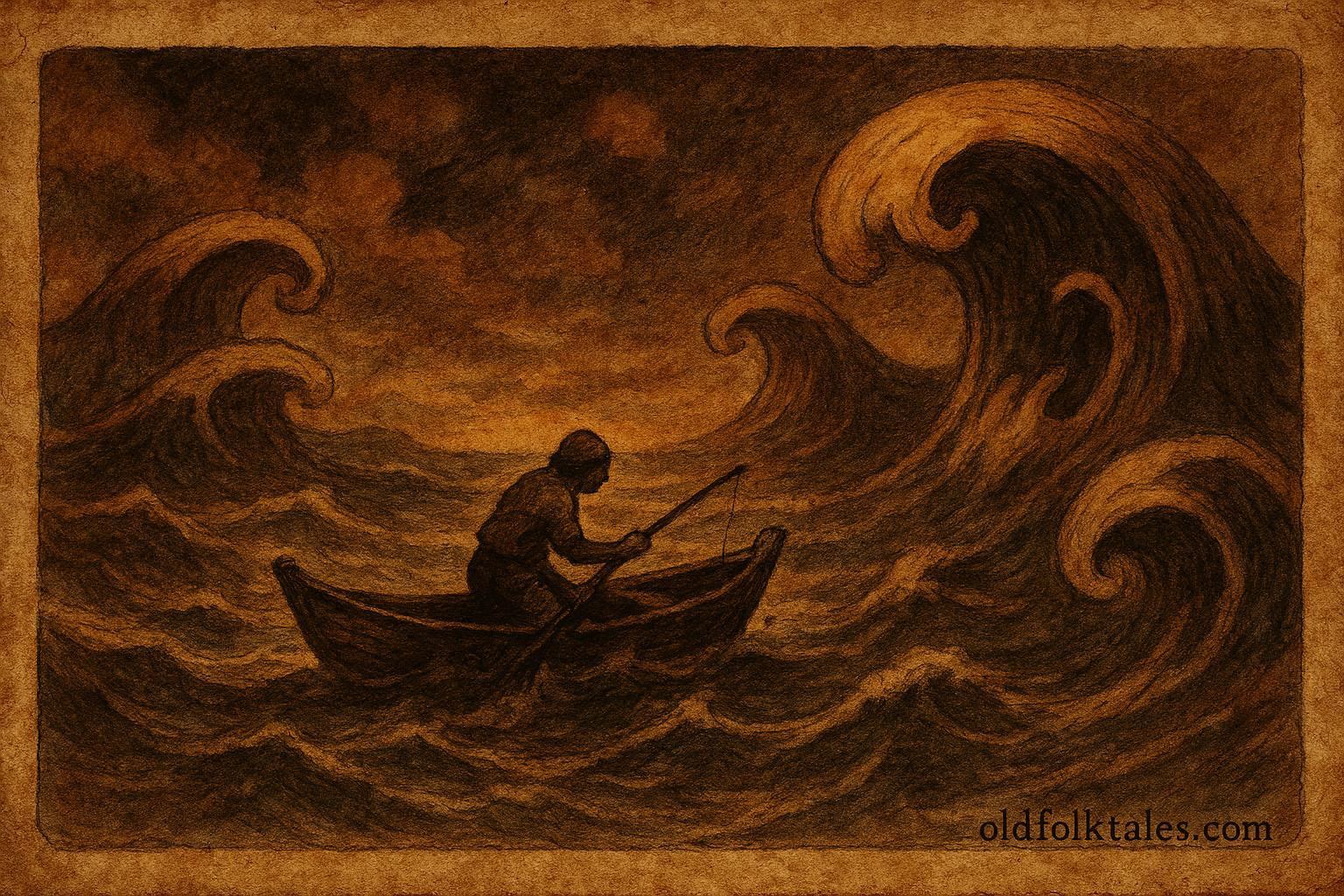
Along the rugged shores of the Lesser Antilles, where waves met volcanic stone and trade winds carried the scent of salt and seaweed, there lived a fisherman named Kalani. He was strong, skilled, and widely known for his success. His nets were always full, his canoe swift, and his catches larger than most. Over time, pride grew in his heart like an unchecked tide.
Kalani began to boast openly. He laughed at storms and mocked the warnings of elders. He spoke of the sea as if it were a servant rather than a living force. “The sea knows my name,” he would say. “It bends for me.”
The elders listened in silence. They knew the sea listened too.
One morning, as the horizon glowed pale gold, Kalani prepared his canoe. Other fishermen hesitated, sensing a shift in the wind, but Kalani scoffed. “Fear feeds empty nets,” he said, pushing off from shore. The sea appeared calm, almost amused, its surface smooth and reflective.
As Kalani paddled farther from land, the water began to change. Waves rolled unevenly, not violently, but with a rhythm that felt deliberate. A low sound echoed across the water, something between a sigh and laughter. Kalani ignored it and cast his net with confidence.
The first pull was heavy. He grinned, convinced the sea had proven him right. But when he lifted the net, it was tangled and empty, knotted in strange patterns as though twisted by unseen hands. Annoyed, he tried again.
The sky darkened slowly. Clouds gathered without urgency, and the wind shifted direction again and again, confusing Kalani’s sense of distance. The canoe rocked gently, then more forcefully. Waves splashed over the sides, soaking his supplies.
Still, Kalani refused to turn back.
Then the storm came.
It did not arrive with fury but with laughter. Thunder rolled in uneven bursts, and lightning flickered across the clouds like mocking eyes. The sea rose beneath the canoe, lifting it high, then dropping it suddenly. Kalani struggled to steady himself, his confidence draining faster than the water from his overturned basket.
For the first time, fear entered his heart.
“Sea,” he shouted, “I am strong. I am skilled. Why do you test me?”
The waves answered by spinning the canoe sideways. Kalani was thrown into the water, gasping as salt filled his mouth. He fought to stay afloat, clinging to the canoe as rain poured down.
Between crashes of thunder, he heard it clearly now. The sea was laughing.
Not cruelly, but knowingly.
Exhausted, Kalani stopped struggling. He loosened his grip and let himself float, no longer fighting the water. In that stillness, the laughter faded. The waves softened, and the rain slowed. Kalani bowed his head.
“I spoke without respect,” he whispered. “I forgot that I belong to you, not the other way around.”
The sea stilled completely.
A current carried Kalani gently toward shore. When he awoke, he lay on wet sand, the storm already gone. His canoe rested nearby, damaged but intact.
From that day on, Kalani changed.
He no longer boasted. He listened to the elders and watched the sky carefully before fishing. When storms came, he stayed ashore. When the sea was generous, he gave thanks. His catches returned, though never as abundant as before, and he accepted this with humility.
Children later asked why the sea sometimes sounded like laughter against the rocks. Kalani would smile sadly and say, “Because it remembers when I forgot my place.”
The sea never punished him again, but it never let him forget either.
Explore the ancestral legends of Canada, Mesoamerica, and South America’s Indigenous tribes.
Moral Lesson
Pride blinds people to their place within the natural world. True strength comes from humility, awareness, and respect. When humans forget they are guests of the land and sea, nature responds not with anger, but with lessons that cannot be ignored.
Knowledge Check
1. Why did the sea punish Kalani?
Because he spoke and acted with arrogance, treating the sea as something he controlled rather than respected.
2. How did the sea show its displeasure?
Through confusing currents, tangled nets, and a storm that tested Kalani’s strength and humility.
3. What moment caused Kalani to change?
When he stopped fighting the sea and acknowledged his disrespect.
4. Why did the storm end after Kalani’s apology?
Because the sea responded to humility and recognition of balance.
5. What lesson did the villagers learn from Kalani’s experience?
That nature demands respect and humility, not boasting or dominance.
6. What does the sea’s laughter symbolize?
Natural justice and the quiet reminder that human pride is small compared to nature’s power.
Source
Adapted from Caribbean Indigenous Oral Traditions and archival materials documented by the University of the West Indies.
Cultural Origin
Carib peoples, Lesser Antilles.