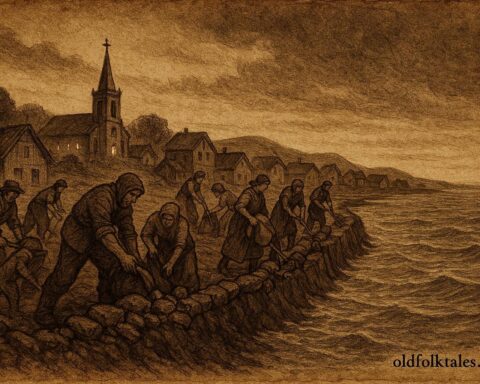
On the rugged shores of Grand Manan Island in New Brunswick, where waves broke against cliffs and the wind carried the brine of the Atlantic, there lived a fisherman named Éloi. He was known across the island for his skill at sea and his respect for the ocean. By his side was his wife, Mireille, whose beauty and kindness were praised by all who met her.
The islanders had long taught that the sea was alive with spirits. Every fisherman made vows before departing on long journeys, asking for safe passage and promising offerings in return. These vows were sacred; breaking them brought consequences that no human could escape. Éloi, careful and devout, never went to sea without words of respect and a small gift of thanks. Mireille, however, was proud and often scoffed at the tales of the spirits.
One harsh winter, Éloi left for an especially perilous voyage. The sea churned, and the wind shrieked across the cliffs. Before leaving, he clasped Mireille’s hand and said, “Promise me you will not take the salt from the cask or speak lightly of the ocean’s power. Keep the offerings ready for when I return.”
Discover ancient tales passed down by the Indigenous peoples of the Americas.
Mireille nodded, but her heart did not match her words. Curiosity and vanity whispered to her. As days passed and Éloi’s absence stretched on, she grew restless. She took the salt from the cask meant for the sea spirits and sprinkled it over her garden, saying aloud that the spirits could wait, that humans must live first.
At first, nothing seemed to happen. The wind carried the same cold chill, and the waves crashed as usual. But over nights, Mireille felt a strange stiffness in her skin, a weight in her limbs. Her reflection in the water shimmered strangely. By the third dawn, her hands were pale and granular, as if composed partly of salt. She panicked but tried to ignore it, believing her imagination played tricks.
The villagers began to notice. When she stepped onto the beach, the sand clung to her skin unnaturally. Fishers whispered in fear, warning Éloi’s friends when he returned that Mireille was changing, though no one could explain why.
Éloi came back just as the tide turned heavy and gray. When he saw Mireille walking toward the shore, glimmering unnaturally in the morning sun, he ran to her.
“Mireille! What has happened to you?” he cried.
She tried to speak but found her voice crackling, coarse as granules of salt rubbing together. She fell to the sand, and a coldness spread through her chest. Éloi’s heart sank. He realized that her small act of defiance toward the spirits had brought this fate.
For weeks, Mireille’s transformation continued. Her hair sparkled like frost, her skin hardened into crystalline flakes, and her warmth faded. The villagers gathered, and the elders spoke.
“The sea does not forgive lightly,” one elder said. “Promises are sacred. Those who break vows offer more than disrespect, they give themselves to the ocean’s judgment.”
Éloi did not leave her side. Each day, he carried offerings to the shore, pleading with the spirits, kneeling in the cold spray, asking for her restoration. The winds howled, and waves crashed harder each time he begged, as if the sea listened but demanded patience.
One night, under a sky lit by moon and stars, Mireille stood at the water’s edge. Her form glimmered entirely in salt. She looked to Éloi with eyes filled with sorrow.
“Do not mourn me as you once knew me,” she whispered. “The sea has claimed what I gave it. Remember this: humans are never above promises, and arrogance invites consequence.”
With that, a wave rose and rolled over her. When it receded, her body was gone, leaving only a small mound of sparkling salt glinting on the sand. Éloi collapsed to his knees, weeping, and the villagers understood that this was both a warning and a lesson from the sea.
From that day onward, the fishermen of Grand Manan Island never took the salt lightly. They offered prayers, gave thanks, and spoke with humility before voyages. Mireille’s story was told for generations, reminding all who heard it that vows to the sea were as binding as life itself. And on quiet nights, when the wind was gentle and the waves whispered, the salt on the shore would glint in the moonlight, a reminder of what pride could cost.
Moral Lesson
Respect and integrity are never optional. Breaking a promise, even in small matters, carries weight beyond human understanding. The sea, like life, honors those who uphold their commitments and teaches through loss and transformation those who forget. True wisdom lies in humility, obedience to sacred agreements, and awareness that even small actions ripple outward with consequences.
Knowledge Check
- Why did Mireille begin to transform into salt?
She broke a sacred promise to the sea spirits by misusing the salt offerings. - What was the role of Éloi in the story?
He was a respectful fisherman devoted to honoring the sea and tried to save his wife. - How did the villagers respond to Mireille’s transformation?
They watched carefully and listened to the elders’ teachings about promises and consequences. - What did the mound of salt symbolize?
It symbolized Mireille’s sacrifice and served as a warning about breaking vows. - How did the story influence future generations?
Fishermen learned to respect the sea, keep promises, and honor rituals. - What broader lesson about human behavior does the tale convey?
That arrogance and neglect of sacred obligations lead to irreversible consequences.
Source:
Adapted from New Brunswick Folklore Studies and the Canadian Folklore Database.
Cultural Origin:
Maritime folklore, Grand Manan Island, New Brunswick.