Long ago, when the Inca ruled the highlands and the stars still whispered secrets to those who knew how to listen, there lived a humble herdsman on the steep slopes of the Andes. His home was simple a small stone shelter tucked among the rocks and his life was quiet, marked by the rhythm of seasons and the soft bleating of his animals. But of all his possessions, the man treasured one above all others: his beloved llama.
This was no ordinary creature. The llama was faithful and strong, with eyes like polished obsidian that seemed to hold an ancient understanding. Day after day, it climbed beside him through mountain passes where condors soared and the air grew thin and cold. Night after night, it rested near his fire, a warm and steady presence in the loneliness of the peaks. The herdsman spoke to the llama as one speaks to a friend, and though it never answered, he felt certain it understood every word.
Click to read all Andean Highland Folktales — echoing from the mountain peaks of Peru, Bolivia, and Ecuador.
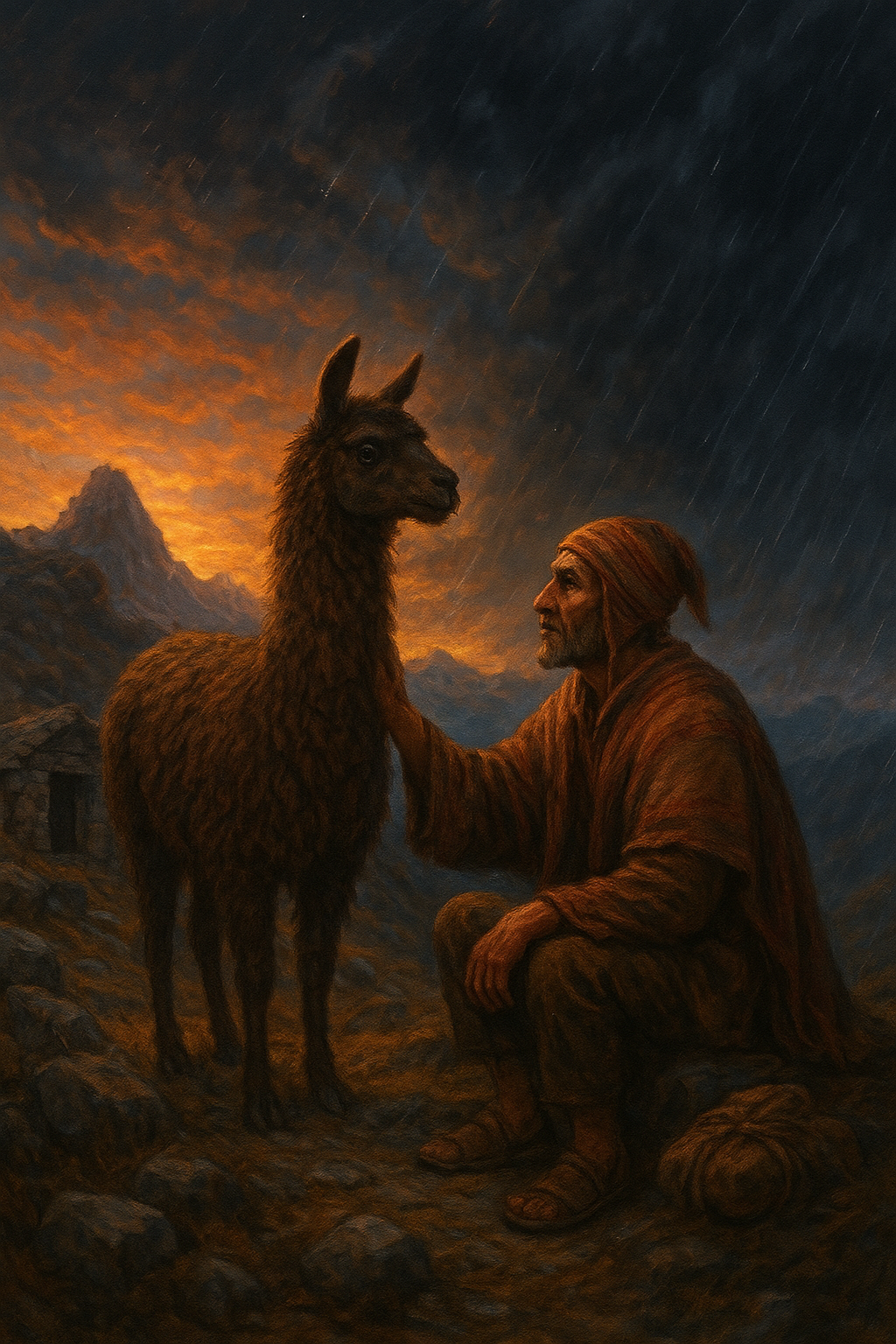
One evening, as the sun descended behind the snow-capped mountains and painted the sky in shades of crimson and gold, something changed. The llama stood apart from the others, refusing to graze on the tender grass the man had led it to. Its body trembled, and its gaze was fixed on the distant horizon where storm clouds gathered like dark omens.
“What troubles you, my friend?” the herdsman asked softly, running his hand along the llama’s woolly neck. “Are you ill? Are you afraid?”
The llama turned its great dark eyes upon him, and then to the man’s utter astonishment it spoke in a clear human voice.
“Good master,” the llama said, its tone heavy with sorrow, “I cannot eat, for my heart is burdened with terrible knowledge. A great flood is coming waters such as the world has never seen. Soon they will rise and cover all the earth, drowning every living thing. If you wish to live, you must come with me now. We must climb to the very peak of Huillcacoto, the highest mountain, for there alone will we be safe.”
The herdsman’s breath caught in his throat. Fear gripped him,but so did trust. The llama had never failed him, never led him astray. Without hesitation, he gathered a small bundle of food dried potatoes, strips of charqui, a gourd of water and began the journey upward.
For many days they climbed. The path grew steeper and more treacherous with each step. Jagged rocks cut at the man’s feet, and the wind howled through the mountain passes like the voices of restless spirits. The llama moved steadily ahead, never faltering, always finding the way even when the trail seemed to vanish into clouds and mist.
As they ascended, the sky grew heavier. Dark clouds rolled in from every direction, blotting out the sun and turning day into twilight. The air felt thick and oppressive, charged with something the man could not name but deeply feared.
At last, after what seemed an eternity of climbing, they reached the summit of Huillcacoto. The peak rose above all others, a finger of stone pointing toward the heavens. From this height, the herdsman could see the entire world spread below him valleys, rivers, villages, forests all bathed in the strange gray light of the gathering storm.
Then the rain began.
At first, it fell softly, pattering against the rocks like gentle fingers. But soon it grew fiercer, lashing at the mountain with a fury that seemed to tear at the very fabric of the earth. Thunder cracked and rolled across the sky. Lightning split the darkness in jagged white scars. And below, the waters began to rise.
The herdsman watched in horror as rivers overflowed their banks, sweeping away everything in their path. Villages disappeared beneath the torrents. Valleys filled like cups until they became lakes, then seas. Even the tallest trees vanished beneath the relentless flood. The screams of people and animals echoed briefly, then were silenced forever by the roar of the water.
The man wept for the world that was drowning, but the llama stood beside him, steady and calm, its presence a comfort in the midst of devastation.
For many days and nights the storm raged. The herdsman and his llama huddled together on the peak, the only living souls above the endless expanse of water that now covered the earth. They ate sparingly from the small bundle of provisions, and the man prayed to Viracocha, the great creator god, begging for mercy and deliverance.
Finally, after what felt like an age, the rain stopped. The clouds began to part, revealing patches of blue sky. Slowly so slowly the waters began to recede, draining back into the earth, revealing muddy slopes and bare stone where forests and fields had once flourished.
When at last it was safe, the herdsman and his llama descended from their refuge. The world they returned to was cleansed but empty a blank canvas waiting to be filled once more with life.
As their feet touched the new soil, something miraculous happened. The llama knelt down and began to weep. From its eyes flowed tears like liquid silver, shimmering in the newborn sunlight. Where the tears touched the earth, they formed streams that grew into rivers, flowing down through the valleys and bringing water precious, life-giving water back to the Andes.
The herdsman fell to his knees in gratitude. He gave thanks to Viracocha for sparing his life and for the wisdom of the sacred llama. From that day forward, he vowed to honor and care for all llamas and every creature that walked the earth, remembering always the gift of survival he had been given.
Thus it is said among the Quechua and Inca peoples that llamas remember the great flood. Even today, when they raise their heads toward the mountains and hum their soft, mournful songs, they are recalling that ancient time when one of their kind spoke with a human voice and saved the world from oblivion.
Discover the sacred tales of llamas, condors, and gods who guard the Andes
The Moral of the Story
This ancient tale teaches us the importance of listening to warnings and heeding the wisdom of those around us even when that wisdom comes from unexpected sources. The herdsman’s survival depended on his humility and willingness to trust his llama, despite the strangeness of its message. The story also reminds us of the sacred relationship between humans and animals, and our responsibility to care for all living creatures with respect and gratitude. In times of crisis, faith, preparation, and mutual respect can mean the difference between destruction and survival.
Knowledge Check
Q1: Who warned the herdsman about the coming flood?
A: His faithful llama warned him by speaking in a human voice, telling him that a great flood would cover the earth and that they must climb to the highest mountain to survive.
Q2: What mountain did the llama and herdsman climb to escape the flood?
A: They climbed to the peak of Huillcacoto, the highest mountain in the Andes, where they would be safe from the rising waters.
Q3: What happened when the llama cried after the flood ended?
A: The llama’s tears turned to silver and flowed across the earth, creating the rivers of the Andes that brought water and life back to the cleansed world.
Q4: Why are llamas considered sacred in Incan culture according to this story?
A: Llamas are sacred because one of their kind saved humanity by warning of the great flood and helping a man survive, demonstrating divine wisdom and connection to the creator god Viracocha.
Q5: What does the herdsman’s trust in the llama teach us?
A: It teaches the importance of listening to wisdom from unexpected sources, showing humility, and maintaining faith even when circumstances seem strange or frightening.
Q6: What cultural significance does the flood motif have in Andean mythology?
A: The flood represents divine judgment and renewal in Andean cosmology, associated with Viracocha the creator god who reshapes the world after catastrophe, cleansing it for a new beginning.
Source: Adapted from “The Llama Who Saved the World,” documented in Inca Mythology and Legend, compiled by Marion Morrison (1926)
Cultural Origin: Inca Empire and Quechua peoples